Inverter Beeping Continuously - What Each Beep Pattern Means
Updated 2 August 2026 · By SolarNevs Research Desk, Dealer surveys + verified sources · 28 sources · Method ↗
Inverter Beeping Continuously - What Each Beep Pattern Means
{/* visual_plan: stat_block */}
Key Takeaways
- A single beep every few seconds is usually informational, such as mains on or off, or a mode change, while fast or continuous beeping is a critical warning such as overload or overheating.
- One long, solid tone points to system failure or a short circuit and is the most serious sound your inverter makes.
- Continuous beeping followed by an automatic shutdown is the protection circuit doing its job; the fault is real and repeating the reset will not fix it.
- Only about 4% of Pakistani solar homes have any battery storage (2025 data), so most beeping complaints here are grid or load related, not battery related.
- Muting the buzzer removes your only early warning; a short-circuit or earth-fault alarm must never be silenced, and lingering faults can damage the battery or cause fire.
What is your inverter telling you when it beeps?
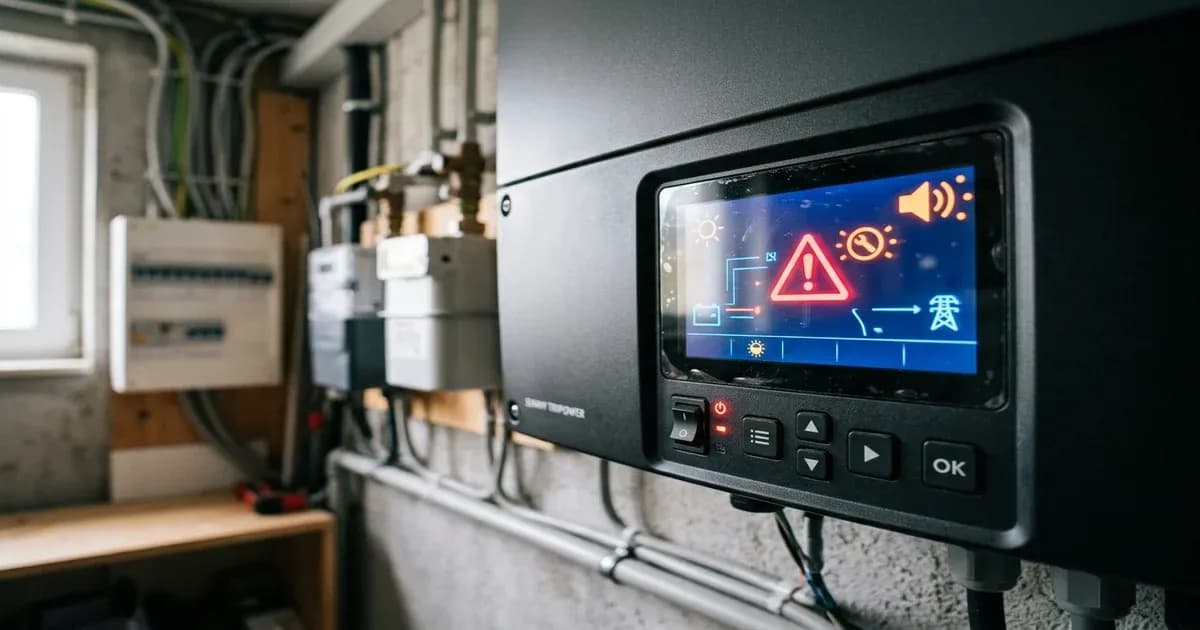
The buzzer is a one-bit communication channel. It cannot tell you what is wrong, only that something is. The screen or the monitoring app carries the actual information, and the first move on any alarm is always to read the fault code and note the time it appeared, not to start pressing buttons.
That distinction matters in Pakistan more than in most markets, because the majority of what makes an inverter beep here is not a fault in the inverter. It is the grid outside your gate, the load inside your house, or the July heat on the wall behind it. Only about 4% of solar homes in Pakistan have any battery at all (2025), which means the classic "low battery" alarm most guides lead with is simply not the answer for most local systems.
What does each beep pattern mean?
Manufacturers vary, so treat this as a strong prior rather than gospel, and confirm against your own manual.
A single beep after every few seconds generally refers to normal notifications, such as mains coming on or off, a switch into battery mode, or a low battery advisory. This is status reporting. It is annoying and it is not an emergency.
A fast or continuous beep generally refers to a critical warning such as overload or overheating. This is the sound most people search for. It means a protection threshold has been crossed and output is about to stop, or has already stopped.
One long, solid tone is the serious one. It signals system failure, including a fully drained battery, or a short circuit on the output. If you are hearing a continuous unbroken tone, disconnect loads and stop using the system until someone competent has looked at it.
The code on the screen names the family. Across common hybrid and off-grid platforms you will see low battery grouped under codes like F04, inverter overload under F07 or fault 14, short-circuit detection around code 17, high battery voltage or overcharge around 04 and 06, PV input voltage faults around F52 and 09, and overheating or fan failure under F01, OH, 19, 20 and the P5 to P7 range. Numbers differ between brands. Categories do not.
{/* visual_plan: comparison */}
Which beeping is urgent and which is cosmetic?
Cosmetic, in the sense of "note it and move on": short beeps and mechanical clicking early in the morning or at dusk, which is the MPPT trying to wake on marginal light and giving up. Brief alarms when the grid returns after load shedding, which is the inverter reacting to a supply that can spike to 280-300V for a few seconds as transformers ring back up (May 2026). Grid overvoltage trips in a street with heavy solar penetration, where local voltage rises when everyone exports at once. A communication alarm where the inverter shows a green light but the app shows no data, which is a Wi-Fi problem, not a power problem.
Urgent, in the sense of "act today": continuous beeping with automatic shutdown under load, which is overload and will keep happening until the load or the sizing changes. Any overheat or fan-failure alarm in a Pakistani summer, because thermal stress is cumulative and some warranties explicitly exclude installations that exceed a 45 degree ambient limit in poorly ventilated spaces (May 2026). Repeated high battery voltage alarms, which point at wrong charge settings and will cook a lead-acid bank.
Stop-everything urgent, such as any alarm reading Isolation Fault, ISO Fault, or Earth Fault. That is a live-parts safety condition, not a performance complaint, and the correct response is to shut the system down and call a licensed electrician rather than reset it.
Why does the beeping start when the air conditioner starts?
Because a compressor does not draw its running current at the moment it starts. Motors and compressors surge to roughly 3 to 5 times their running wattage for the first half-second to a second and a half, a figure your inverter's continuous rating never covered. A hybrid inverter has two envelopes, namely its continuous output, which it can hold indefinitely, and its surge capability, which is time-limited (think roughly twice rated power for a few seconds and around 1.5 times for longer).
So a 5kW inverter carrying 3.5kW of steady household load has 1.5kW of headroom. A 1.5-ton conventional split unit whose steady draw is 1.5kW may demand 4.5kW or more for a second at start. The inverter beeps, trips, and by the time you walk over to look, everything reads normal. That is the signature of a startup surge problem, and it will repeat every single time the compressor cycles.
Two things reduce it. A DC inverter-type air conditioner ramps its compressor rather than slamming it, and draws a far smaller starting surge than a conventional unit. A soft starter fitted to an existing conventional AC does the same job by ramping the applied voltage. Both are cheaper than the inverter you would otherwise have to buy again.
Why does the beeping start when the battery is involved?
If you do have storage, the beeping usually reports one of four states, and the fix differs sharply by chemistry.
A lead-acid or tubular bank that alarms on low voltage every evening is usually a bank that has lost capacity rather than a bank that is being over-discharged today. Tubular batteries in Pakistan sit in a broad price band, with an Osaka HT-2000 200Ah listed around Rs 48,970 including sales tax (2026), and the wider 200Ah tubular market spanning roughly Rs 28,500 to Rs 60,000 (2026), and a bank three or four summers old that alarms nightly is telling you its useful life is ending.
A lithium LiFePO4 pack that alarms is more often reporting a BMS decision than a dead cell. The BMS can refuse charge or discharge on temperature, cell imbalance, or an over/under-voltage limit, and the inverter simply reports the resulting condition as an alarm. A 5kWh home pack in Pakistan sits around Rs 205,000 to Rs 255,000 (2026), so it is worth reading the BMS log rather than replacing the pack on a guess.
A repeated high battery voltage or overcharge alarm almost always means the inverter's battery type setting does not match the battery installed. This is the local market, such as a lithium pack left on lead-acid charge parameters, or a tubular bank set to a lithium profile.
What should you do before calling a technician?
Work in this order and stop as soon as something explains the alarm.
Read and write down the exact code and the timestamp. Check whether the alarm correlates with a specific appliance, a specific hour, or specific weather. Reduce load by switching off the AC, the water pump, the iron, and see whether the alarm clears. Put a hand near, but not on, the inverter's heatsink to judge whether it is running hot, and check that nothing is blocking the vents; 30cm clearance on the sides and 50cm above is a reasonable minimum. Confirm the battery type setting in the menu matches the battery you own.
Then, if nothing explains it, perform one clean restart, requiring AC off, DC off, waiting 5 to 10 minutes for the internal capacitors to discharge, then DC on, waiting a minute, and AC on. One restart. If the alarm returns, you have a real condition and it is time to pay someone. In Lahore, an out-of-warranty bench fee around PKR 2,500 (May 2026) plus priced parts is a normal structure, and a failed cooling fan (a very common cause of overheat alarms on units past their third summer) is around PKR 3,500 (May 2026).
What are the red lines that mean stop immediately?
Some sounds and smells end the troubleshooting session.
Stop and shut down if you smell burning plastic, hot varnish, or a sharp ozone-like smell near the inverter, the combiner box, or the battery bank. Stop if you see smoke, scorch marks, browned terminals, or melted MC4 connectors. Stop if the beeping is accompanied by crackling, hissing, or a frying sound from DC cabling, which is very likely a DC arc, and DC arcs do not self-extinguish the way AC arcs do. Stop if any DC cable, isolator, connector or battery terminal is too hot to hold comfortably, or if a lead-acid battery case is hot, bulging, or venting a rotten-egg smell.
In any of those cases, switch off the AC breaker, switch off the DC isolator if it is safely reachable, keep people away, and call your installer. Around 50 to 60% of PV fires trace back to wiring and connector failures rather than the panels, and almost all of those begin as a slow-heating bad connection long before anything visible happens.
Three rules that hold no matter how handy you are. Never open an inverter. Internal capacitors hold lethal voltage for up to 5 minutes after full disconnection, there are no user-serviceable parts inside, and opening the case ends your warranty. Never touch DC wiring, MC4 connectors, or panel terminals; a rooftop string is live at several hundred volts DC whenever daylight falls on it and no breaker in your house can switch that off. Never pull an MC4 connector apart under load because that is how you create an arc with your hand in the circuit.
Frequently Asked Questions
Why is my solar inverter beeping continuously?
Fast or continuous beeping is a critical warning, usually overload, overheating or a critically low battery. The inverter will normally shut down its output to protect itself until the condition clears.
Is it safe to ignore an inverter beep?
A single beep every few seconds is normally informational. Continuous beeping or one long solid tone is not, and lingering faults can damage the battery or start a fire.
Can I disable the inverter alarm buzzer?
Most units allow the buzzer to be muted in settings, but muting hides the only warning you get. Fix the cause first; never mute an overheat, short-circuit or earth-fault alarm.
References
- Solar Valley, 10 Common Causes of Inverter Beeping and Fault Codes
- SolaX, Why Is My Inverter Beeping
- Solar Fix, Why Is My Inverter Beeping
- SRNE Solar, What Happens If You Overload a Hybrid Inverter
- EcoFlow, LRA, Surge Power and Inverter Matching Guide
- CNC Electric Pakistan, Voltage Regulator vs Voltage Protector
- Solar Installation Lahore, Inverex Service and Warranty Review
- Solar Hub Official, 200Ah Tubular Battery Price in Pakistan
- Solar Panel Rates, Lithium Battery Price in Pakistan
- GM Energy, Inverter Installation and Operation Manual
- SolarVision AI, MC4 Connectors and Solar Safety
Frequently asked questions
Why is my solar inverter beeping continuously?
Fast or continuous beeping is a critical warning, usually overload, overheating or a critically low battery. The inverter will normally shut down its output to protect itself until the condition clears.
Is it safe to ignore an inverter beep?
A single beep every few seconds is normally informational. Continuous beeping or one long solid tone is not, and lingering faults can damage the battery or start a fire.
Can I disable the inverter alarm buzzer?
Most units allow the buzzer to be muted in settings, but muting hides the only warning you get. Fix the cause first; never mute an overheat, short-circuit or earth-fault alarm.
References
- Solar Valley — accessed 26 July 2026
- Solar Fix — accessed 26 July 2026
- Xindun Power — accessed 26 July 2026
- SolaX Power — accessed 26 July 2026
- EPEVER — accessed 26 July 2026
- In Balance Energy — accessed 26 July 2026
- EcoFlow — accessed 26 July 2026
- Generator Checker — accessed 26 July 2026
- SRNE Solar — accessed 26 July 2026
- Generator Checker — accessed 26 July 2026
- NEPRA — accessed 26 July 2026
- CNC Electric Pakistan — accessed 26 July 2026
- Solar Installation Lahore — accessed 26 July 2026
- Solar Hub — accessed 26 July 2026
- Solar Price PK — accessed 26 July 2026
- Solar Panel Rates — accessed 26 July 2026
- Solar Hub — accessed 26 July 2026
- Hizn Lithium — accessed 26 July 2026
- Lithium Battery Online — accessed 26 July 2026
- Ampinvt — accessed 26 July 2026
- Afor Energy — accessed 26 July 2026
- GreenLancer — accessed 26 July 2026
- GM Energy — accessed 26 July 2026
- Manuals+ — accessed 26 July 2026
- SolarVision AI — accessed 26 July 2026
- AllShield Coatings — accessed 26 July 2026
- PSC Energy — accessed 26 July 2026
- Afor Energy — accessed 26 July 2026
Related guides
More from inverter errors & fixes.