NEPRA Policy Decision Tracker: Net Metering and Billing Rules
Updated 2 August 2026 · By SolarNevs Research Desk, Dealer surveys + verified sources · 3 sources · Method ↗
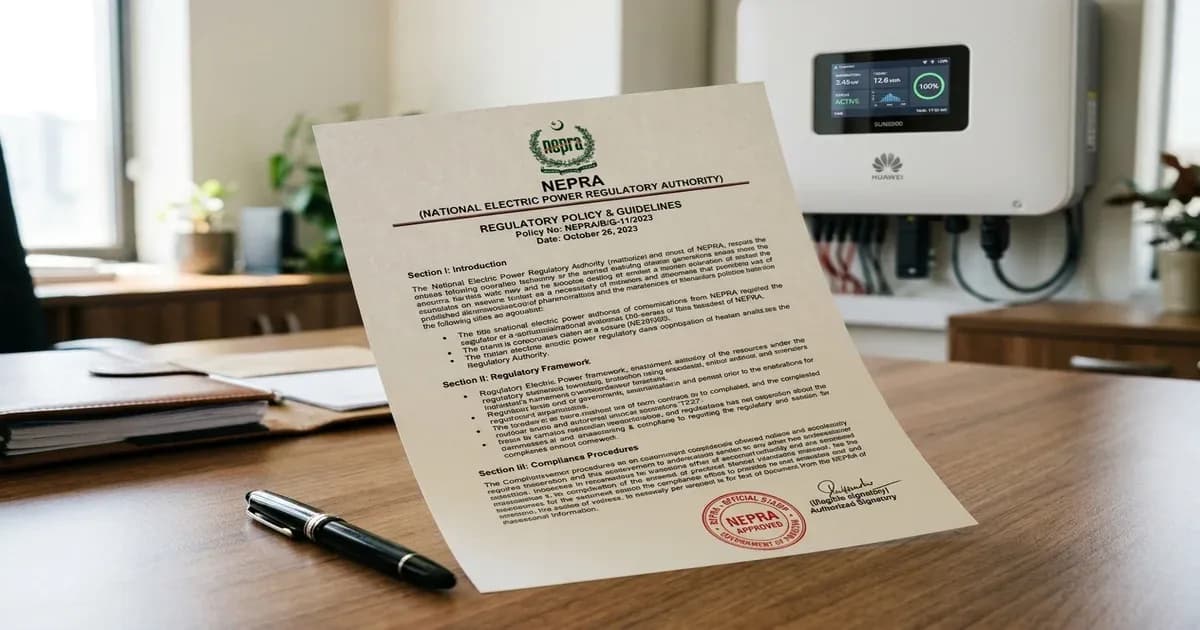
NEPRA Policy Decision Tracker - Net Metering and Billing Rules
{/* visual_plan: stat_block */}
Key Takeaways
- NEPRA's net billing framework sets the export buyback rate for excess residential solar energy at Rs. 22/kWh (July 2026) across DISCO networks.
- Distributed net metering license approvals take between 30 and 45 days through local distribution companies like LESCO, K-Electric, and IESCO.
- NEPRA requires all solar grid interconnects over 10 kW to install automated isolation relays and anti-islanding protection equipment.
- Grid export limits are capped at 1.5 times the consumer's sanctioned grid load under current NEPRA distribution regulations.
Introduction
The National Electric Power Regulatory Authority (NEPRA) is the primary regulatory body governing electricity tariffs, net metering licenses, and grid interconnections in Pakistan. This living policy tracker monitors NEPRA regulatory decisions, tariff determinations, and distribution rules affecting solar and EV owners.
What is the current NEPRA net metering and net billing framework?
NEPRA's net metering regulations allow distributed solar producers to connect their rooftop photovoltaic systems to local DISCO grids.
Under original net metering rules, exported solar units directly offset imported grid units on a 1-to-1 volumetric basis. In response to rising rooftop capacity, NEPRA introduced a net billing framework.
Under net billing, imported grid electricity is billed at standard residential retail tariffs averaging Rs. 60/kWh (July 2026). Excess solar electricity exported back to the grid is credited at NEPRA's benchmark generation buyback rate of Rs. 22/kWh (July 2026). Monetary credits accumulate on monthly bills, offsetting future electricity charges.
What are the key technical compliance requirements for grid interconnects?
NEPRA enforces strict technical standards to protect DISCO grid stability and line worker safety.
The summary compliance checklist table below outlines key technical requirements:
Technical Requirement | NEPRA Standard Limit | Equipment Solution |
|---|---|---|
Anti-Islanding Protection | IEEE 1547 / IEC 62116 | Automated inverter shutdown relay |
Total Harmonic Distortion (THD) | Under 3 percent | Grid-tied inverter output filter |
Power Factor Range | 0.95 leading to 0.95 lagging | Inverter reactive power control |
Maximum Interconnect Capacity | 150 percent of sanctioned load | System sizing restriction |
Bi-Directional Metering | Accuracy Class 0.5S | Dual-channel AMI smart meter |
Installing certified AEDB-approved inverters ensures full compliance with NEPRA grid safety standards.
How does the NEPRA license application process work across DISCOs?
Obtaining a formal NEPRA net metering license involves a standardized multi-step procedure managed by local DISCOs (such as LESCO, IESCO, FESCO, or K-Electric).
- Step 1 - Application Submission - The consumer submits system single-line diagrams, AEDB installer verification, and load sanction forms to the local DISCO office.
- Step 2 - Technical Site Inspection - DISCO engineers inspect the rooftop installation, testing isolation relays and earthing resistance.
- Step 3 - License Issuance & Meter Installation - NEPRA issues the 7-year distributed generation license, and the DISCO installs the bi-directional AMI smart meter.
What policy decisions are currently under NEPRA review?
NEPRA is actively evaluating policy frameworks for localized Battery Energy Storage Systems (BESS) and Vehicle-to-Grid (V2G) integration. Proposed regulatory updates aim to offer higher export tariffs for battery power discharged during evening peak hours (6:00 PM to 10:00 PM), incentivizing private energy storage deployment.
Call to Action
Check NEPRA's official portal regularly or consult certified AEDB installers to review current net billing export rates before sizing your rooftop solar array.
Frequently Asked Questions
Can a consumer transfer excess net billing credits to another property?
No, net billing credits apply strictly to the specific DISCO service account connected to the net-metered solar system.
What happens to unused net billing credits at the end of the fiscal year?
Under NEPRA rules, DISCOs settle remaining monetary credits at the end of each fiscal year via direct account credit.
Is a separate license required for off-grid solar systems?
No, off-grid solar systems operating completely isolated from utility grid lines do not require NEPRA licensing.
References
- nepra.org.pk Source - NEPRA Net Metering Rules and Regulations (Verified)
- aedb.org.pk Source - Alternative Energy Development Board Installer Portal (Verified)
- pbs.gov.pk Source - Pakistan Bureau of Statistics Energy Data (Verified)
Frequently asked questions
Can a consumer transfer excess net billing credits to another property?
No, net billing credits apply strictly to the specific DISCO service account connected to the net-metered solar system.
What happens to unused net billing credits at the end of the fiscal year?
Under NEPRA rules, DISCOs settle remaining monetary credits at the end of each fiscal year via direct account credit.
Is a separate license required for off-grid solar systems?
No, off-grid solar systems operating completely isolated from utility grid lines do not require NEPRA licensing.
References
- NEPRA — accessed 25 July 2026
- AEDB — accessed 25 July 2026
- Pakistan Bureau of Statistics — accessed 25 July 2026
Related guides
More from reports & data stories.