Solar Panel Degradation in Pakistani Heat and Dust Conditions
Updated 2 August 2026 · By SolarNevs Research Desk, Dealer surveys + verified sources · 4 sources · Method ↗
Solar Panel Degradation in Pakistani Heat and Dust Conditions
{/* visual_plan: stat_block */}
Key Takeaways
- Pakistani summer cell temperatures exceeding 65 degrees Celsius increase thermal stress and accelerate long-term power output degradation.
- N-type TOPCon panels limit initial light-induced degradation below 1.0%, outperforming legacy P-type PERC panels in extreme heat.
- Dust, sand, and industrial soot accumulation reduce solar generation by 10% to 25% if panels remain unwashed during dry months.
- Tier-1 TOPCon modules cost Rs 39 to Rs 46 per watt (July 2026), providing superior thermal coefficients of -0.30% per degree Celsius.
- Tax-verified document panels carrying 10% GST under the Finance Act 2025 guarantee 30-year linear performance backing from local service hubs.
How do Pakistani heat and dust affect solar panel degradation?
Solar panel degradation in Pakistan is shaped by three environmental stressors, including extreme ambient heat, heavy atmospheric dust, and seasonal humidity. Summer temperatures across Punjab, Sindh, and Balochistan frequently exceed 40 to 45 degrees Celsius, raising rooftop solar cell temperatures above 65 degrees Celsius.
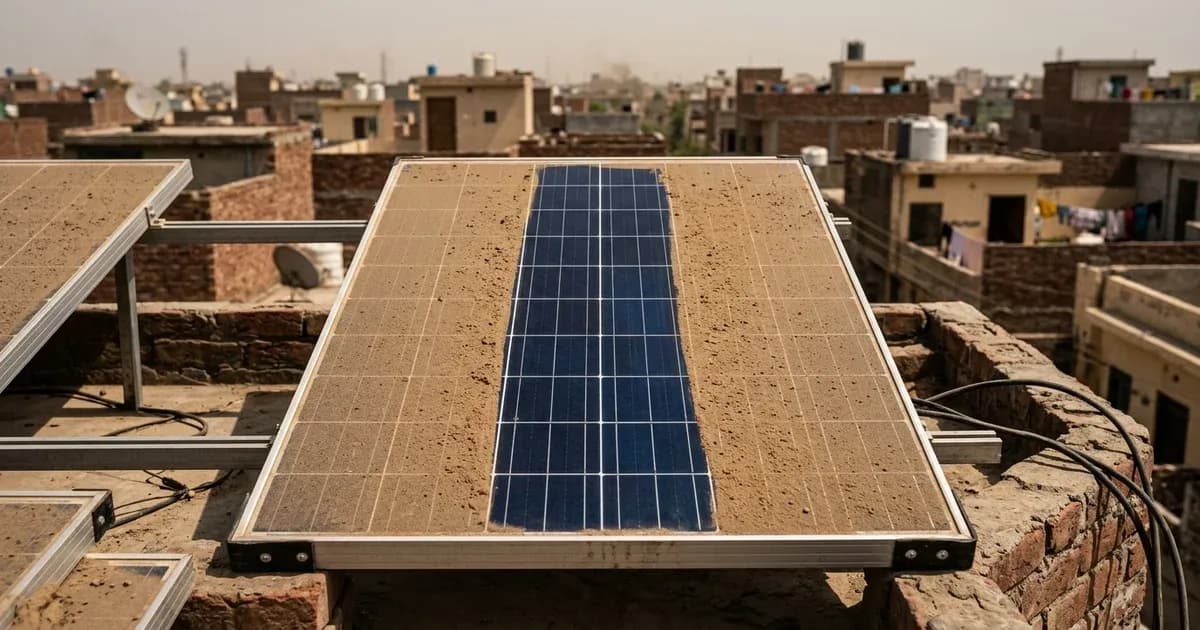
High operating temperatures degrade EVA encapsulant layers and increase thermal expansion stress on internal cell interconnects. In addition, airborne dust in urban centers like Lahore and Karachi forms thick soiling layers on panel glass, blocking solar irradiance and creating localized hot spots.
Selecting N-type TOPCon technology helps mitigate heat-induced degradation. Standard Tier-1 TOPCon modules retail between Rs 39 and Rs 46 per watt (July 2026), offering enhanced thermal resistance and linear performance warranties.
Environmental Stressor | Operational Impact | Recommended Mitigation Strategy | Expected Performance Retention |
|---|---|---|---|
Ambient Heat (40C to 48C) | Voltage drop & thermal wear | Select N-type TOPCon (-0.30%/C) | 87.4% at Year 30 |
Heavy Soiling & Dust | 10% to 25% output loss | Bi-weekly early morning washing | Restores 98% nominal yield |
Coastal Humidity (Karachi) | Potential PID & frame oxidation | Dual-glass POE encapsulated panels | Prevents moisture ingress |
Agricultural Pollution | Ammonia & chemical film | Neutral pH detergent cleaning | Prevents glass etching |
What is the difference between thermal degradation and soiling loss?
Solar system owners must distinguish between permanent thermal degradation and temporary soiling loss. Thermal degradation represents irreversible physical changes within the silicon wafer, EVA film, or metal busbars caused by heat and ultraviolet exposure over time.
Soiling loss refers to temporary light blockage caused by dust, sand, bird droppings, or soot settling on the exterior glass surface. While thermal degradation occurs gradually at 0.40% per year for N-type panels, uncleaned dust accumulation can reduce power output by 15% within three weeks of dry weather in urban centers.
Bi-weekly washing removes surface soiling and restores panel output to baseline levels. However, using improper washing techniques can turn temporary soiling into permanent glass damage.
Why does N-type TOPCon handle Pakistani heat better than P-type PERC?
N-type TOPCon panels handle high temperatures better than legacy P-type PERC modules due to phosphorus doping and lower temperature coefficients. P-type PERC panels suffer Light-Induced Degradation during the first year, losing up to 3.0% of nominal capacity when exposed to intense sunlight.
N-type TOPCon wafers eliminate boron-oxygen complexes, restricting first-year degradation under 1.0%. In addition, N-type panels feature a lower temperature coefficient of -0.30% per degree Celsius, compared to -0.35% for P-type panels. When operating at 65 degrees Celsius, N-type panels generate 3% to 5% more daily energy, improving financial returns under NEPRA prosumer export tariffs of Rs 11 per unit (July 2026).
What maintenance practices prevent premature solar panel failure in Pakistan?
Implementing proper cleaning and inspection routines extends module operating life and prevents premature warranty voids. System operators should adopt four key maintenance guidelines.
First, wash panels during early morning hours before sunlight heats the glass. Pouring cold tap water onto hot 65-degree panel glass causes thermal shock, fracturing the top tempered glass layer.
Second, use purified or low-mineral water for cleaning. Hard groundwater across many Pakistani regions contains high concentrations of dissolved calcium and magnesium. Washing panels with hard water leaves mineral scale deposits that etch the anti-reflective glass coating.
Third, inspect mounting structure clearances. Maintaining a minimum clearance gap of 15 to 20 centimeters between the roof deck and panel backsheet allows convective airflow, lowering cell operating temperatures by 5 to 8 degrees Celsius.
Fourth, check electrical connections annually. Loose DC connectors increase electrical resistance, causing localized heating that can burn junction boxes.
Frequently Asked Questions
How much power do solar panels lose per year in Pakistan?
Tier-1 N-type TOPCon panels lose less than 1.0% in year one and 0.40% annually thereafter, retaining 87.4% output after 30 years despite severe local heat.
How does dust accumulation impact solar panel generation?
Uncleaned dust and industrial soot reduce daily generation by 10% to 25% across Pakistani cities, requiring bi-weekly washing during dry seasons.
Does washing solar panels with hard tap water cause permanent damage?
Yes, washing hot solar panels with high-mineral hard water leaves calcium scale deposits that create localized hot spots and permanent anti-reflective coating damage.
References
Frequently asked questions
How much power do solar panels lose per year in Pakistan?
Tier-1 N-type TOPCon panels lose less than 1.0% in year one and 0.40% annually thereafter, retaining 87.4% output after 30 years despite severe local heat.
How does dust accumulation impact solar panel generation?
Uncleaned dust and industrial soot reduce daily generation by 10% to 25% across Pakistani cities, requiring bi-weekly washing during dry seasons.
Does washing solar panels with hard tap water cause permanent damage?
Yes, washing hot solar panels with high-mineral hard water leaves calcium scale deposits that create localized hot spots and permanent anti-reflective coating damage.
References
- Solar Citizen — accessed 25 July 2026
- W11Stop — accessed 25 July 2026
- FBR — accessed 25 July 2026
- NEPRA — accessed 25 July 2026
Related guides
More from what to buy — and how not to get cheated.