Ireland Commercial Bess And DS3 Grid Firming Revenue Guide
Updated 19 September 2026 · By SolarNevs Research Desk, Dealer surveys + verified sources · 2 sources · Method ↗
<!-- visual_plan -->
Key Takeaways
- Providing units can apply to contract with EirGrid and SONI to provide System Services, stacking revenue alongside wholesale trading.
- Trading period remuneration follows the statutory formula: Trading Period Payment = Available Volume × Payment Rate × Scaling Factor × Trading Period Duration.
- Operating reserve services span distinct temporal windows: POR (T+5s to T+15s), SOR (T+15s to T+90s), TOR1 (T+90s to T+300s), and TOR2 (T+5 minutes to T+20 minutes).
- Total Availability Factor will be calculated for each calendar month and will apply to all payments in that month.
- The Performance Incident Response Factor (PE) ranges between 1 and 0, with event penalties impacting payments across a 5-month dynamic decay period.
- System services compliance tests offer no derogation process if a unit fails, representing mandatory standards additional to base Grid Code testing.
- Operators must submit a System Services Scope Document two business days following confirmation of the test date.
Commercial BESS Participation in DS3 System Services
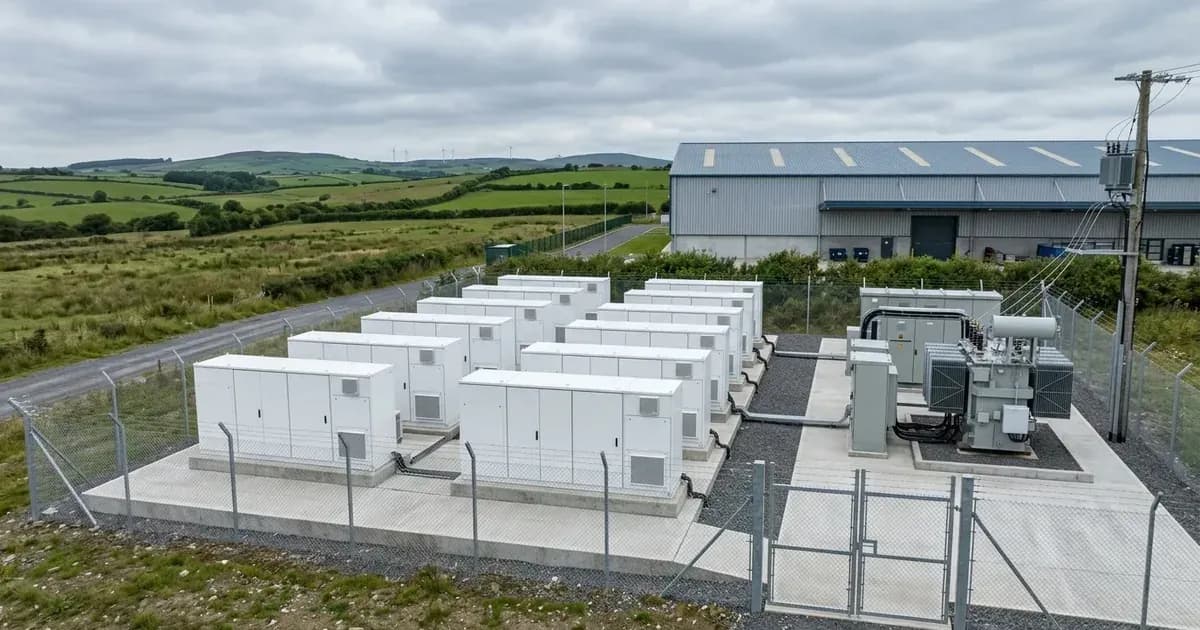
Battery Energy Storage Systems (BESS) deployed across commercial, industrial, and utility sites provide crucial grid firming. In Ireland's single electricity market (SEM), providing units can apply to contract with EirGrid and SONI to provide System Services.
To monetize battery capacity, projects must comply with rigorous qualification standards:
- Additional Testing: These testing requirements are in addition to the standard Grid Code tests.
- Strict Certification: There is no derogation process if a unit is unsuccessful in completing a System Services test.
- Administrative Lead Time: A System Services Scope Document is to be submitted two business days following confirmation of test date.
The DS3 Payment Formulation
Commercial revenue is determined by availability, dispatch compliance, and system scarcity multipliers:
- Trading Period Payment Formula: Under Schedule 2 of the legal agreements, Trading Period Payment = Available Volume × Payment Rate × Scaling Factor × Trading Period Duration.
- Monthly Availability Tracking: The Total Availability Factor will be calculated for each calendar month and will apply to all payments in that month, penalizing assets that fail to maintain contracted state of readiness.
- Performance Incident Response Factor (PE): A Performance Incident Response Factor (PE) value between 1 and 0 will be calculated on a monthly basis.
- Penalty Decay Structure: When a battery under-delivers during a grid disturbance, the maximum duration a Performance Incident can impact the Performance Incident Response Factor (PE) is 5 months with the impact reducing each month.
Operating Reserve Service Windows
Commercial battery inverters deliver multiple reserve streams across defined timeframes following a disturbance:
Operating Reserve Stream | Assessment Period Following Time Zero | Technical Delivery Focus |
|---|---|---|
Primary Operating Reserve (POR) | POR period is taken to be between T+5 seconds to T+15 seconds after the Time Zero for a given Frequency Event | Rapid initial active power injection |
Secondary Operating Reserve (SOR) | SOR period is taken to be between T+15 seconds to T+90 seconds after the Time Zero for a given Frequency Event | Sustained frequency containment |
Tertiary Operating Reserve 1 (TOR1) | T+90 seconds to T+300 seconds after the Time Zero for a given Frequency Event | Primary grid stabilization |
Tertiary Operating Reserve 2 (TOR2) | T+5 minutes to T+20 minutes after Time Zero for a given Frequency Event | Thermal plant ramp support & reserve recovery |
Throughout all operating modes, the Providing Unit shall provide a real-time signal confirming its remaining charge available, ensuring system operators can verify instantaneous firming reserves. Furthermore, Providing Units must have a Phasor Measurement Units (PMU) installed to validate millisecond-level compliance.
Frequently asked questions
How is DS3 System Services revenue calculated for commercial BESS?
Payment follows the statutory formula Trading Period Payment = Available Volume × Payment Rate × Scaling Factor × Trading Period Duration.
What are the primary reserve timeframes under the DS3 protocol?
POR covers T+5s to T+15s, SOR covers T+15s to T+90s, TOR1 covers T+90s to T+300s, and TOR2 covers T+5 minutes to T+20 minutes after Time Zero.
How long does a performance incident penalize BESS revenue?
Under the dynamic time scaling factor, the maximum duration a Performance Incident can impact the Performance Incident Response Factor (PE) is 5 months with the impact reducing each month.
Can battery operators seek derogations if they fail a system services compliance test?
No, there is no derogation process if a unit is unsuccessful in completing a System Services test; testing requirements are in addition to standard Grid Code tests.
References
- EirGrid and SONI DS3 System Services Protocol Volume Capped — accessed 28 August 2026
- EirGrid System Service Testing Guidelines — accessed 28 August 2026
Related guides
More from schemes, subsidies & financing.