Ireland Commercial and Public Solar Planning Exemptions: S.I. No. 493/2022 Fast-Wins
Updated 18 September 2026 · By SolarNevs Research Desk, Dealer surveys + verified sources · 1 source · Method ↗
Key Takeaways
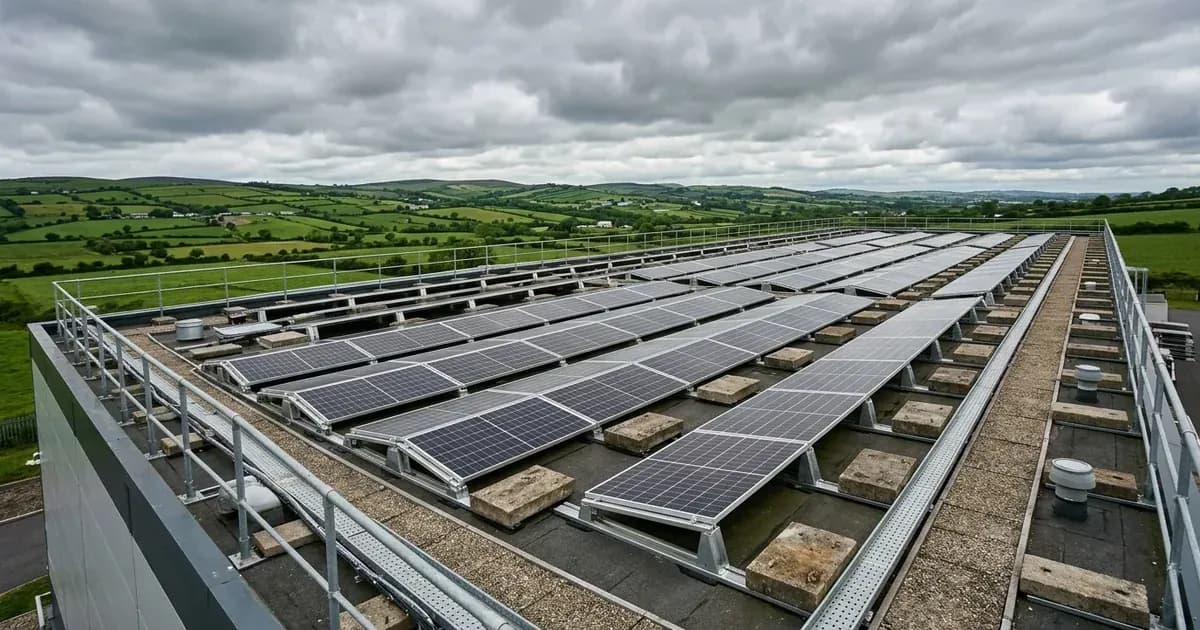
- Roof-mounted solar on business premises can be exempt if panels do not exceed 1.2 metres above a flat roof (August 2026).
- Installations within a Solar Safeguarding Zone are capped at 300 square metres total aperture area (August 2026).
- Free-standing solar installations for commercial use are limited to 75 square metres total aperture area (August 2026).
- Planning authorities must be notified 4 weeks after commencement for developments within a Solar Safeguarding Zone (August 2026).
What are the key exemptions under S.I. No. 493/2022 for commercial and public solar?
The Planning and Development Act 2000 (Exempted Development) (No. 3) Regulations 2022, specifically S.I. No. 493 of 2022, outlines planning exemptions for solar installations on commercial buildings, apartments, and public institutions in Ireland. These regulations aim to streamline solar deployment by defining specific conditions under which projects do not require full planning permission. For instance, roof-mounted solar panels on a business premises are exempt if they do not exceed 1.2 metres above a flat roof (August 2026), while those on industrial buildings can extend up to 2 metres above a flat roof (August 2026).
The table below summarises key provisions and limitations for various types of solar installations under S.I. No. 493/2022.
Provision Parameter | Statutory Limitation / Requirement |
|---|---|
Solar Safeguarding Zone (SSZ) Cap | Total aperture area of solar panels within an SSZ shall not exceed 300 square metres. |
SSZ Planning Authority Notification | Planning authority must be notified in writing no later than 4 weeks after commencement of development within an SSZ. |
Class 56(e) Business Premises Roof Distance | Panels on a business premises: 1.2 metres maximum distance from roof plane for flat roofs, 15cm for other cases. |
Class 56(d) Industrial Roof Distance | Panels on an industrial building: 2 metres maximum distance from roof plane for flat roofs, 1.2 metres for other cases. |
Commercial Roof Edge Setback | Panels must be a minimum of 2 metres from the edge of a flat roof, or 50cm from the edge of other roof types. |
Ancillary Equipment Height Limit | Height of ancillary equipment on a flat roof shall not exceed 1.6 metres above roof level and must be set back at least 2 metres from the roof edge. |
Class 60 Apartment Rooftop Rules | Solar allowed on apartment roofs up to 1.2 metres on flat roofs (or 15cm on pitched roofs), with a 2-metre flat roof edge setback. Wall mounting and free-standing installations are not exempted development for apartments. |
Class 61 Public & Community Facilities | Covers educational buildings, health centres/hospitals, sports facilities, places of worship, community centres, libraries, and statutory undertakers. Allows 1.2m flat roof projection and up to 75 square metres of free-standing solar. |
Commercial Free-Standing Sizing Limit | Total aperture area of free-standing solar panels shall not exceed 75 square metres, with a maximum height of 2.5 metres. |
Industrial Wall-Mounted Solar Sizing | Total aperture area of wall-mounted solar panels on industrial buildings shall not exceed 75 square metres. |
On-Site Primary Consumption Rule | Development must be primarily used (greater than 50%) for electricity or heating within the curtilage. |
Airport Safety Glint and Glare Clause | Development shall not endanger public safety by reason of hazardous glint and/or glare for the operation of airports, aerodromes or aircraft. |
Figures as of August 2026.
How do roof-mounted solar installations qualify for exemption?
S.I. No. 493/2022 sets specific dimensions and conditions for roof-mounted solar panels to be considered exempted development. For a business premises (Class 56(e)), the distance between the roof plane and the panels shall not exceed 1.2 metres in the case of a flat roof (August 2026). For other roof types on a business premises, this distance is limited to 15cm (August 2026). Industrial buildings (Class 56(d)) have a higher allowance, with panels not exceeding 2 metres above a flat roof (August 2026) or 1.2 metres in any other case (August 2026).
All roof-mounted panels on commercial properties must maintain a minimum setback from the roof edge. This setback is 2 metres for flat roofs (August 2026) and 50cm for other roof types (August 2026). Ancillary equipment associated with solar panels on a flat roof must not exceed 1.6 metres above roof level and must also be set back at least 2 metres from the roof edge (August 2026).
For apartments (Class 60), solar installations on roofs are exempted development if they do not exceed 1.2 metres on flat roofs or 15cm on pitched roofs, with a 2-metre flat roof edge setback (August 2026). However, wall-mounted and free-standing solar installations are explicitly not exempted development for apartments under this class.
Public and community facilities (Class 61), including educational buildings, health centres, hospitals, sports facilities, and places of worship, also benefit from these exemptions. They are permitted a 1.2m flat roof projection (August 2026) for solar installations.
What are the rules for free-standing and wall-mounted solar?
Beyond roof-mounted systems, S.I. No. 493/2022 also provides exemptions for certain free-standing and wall-mounted solar installations. For commercial free-standing solar panels, the total aperture area, combined with any other existing free-standing panels, must not exceed 75 square metres (August 2026). The maximum height for these free-standing installations is 2.5 metres (August 2026).
Industrial buildings can also have wall-mounted solar panels as exempted development. The total aperture area for these wall-mounted panels, including any existing ones, must not exceed 75 square metres (August 2026).
It is important to note that for apartments (Class 60), wall mounting and free-standing installations are not considered exempted development under these regulations.
What is a Solar Safeguarding Zone and how does it affect my project?
A Solar Safeguarding Zone (SSZ) is an area where solar installations have specific restrictions due to proximity to airports or aerodromes. If your development is located within an SSZ, the total aperture area of all solar photo-voltaic and/or solar thermal collector panels on a roof, including any previously installed panels, must not exceed 300 square metres (August 2026) to qualify for exemption.
Furthermore, if your project is within an SSZ, the planning authority for the area must be notified in writing no later than 4 weeks after the commencement of the development (August 2026). This notification must include details regarding the location and scale of the development. This requirement ensures that potential glint and glare hazards to aircraft operations are managed. The regulations state that development shall not "endanger public safety by reason of hazardous glint and/or glare for the operation of airports, aerodromes or aircraft."
For more detailed information on SSZs and aviation considerations, you can consult our guide on Ireland Solar Safeguarding Zones (SSZ) and Aviation.
Are there other important conditions for planning exemption?
Beyond the size, height, and location rules, S.I. No. 493/2022 includes other critical conditions for solar installations to qualify as exempted development. One key condition is the "on-site primary consumption rule." This rule states that the solar development must be "primarily used for the provision of electricity or heating for use within the curtilage" (August 2026). "Primarily" is defined as greater than 50% (August 2026). This means the majority of the generated energy must be consumed on-site.
Additionally, as mentioned regarding SSZs, all solar developments must ensure they do not "endanger public safety by reason of hazardous glint and/or glare for the operation of airports, aerodromes or aircraft" (August 2026). This clause applies broadly, not just within designated SSZs, and requires developers to consider potential visual impacts.
What projects still require full planning permission?
While S.I. No. 493/2022 significantly expands planning exemptions for solar, certain types of installations still require a formal planning application under the standard Planning and Development Act 2000 framework.
Specifically, ground-mounted utility solar farms are not covered by these exemptions and require full planning permission. Similarly, any installations within designated Solar Safeguarding Zones that exceed the 300 square metres total aperture area limit (August 2026) will also require a formal planning application. For apartments, wall-mounted and free-standing solar installations are not exempted development under Class 60.
Understanding these limitations is crucial to avoid delays and ensure compliance. If your project falls outside the defined exempted development criteria, you must apply for planning permission. You can explore further details on commercial rooftop planning exemptions in our dedicated guide: Commercial Solar Rooftop Planning Exemptions Guide Ireland. For information on financial support, consider the SEAI Non-Domestic Microgeneration Grant Business Guide.
How we verified this information
We verified the information presented in this article by directly consulting the official publication of the Planning and Development Act 2000 (Exempted Development) (No. 3) Regulations 2022 (S.I. No. 493 of 2022) on the Irish Statute Book website. Our review was conducted on August 23, 2026, to ensure accuracy and adherence to the statutory provisions. All figures and conditions cited are directly sourced from this primary legal document.
Frequently asked questions
What is the maximum size for solar installations within a Solar Safeguarding Zone in Ireland?
Within a Solar Safeguarding Zone, the total aperture area of solar panels, including any existing ones, must not exceed 300 square metres to qualify for planning exemption (August 2026). Installations exceeding this limit require a formal planning application.
What are the height limits for roof-mounted solar panels on commercial buildings under S.I. No. 493/2022?
For business premises, panels on a flat roof must not exceed 1.2 metres above the roof plane (August 2026). For industrial buildings, this limit is 2 metres for flat roofs (August 2026). For pitched roofs, the limits are 15cm for business premises and 1.2 metres for industrial buildings (August 2026).
Are there specific setback requirements for roof-mounted solar panels on commercial properties in Ireland?
Yes, panels must be set back a minimum of 2 metres from the edge of a flat roof (August 2026). For other roof types, the minimum setback is 50cm from the roof edge (August 2026).
What is the size limit for free-standing solar panels to be exempt from planning permission for commercial use?
The total aperture area of free-standing solar panels, including any existing ones, must not exceed 75 square metres (August 2026). The maximum height for such installations is 2.5 metres (August 2026).
Do solar installations on apartments (Class 60) have different planning exemption rules?
Yes, Class 60 allows solar on apartment roofs up to 1.2 metres on flat roofs or 15cm on pitched roofs, with a 2-metre flat roof edge setback (August 2026). However, wall mounting and free-standing installations are not exempted development for apartments under this class.
References
- Planning and Development Act 2000 (Exempted Development) (No. 3) Regulations 2022 (S.I. No. 493 of 2022) — accessed 23 August 2026
Related guides
More from schemes, subsidies & financing.