Ireland Domestic Solar Planning Exemption Class 2 Rules: Understanding the 2022 Regulations
Updated 18 September 2026 · By SolarNevs Research Desk, Dealer surveys + verified sources · 1 source · Method ↗
Key Takeaways
- Ireland's S.I. No. 493 of 2022 introduced new Class 2 planning exemptions for domestic solar installations (August 2026).
- Solar panels on flat roofs must not exceed 50cm above the roof plane; on pitched roofs, this limit is 15cm (August 2026).
- A minimum 50cm setback from the roof edge is required for all rooftop solar installations (August 2026).
- Free-standing solar installations are capped at 25 square metres aperture area and 2.5 metres height (August 2026).
What are the Class 2 Domestic Solar Planning Exemptions in Ireland?
Ireland's Class 2 domestic solar planning exemptions, established by the Planning and Development Act 2000 (Exempted Development) (No. 3) Regulations 2022 (S.I. No. 493 of 2022), simplify the process for homeowners to install solar photo-voltaic (PV) and solar thermal collectors. These regulations apply to installations on the roof of a house, within its curtilage, or on the roof of any ancillary buildings within the curtilage of a house. It is important to note that these exemptions do not extend to apartments.
These regulations allow homeowners to install rooftop and ground-mounted solar installations without requiring full planning permission, provided all specific statutory conditions and limitations are met.
How do we verify these regulations?
We verify these regulations by directly consulting the official statutory instrument. Our information is sourced from the Irish Statute Book, specifically S.I. No. 493/2022 – Planning and Development Act 2000 (Exempted Development) (No. 3) Regulations 2022. We accessed and reviewed this document on 23 August 2026 to ensure the accuracy of the provisions cited in this article.
What are the specific rules for rooftop solar installations?
Rooftop solar installations under Class 2 exemptions must adhere to specific dimensional limits to qualify for exempted development status. These limits are designed to manage the visual impact of the panels.
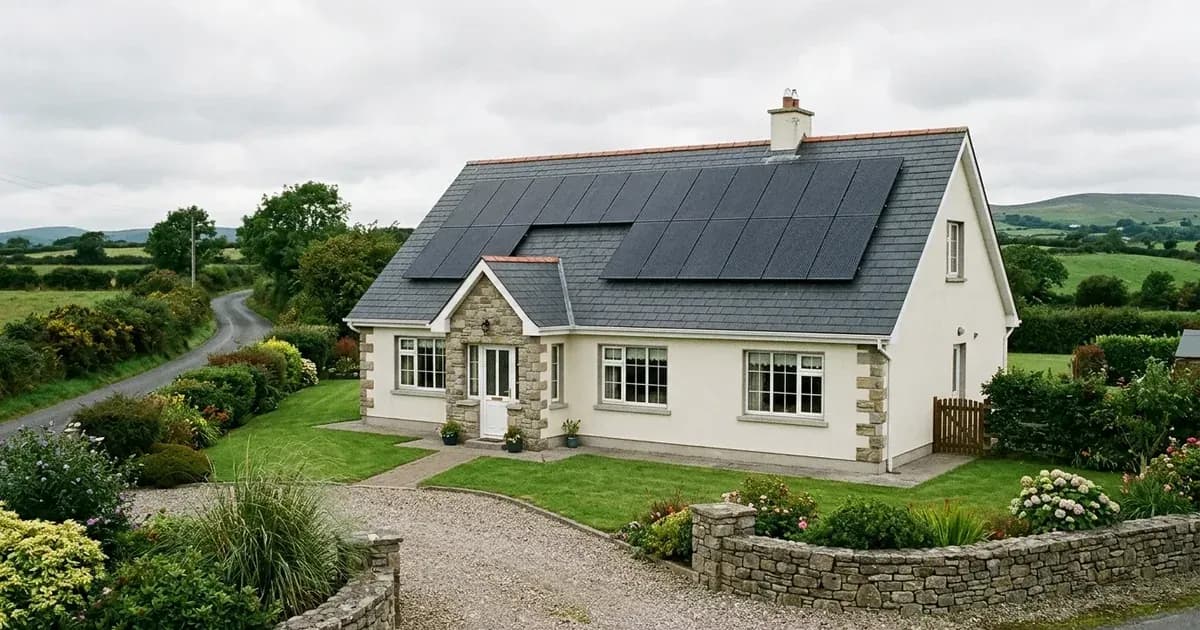
The distance between the plane of the roof and the solar photo-voltaic or solar thermal collector panels must not exceed 50cm in the case of a flat roof. For any other roof type, typically pitched roofs, this distance must not exceed 15cm.
Additionally, all rooftop solar photo-voltaic or solar thermal collector panels must be installed a minimum of 50cm from the edge of the roof on which they are mounted. This roof edge setback distance applies universally to all exempted rooftop installations.
What are the rules for free-standing solar installations?
Free-standing solar photo-voltaic or solar thermal collector installations also fall under Class 2 exemptions but come with their own set of restrictions. These installations are typically ground-mounted systems within the property's curtilage.
A key prohibition is that any free-standing solar installation cannot be placed or erected forward of the front wall of the house. This prevents installations from impacting the street-facing aesthetic of residential properties.
There are also size and proximity limits:
- The total aperture area of any free-standing solar photo-voltaic and solar thermal collector panels, combined with any other existing free-standing panels, must not exceed 25 square metres.
- The height of the free-standing solar photo-voltaic and/or solar thermal collector installation must not exceed 2.5 metres at its highest point above ground level.
- The installation must not reduce the remaining area of private open space, reserved exclusively for the use of the occupants of the house, to the rear or to the side of the house to less than 25 square metres.
What should you consider before installing domestic solar?
Understanding these regulations is crucial before planning your domestic solar installation. While Class 2 exemptions simplify the process, failing to meet any of the specified conditions means your installation would require full planning permission. This could lead to delays, additional costs, or even enforcement action if an unexempted installation proceeds without permission.
Always consult the most current statutory instruments or a qualified planning professional to confirm your project's compliance. The regulations are subject to change, and local authority interpretations may vary. For broader context on solar planning in Ireland, you may find our guides on Ireland's Solar Safeguarding Zones and Commercial and Industrial Solar Planning Exemptions helpful. If you are considering a farm installation, our guide on the Farm Solar PV VAT58 Refund Scheme might also be relevant.
To estimate your potential solar system size and output, you can use a solar sizing tool. However, always ensure your plans comply with the physical and spatial limitations outlined in the Class 2 exemptions.
Frequently asked questions
What is Class 2 domestic solar planning exemption in Ireland?
Class 2 exemptions, under S.I. No. 493 of 2022, permit the installation of solar PV or thermal collectors on house roofs or within the curtilage of a house, including ancillary buildings. These regulations do not apply to apartments (August 2026).
What are the roof plane distance limits for solar panels under Class 2 in Ireland?
For flat roofs, the distance between the roof plane and solar panels must not exceed 50cm. For pitched roofs, this distance must not exceed 15cm (August 2026).
Is there a setback requirement from the roof edge for solar panels in Ireland?
Yes, solar panels must be installed a minimum of 50cm from the edge of any roof on which they are mounted (August 2026).
What are the restrictions for free-standing solar installations under Class 2 in Ireland?
Free-standing solar installations cannot be placed forward of the front wall of the house. Their total aperture area must not exceed 25 square metres, and their height cannot exceed 2.5 metres at the highest point above ground level (August 2026).
References
- Irish Statute Book - S.I. No. 493/2022 — accessed 23 August 2026
Related guides
More from schemes, subsidies & financing.