Ireland Agricultural Solar Planning Exemption Class 18 Guide: Farm Solar Rules (August 2026)
Updated 18 September 2026 · By SolarNevs Research Desk, Dealer surveys + verified sources · 1 source · Method ↗
Key Takeaways
- Rooftop solar panels must be set back 2 metres from flat roof edges or 50cm from other roof edges (August 2026).
- Panels on flat roofs cannot exceed 1.2 metres from the roof plane; on pitched roofs, this limit is 15cm (August 2026).
- Free-standing agricultural solar installations are capped at 75 square metres total aperture area and 2.5 metres in height (August 2026).
- Exempted farm solar must be primarily used (greater than 50%) for on-site consumption (August 2026).
What is Ireland's Class 18 Agricultural Solar Planning Exemption?
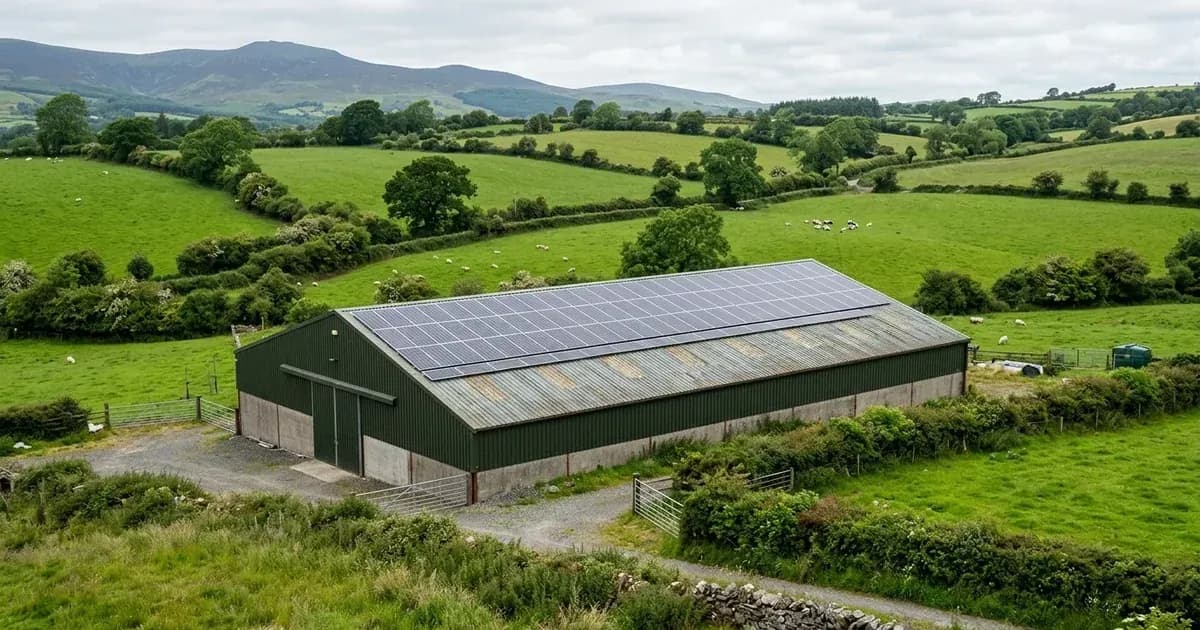
Ireland's Class 18 agricultural solar planning exemption allows for the installation of solar photo-voltaic and solar thermal collectors on farms without requiring full planning permission. This exemption is detailed in the Planning and Development Act 2000 (Exempted Development) (No. 3) Regulations 2022 (S.I. No. 493 of 2022). It covers installations on the roof or wall of an agricultural structure, or within the curtilage of an agricultural holding, including ancillary buildings (August 2026).
This regulation aims to streamline the process for farmers to adopt solar energy. However, specific conditions and limitations apply to ensure the development remains within the scope of exempted development. Understanding these rules is crucial before commencing any installation.
What are the rules for rooftop and wall solar on agricultural structures?
When installing solar panels on the roof or walls of agricultural buildings, specific dimensional limits apply to ensure they integrate appropriately with the existing structure.
For installations on flat roofs, the distance between the plane of the roof and the solar panels must not exceed 1.2 metres (August 2026). For pitched roofs or any other roof type, this distance is limited to 15cm (August 2026).
Setback requirements from the roof edge also apply. On flat roofs, solar panels must be a minimum of 2 metres from the edge of the roof (August 2026). For pitched roofs or any other roof type, this setback is reduced to 50cm from the edge (August 2026). These rules are designed to manage visual impact and structural considerations.
What are the limits for free-standing agricultural solar installations?
Free-standing solar installations within the curtilage of an agricultural holding also fall under Class 18, but with their own set of restrictions. These installations are subject to a total aperture area cap. The combined aperture area of all free-standing solar photo-voltaic and/or solar thermal collector panels, including any previously placed within the curtilage, must not exceed 75 square metres (August 2026).
In terms of height, the free-standing solar installation must not exceed 2.5 metres at its highest point above ground level (August 2026). These limits help to control the scale and visual impact of ground-mounted solar arrays on agricultural land.
What does 'primarily for use' mean for farm solar exemptions?
A key condition for agricultural solar installations to qualify as exempted development under Class 18 is that they must be "primarily used" for the provision of electricity or heating for use within the curtilage of the agricultural holding (August 2026). The regulations define "primarily" as greater than 50% (August 2026).
This means that more than half of the energy generated by the solar installation must be consumed on-site for agricultural purposes. This condition supports the policy objective of promoting self-sufficiency and reducing energy costs for farms, rather than facilitating large-scale energy export without planning oversight. Farmers should assess their energy consumption patterns to ensure compliance with this requirement.
How do Solar Safeguarding Zones (SSZ) affect agricultural solar?
For agricultural solar installations located within a Solar Safeguarding Zone (SSZ), additional rules apply. These zones are designated areas where specific considerations for solar development are in place, often due to proximity to airports or other sensitive infrastructure.
Within an SSZ, the total aperture area of all solar photo-voltaic and/or solar thermal collector panels on roofs, including any previously installed, must not exceed 300 square metres (August 2026). This is a cumulative limit for all rooftop solar on the agricultural holding within the zone.
Furthermore, if your development is located within an SSZ, the planning authority must be notified in writing no later than 4 weeks after the commencement of the development (August 2026). This notification must include details regarding the location and scale of the development. This requirement ensures that authorities are aware of solar installations in sensitive areas.
How we verified these regulations
We checked the Planning and Development Act 2000 (Exempted Development) (No. 3) Regulations 2022 (S.I. No. 493 of 2022) on 23 August 2026. All figures and provisions cited in this article are directly sourced from this statutory instrument, which governs Class 18 agricultural solar planning exemptions in Ireland. The official publication is available on the Irish Statute Book website.
Navigating agricultural solar decisions
Understanding these planning exemptions is a critical first step for any farmer considering solar energy. While Class 18 offers a pathway for exempted development, careful adherence to the specified limits and conditions is essential. Failure to comply can result in enforcement action by the planning authority.
For broader context on solar planning in Ireland, you can review our guides on domestic solar planning exemptions and commercial and industrial solar planning exemptions. If you are also exploring financial support, our guide on the TAMS 3 Solar Capital Investment Scheme may be helpful.
Before making any final decisions, you should confirm your specific site conditions against the regulations. Consider consulting with a qualified professional to ensure your proposed installation fully complies with all relevant planning requirements.
Frequently asked questions
What is Ireland's Class 18 agricultural solar planning exemption?
Ireland's Class 18 exemption, under S.I. No. 493 of 2022, allows for the placement of solar installations on agricultural structures, walls, or within the curtilage of an agricultural holding without requiring planning permission (August 2026). This applies to both solar photo-voltaic and solar thermal collector installations.
What are the roof setback rules for agricultural solar panels in Ireland?
Solar panels on flat roofs of agricultural structures must be a minimum of **2 metres** from the roof edge (August 2026). For pitched roofs or any other roof type, the panels must be a minimum of **50cm** from the edge (August 2026).
What are the height and area limits for free-standing agricultural solar installations?
Free-standing solar installations on agricultural holdings must not exceed a total aperture area of **75 square metres** (August 2026). The height of these installations must also not exceed **2.5 metres** at their highest point above ground level (August 2026).
What does 'primarily for use' mean for agricultural solar exemptions?
For an agricultural solar installation to qualify for exemption, it must be 'primarily used' for electricity or heating within the curtilage of the agricultural holding (August 2026). This means that greater than **50%** of the energy generated must be consumed on-site (August 2026).
Are there special rules for agricultural solar in Solar Safeguarding Zones (SSZ)?
Yes, within a Solar Safeguarding Zone, the total aperture area of all solar panels on roofs of agricultural structures, including existing ones, must not exceed **300 square metres** (August 2026). Additionally, the planning authority must be notified in writing within **4 weeks** of commencing such development (August 2026).
References
Related guides
More from schemes, subsidies & financing.