Ireland Solar Safeguarding Zones (SSZ) and Aviation Guide
Updated 18 September 2026 · By SolarNevs Research Desk, Dealer surveys + verified sources · 3 sources · Method ↗
Key Takeaways
- Ireland has 43 designated Solar Safeguarding Zones (SSZs) to protect aviation from solar glint and glare.
- These zones include 10 SSZs with a 5km radius around airports and 33 SSZs with a 3km radius around aerodromes, military barracks, and emergency hospital helipads.
- Rooftop solar installations on industrial buildings or business premises within an SSZ are generally exempted development up to 300 square metres.
- Any solar development causing hazardous glint and/or glare is not exempted development and requires mitigation to the satisfaction of the Planning Authority.
What are Ireland's Solar Safeguarding Zones (SSZs)?
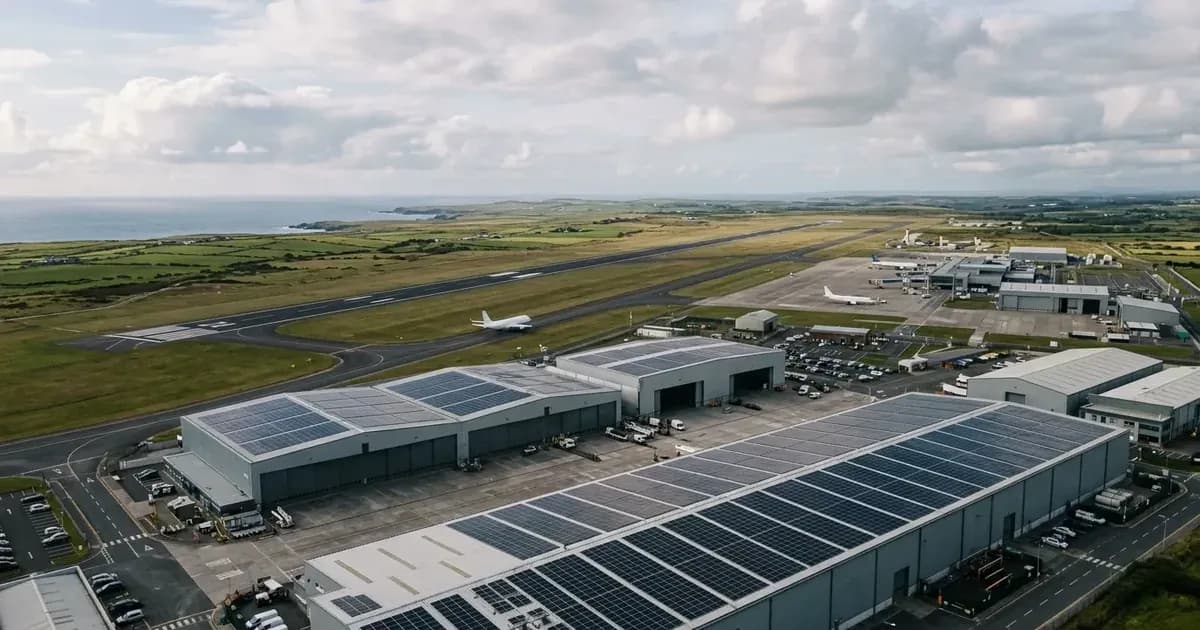
Ireland's Solar Safeguarding Zones (SSZs) are specific geographical areas established to manage the potential impact of solar panel installations on aviation safety. These zones address the risk of glint (a momentary flash of light) and glare (continuous brightness) from solar panels interfering with aircraft operations, particularly during critical phases of flight such as take-off and landing.
The Department of Housing, Local Government and Heritage, in conjunction with statutory stakeholders including the Irish Aviation Authority (IAA), the Department of Defence, and the HSE, introduced SSZs as part of a review of the Planning and Development Regulations 2001. This was done "in order to provide appropriate safeguards in close proximity to aviation sites."
There are 43 SSZs designated nationwide. These zones are categorised by their radius and the type of aviation facility they protect:
- 10 SSZs have a 5km radius and are located around airports.
- 33 SSZs have a 3km radius and are located around aerodromes, military barracks, and emergency hospital helipads.
The specific boundaries and details of these zones are mapped out in the Planning and Development (Solar Safeguarding Zone) Regulations 2022 (S.I. No. 492/2022).
How planning regulations apply to solar installations within SSZs
The installation of solar panels in Ireland is generally considered exempted development under the Planning and Development Regulations 2001 to 2022, meaning it does not require a full planning application, provided certain conditions are met. However, these exemptions are modified or removed when installations are located within an SSZ, primarily due to the risk of glint and glare.
The Planning And Development Act 2000 (Exempted Development) (No. 3) Regulations 2022 (S.I. No. 493/2022) sets out the specific conditions for solar development within SSZs. The core principle is to prevent solar installations from endangering public safety "by reason of hazardous glint and/or glare for the operation of airports, aerodromes or aircraft."
For certain developments within an SSZ, even if they meet the size thresholds for exempted development, there is a mandatory notification requirement. For example, if you install solar panels on an industrial building or business premises within an SSZ, you must notify the planning authority in writing. This notification must be made "no later than 4 weeks after the commencement of such development and such notification shall include details regarding the location and scale of the development."
Solar exemption limits and technical criteria within SSZs
While many solar installations outside SSZs benefit from broad exemptions, specific limits and conditions apply within these safeguarding zones. The primary concern is the total area of solar panels and their potential to cause hazardous glint or glare.
The table below outlines key exemption thresholds and conditions for solar panel installations within SSZs, as specified in S.I. No. 493/2022.
Category / Class | Exemption Threshold | Setback & Height Condition |
|---|---|---|
Rooftop solar on industrial buildings or business premises within SSZ | Total aperture area not to exceed 300 square metres | Development must not cause hazardous glint and/or glare. |
Development causing hazardous glint and/or glare | Not exempted development | Panels must be removed or covered until a mitigation plan is agreed and implemented to the satisfaction of the Planning Authority. |
It is important to note that general exemptions for other types of solar installations, such as those on houses (e.g., a total aperture area not exceeding 25 square metres for free-standing panels) or wall-mounted panels on industrial buildings (e.g., a total aperture area not exceeding 75 square metres), still exist. However, the overriding condition within an SSZ is the prevention of hazardous glint and glare. If any installation, regardless of its size, is deemed to cause hazardous glint and/or glare, it loses its exempted development status.
Glint and Glare assessments and Section 5 declarations
The risk of glint and glare is a critical factor within Ireland's Solar Safeguarding Zones. The Irish Aviation Authority (IAA) is a key stakeholder in assessing this risk. Glint refers to a momentary reflection of sunlight, while glare is a continuous, bright reflection. Both can impair pilot visibility and compromise aviation safety.
Any solar development that "causes hazardous glint and/or glare shall not be exempted development." This means that even if an installation meets the size thresholds for exemption (e.g., 300 square metres for industrial rooftops within an SSZ), if it is found to produce hazardous glint or glare, it will require formal planning permission. Furthermore, "any solar photo-voltaic or solar thermal collector panels which are causing hazardous glint and/or glare shall either be removed or be covered until such time as a mitigation plan to address the hazardous glint and/or glare is agreed and implemented to the satisfaction of the Planning Authority."
In situations where the exempted development status of a proposed solar installation is unclear, particularly within an SSZ or if there's a potential for glint and glare issues, you can apply to your local planning authority for a Section 5 declaration of exemption. This process allows the planning authority to formally determine whether a proposed development is or is not exempted development under the Planning and Development Act 2000. This is especially relevant if your site is near one of the 43 SSZs, including the 10 airport 5km zones or 33 aerodrome/helipad 3km zones, or if there are concerns about the impact on Protected Structures or Architectural Conservation Areas.
What the published sources do not tell you
While the regulations clearly define Solar Safeguarding Zones and their purpose, some specific details are not fully elaborated in the provided sources. For instance, the complete list of all 43 SSZs and their associated townlands or electoral divisions, as detailed in S.I. No. 492/2022, is extensive and not fully reproduced here. Similarly, while the regulations specify the number of 5km airport zones and 3km aerodrome/helipad zones, the exact names of all these specific airports, aerodromes, military barracks, and emergency hospital helipads are not explicitly listed in the summary documentation.
The regulations also do not explicitly state specific area thresholds for residential rooftop solar installations within SSZs. While a general exemption of 25 square metres applies to free-standing residential solar panels, it is not explicitly clarified if this threshold changes or if additional conditions apply specifically within an SSZ for residential properties, beyond the overarching glint and glare prohibition.
Furthermore, the precise planning application triggers for exceeding SSZ thresholds are not detailed beyond the notification requirement for industrial and business premises. The timeline for receiving a Section 5 determination from a local planning authority, while typically around 4 weeks, is also not specified in the regulations themselves. These aspects may require direct consultation with the local planning authority or a qualified planning consultant.
Frequently asked questions
What are Solar Safeguarding Zones (SSZs) in Ireland?
SSZs are designated areas around aviation sites in Ireland, introduced to safeguard against the impact of glint and glare from solar panels on aircraft operations. There are 43 such zones nationwide, including 10 zones with a 5km radius around airports and 33 zones with a 3km radius around aerodromes, military barracks, and emergency hospital helipads.
How many Solar Safeguarding Zones are there in Ireland, and what are their radii?
Ireland has 43 Solar Safeguarding Zones (SSZs). These comprise 10 zones with a 5km radius specifically around airports, and 33 zones with a 3km radius covering aerodromes, military barracks, and emergency hospital helipads.
What is the rooftop solar area threshold for industrial buildings within an SSZ?
For industrial buildings or business premises located within a Solar Safeguarding Zone, the total aperture area of solar panels, including any previously installed, must not exceed 300 square metres to remain exempted development under S.I. 493/2022.
What happens if solar panels cause hazardous glint or glare within an SSZ?
If solar panels cause hazardous glint and/or glare, the development is no longer considered exempted development. The panels must be removed or covered until a mitigation plan is agreed upon and implemented to the satisfaction of the Planning Authority.
Do I need to notify the planning authority if I install solar panels on an industrial building within an SSZ?
Yes. For industrial buildings or business premises within an SSZ, the planning authority must be notified in writing no later than 4 weeks after the commencement of the development. This notification must include details regarding the location and scale of the installation.
References
- data.gov.ie - Solar Safeguarding Zones — accessed 28 August 2026
- S.I. No. 493/2022 - Planning And Development Act 2000 (Exempted Development) (No. 3) Regulations 2022 — accessed 28 August 2026
- S.I. No. 492/2022 - Planning and Development (Solar Safeguarding Zone) Regulations 2022 — accessed 28 August 2026
Related guides
More from schemes, subsidies & financing.