Deye SUN-5K-SG04LP1-EU 5kW Single-Phase Hybrid Inverter
Price being verified — see the live table on the price index.
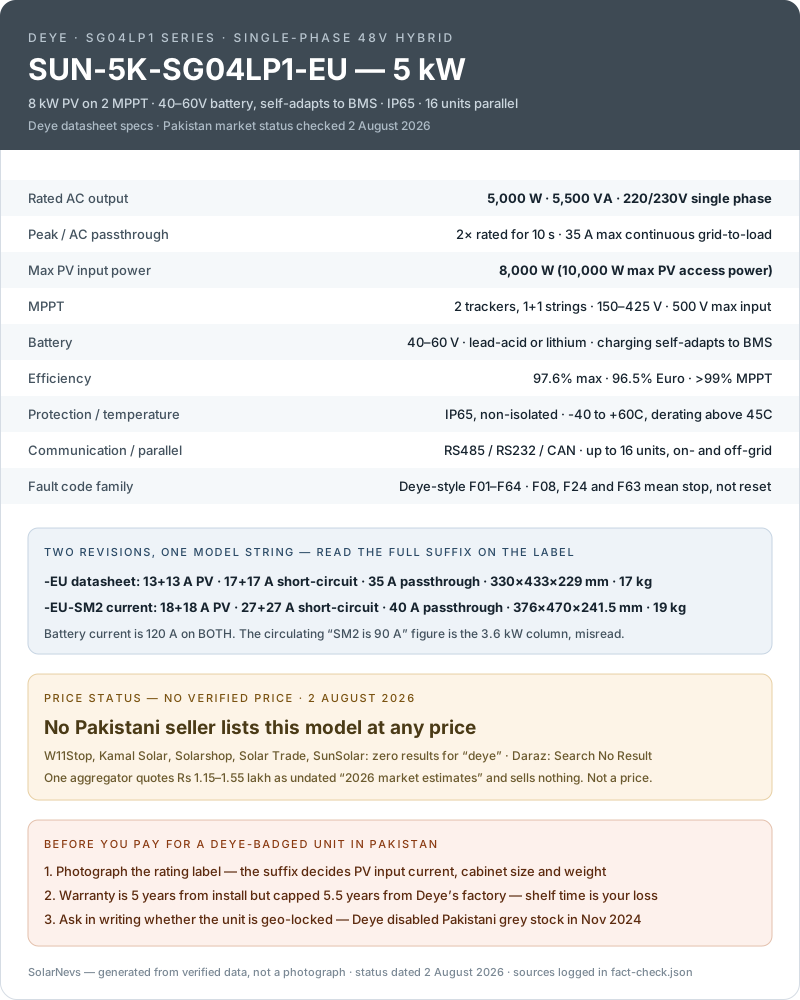
Specifications
| ratedAcOutput | 5,000 W (5,500 VA apparent), 220/230V single phase |
|---|---|
| peakPower | 2x rated power for 10 seconds, off-grid |
| maxPvInputPower | 8,000 W (10,000 W max PV access power) |
| mppt | 2 trackers / 1+1 strings, 150-425V, 500V max PV input |
| batteryVoltage | 40-60V, lead-acid or lithium, charging self-adapts to the BMS |
| batteryCurrent | 120A charge / 120A discharge - unchanged between the original -EU datasheet and the current -EU-SM2 revision |
| efficiency | 97.6% max, 96.5% Euro, >99% MPPT |
| protection | IP65, non-isolated, -40 to +60C with derating above 45C |
| communication | RS485 / RS232 / CAN; WiFi, GPRS, Bluetooth, 4G or LAN logger optional |
| parallel | up to 16 units, on-grid and off-grid |
| Warranty | Deye's General Warranty Agreement V2.3 (14 Jan 2025) lists SUN-3/3.6/5/6K-SG04LP1-EU at 5 years, service mode "customer replace, faulty units return to Deye" with Deye arranging spare parts. The clock is capped - "5 years from the date of installation, and no more than 5 and half years from the date of delivery from Deye factory" - and a serial number must be provided to claim. Clause 5 conditions the whole commitment on "the formal sales contract signed with Deye", which no Pakistani seller has been shown to hold. |
The Deye SUN-5K-SG04LP1-EU is the single-phase 5kW low-voltage hybrid that most of Pakistan's 48V hybrid market is descended from - two MPPTs, a 40-60V battery port that self-adapts to the BMS, IP65, generator input, and up to 16 units in parallel. We publish no Pakistani price for it, because on 2 August 2026 no Pakistani seller we could open lists it: W11Stop, Kamal Solar, Solarshop, Solar Trade and SunSolar all return zero results for "deye", and Daraz returns "Search No Result" for "deye sun hybrid". The one Pakistani page quoting figures - Rs 1.15-1.55 lakh at solarpricepakistan.com.pk - labels them "2026 market estimates", carries no verification date and sells nothing.
This page exists to give the specification honestly, because thousands of Pakistani systems run this hardware under other badges, and because the two revisions of this exact model string are not the same inverter - though not in the direction most quotes imply.
Specifications
Spec | SUN-5K-SG04LP1-EU (datasheet) | SUN-5K-SG04LP1-EU-SM2 (current) |
|---|---|---|
Rated AC output | 5,000 W | 5,000 W |
Max AC apparent power | 5,500 VA | 5,500 VA |
Peak power, off-grid | 2x rated, 10 s | 2x rated, 10 s |
Rated AC current | 22.7 / 21.7 A | 22.8 / 21.8 A |
Max continuous AC passthrough | 35 A | 40 A |
Max PV access power | 10,000 W | 10,000 W |
Max PV input power | 8,000 W | 8,000 W |
Max PV input voltage | 500 V (start-up 125 V) | 500 V (start-up 125 V) |
MPPT range / trackers | 150-425 V, 2 trackers, 1+1 strings | 150-425 V, 2 trackers, 1+1 strings |
Max operating PV input current | 13+13 A | 18+18 A |
Max input short-circuit current | 17+17 A | 27+27 A |
Battery voltage range | 40-60 V | 40-60 V |
Max charge / discharge current | 120 A / 120 A | 120 A / 120 A |
Battery type | Lead-acid or lithium, self-adapts to BMS | Lead-acid or lithium |
Max / Euro efficiency | 97.6% / 96.5% (MPPT >99%) | 97.6% |
Cabinet size | 330 x 433 x 229 mm | 376 x 470 x 241.5 mm |
Weight | 17 kg | 19 kg |
Ingress protection | IP65, non-isolated, natural cooling | IP65 |
Operating temperature | -40 to +60C, derating above 45C | -40 to +60C |
Communication | RS485 / RS232 / CAN | WiFi, RS485, CAN |
Parallel | up to 16 units, on-grid and off-grid | up to 16 units |
Warranty (Deye) | 5 years / 10 years, depends on installation site | 5 years / 10 years |
The rows that matter are on the PV and AC side, not the battery side. Battery current is identical at 120A on both revisions - roughly 5.8kW at 48V nominal, enough to drive a two-module Pylontech-class bank at full rate. What Deye actually changed in the SM2 is string handling: maximum operating PV input current rises from 13+13A to 18+18A and short-circuit tolerance from 17+17A to 27+27A, so the SM2 accepts fatter modern modules without exceeding its input rating; continuous grid-to-load passthrough rises from 35A to 40A; and the cabinet grows by about 2kg. On paper the SM2 is the better box.
We flag this because the widely repeated claim that the SM2 cut battery current to 90A is a column-misreading of Deye's own table: 90A is the SUN-3.6K column. Across the five columns of Deye's current data table the battery-current row reads 140 / 70 / 90 / 120 / 135 A for the 3K-24V, 3K, 3.6K, 5K and 6K models respectively - the same sequence as the older -EU datasheet. If a spec sheet in front of you says a SUN-5K-SG04LP1-EU-SM2 is a 90A machine, that sheet is wrong.
Honest assessment
Pros. The specification is exactly right for Pakistan: a 40-60V low-voltage battery port that matches the LiFePO4 racks actually stocked here rather than a high-voltage stack nobody sells; charging that self-adapts to the BMS instead of running on hand-set voltages; two MPPTs with a wide 150-425V window that tolerates mismatched string lengths on a real rooftop; 35A continuous grid passthrough; diesel-generator charge support; and AC coupling to retrofit an existing array. Deye documents all of it publicly with a versioned battery-compatibility list, which is more than most brands sold here manage. Derating starting at 45C rather than 40C is a genuine Pakistani-summer advantage.
Cons. As a purchase in Pakistan it does not exist, and the paperwork behind it is worse than absent. The 5-year warranty is capped at 5.5 years from factory delivery, so shelf time is deducted from your cover; it requires a serial number; and clause 5 conditions the entire commitment on a formal sales contract signed with Deye, which no Pakistani seller has been shown to hold. The two revisions sharing one model string invite mis-selling in both directions - an -EU-era sheet quoted against an SM2 unit understates PV input current and overstates nothing, while circulating "SM2 is only 90A" sheets understate battery current by reading the wrong column. And a unit outside the authorised chain is precisely the population Deye disabled by firmware in November 2024.
Who should buy. Someone completing or servicing an existing installation of this exact platform, who can read the full suffix off the label and accept that the warranty is whatever their dealer personally honours. A first-time 5kW buyer in Pakistan should buy the same platform with a service counter attached - Inverex Nitrox, whose screens show the same Deye-style F01-F64 fault codes - or an independently priced alternative such as Solis.
Pakistan reality check
No channel, no price, no counter. Five Pakistani solar retailers, Daraz and OLX were searched on 2 August 2026 and produced not one Deye-badged inverter between them. Deye's own site names no Pakistani entity and publishes only +86 Ningbo service lines; its store-verification page lists authorised entities for Europe and Australia and none for Pakistan. FBR Valuation Ruling No. 2015/2025 names Inverex - not Deye - in the tier-1 brand list behind its higher customs-value column, which is a statement about official recognition. It is not, however, a statement that Deye lands cheaper: Note 1 of the same ruling extends the Category A values to any other brand importing IP65 or IP66 hybrid inverters, and this model is IP65. So a Deye-badged SUN-5K should be assessed in Category A at US$100/kW C&F for the 3-5 kW band, not the Category B US$65/kW. Either figure is a minimum benchmark customs value before duty, taxes, freight and margin, not a retail price, and we deliberately do not convert it into rupees to look like one.
The revision question, in practice. Ask for a photograph of the rating label before you pay, and read the whole string. "SUN-5K-SG04LP1-EU" and "SUN-5K-SG04LP1-EU-SM2" are quoted interchangeably by resellers, and the sheet they hand you decides which PV input current, short-circuit rating, cabinet size and shipping weight you are agreeing to. Battery current is not the differentiator - it is 120A on both. The cheapest test of whether a seller knows what is in the box is to ask which revision the quoted PV input current came from: 13+13A is the old sheet, 18+18A is the SM2.
BMS compatibility. Deye's Approved Battery List DY-LV48-0121, issued 25 February 2026, names this model family explicitly. Over CAN at lithium setup 00 it clears Pylontech's whole 48V range - US2000B/US3000/US2000C/US3000C/US2000D/US3000D/UP5000/US5000/UF5000/Force L1/L2/Pelio-L - which means it pairs with both the US-series stock leaving the Pakistani channel and the UF5000 replacing it. Also cleared over CAN: Dyness B4850/A48100, Narada 48NPFC80/100/150/200, BYD Battery-Box LV5.0, Fox ESS LD-48100P, Livoltek BLF48100/BLF51-5, Soluna 4K/5K packs. The RS485 path at setup 12 is a legacy list covering Pylontech's US series and UP5000 but not the UF5000 - so a UF5000 pairing must be CAN. Knox, Osaka Lithium, Fronus, Vaults and Dongjin appear nowhere on the list, and Deye's note states it "will not be liable for any failure that caused by communication issue" with a pack the supplier has not confirmed.
The remote off-switch. The November 2024 shutdown reached inverters through their monitoring connection. That leaves a Pakistani owner of grey stock with a genuinely unpleasant choice: connect the logger and get SOLARMAN monitoring plus exposure to whatever Deye decides about unauthorised units, or leave it offline and lose remote diagnostics, firmware updates and any hope of a data-backed warranty claim. There is no third option, and any seller who tells you otherwise is guessing.
Fault codes. This platform reports Deye-style F01 to F64. Three of those codes mean stop rather than reset: F08 (GFDI relay failure), F24 (DC insulation impedance failure) and F63 (arc fault). See our inverter error-code glossary - and note that the same glossary warns a two-digit code means you are looking at a Voltronic-family unit, not this one.
Price context vs rivals (August 2026)
There is no Deye figure to place on a shelf, so this table is what the 5-6kW hybrid class actually costs a Pakistani buyer. These are individual live listings read on 2 August 2026, single sellers rather than market rates.
5-6 kW class option | Price (2 Aug 2026) | Where |
|---|---|---|
Crown Relevo 4.2kW hybrid | Rs 115,000 | Daraz.pk listing |
Anenji 6.2kW hybrid off-grid | Rs 145,000 | Daraz.pk listing |
Crown Relax 6.2kW hybrid off-grid | Rs 194,000 | Daraz.pk listing |
TD 6kW hybrid (TD6K-SPLVES2-EU) | Rs 277,333 | Daraz.pk, Solar Trade Hub |
Inverex Nitrox 6kW MPPT hybrid | Rs 345,999 | Daraz.pk listing |
Deye SUN-5K-SG04LP1-EU | no listing at any price | nine channels checked |
The comparison a buyer should actually make is not against a price but against a channel: everything above can be bought, warranted and complained about in Pakistan. This cannot. Full brand context on the Deye hub page.
Frequently asked questions
What does a Deye SUN-5K-SG04LP1 cost in Pakistan?
We publish no price. On 2 August 2026 no Pakistani seller we could open listed this model - W11Stop, Kamal Solar, Solarshop, Solar Trade and SunSolar return zero results for "deye", and Daraz returns "Search No Result" for "deye sun hybrid". The only Pakistani page quoting a number, solarpricepakistan.com.pk at Rs 1.15-1.55 lakh, calls its figures "2026 market estimates", carries no date and sells nothing. One undated estimate from a non-seller is not a price.
Is the SM2 version the same inverter?
Not quite, but the differences run the other way from what dealers often claim. Battery current is identical - Deye specifies 120A charge and 120A discharge for the 5kW column on both the original -EU datasheet and the current -EU-SM2 table. What did change is the PV and AC side - maximum operating PV input current 13+13A to 18+18A, short-circuit 17+17A to 27+27A, continuous grid-to-load passthrough 35A to 40A, and a bigger cabinet (330x433x229mm and 17kg becoming 376x470x241.5mm and 19kg). The SM2 is the more capable revision on paper. Read the full suffix on the label anyway, because the two sheets are not interchangeable.
How much battery can it actually charge?
120A at 48V nominal is roughly 5.8kW of charge or discharge, on both revisions - enough to drive a two-module Pylontech-class bank at full rate. That is above the 5kW AC output rather than below it, so the pack, not the inverter, is usually the limit in a real install. Size the battery bank for the current you actually want, not for the inverter's ceiling.
Which batteries are cleared for it?
Deye's Approved Battery List DY-LV48-0121 (25 February 2026) names the SUN-3/3.6/5/6K-SG04LP1-EU explicitly and clears roughly 120 packs. Over CAN at lithium setup 00 that includes Pylontech's full 48V range with the UF5000, Dyness B4850/A48100, Narada 48NPFC80-200, BYD Battery-Box LV5.0, Livoltek BLF48100/BLF51-5 and Fox ESS LD-48100P. Knox, Osaka Lithium, Fronus, Vaults and Dongjin are not on the list, and Deye disclaims liability for communication failures with unlisted packs.
Can it run on a generator?
Yes - the datasheet states it supports storing energy from a diesel generator, and it will AC-couple to retrofit an existing solar system. Maximum continuous AC passthrough from grid to load is 35A on this model, which is the number that decides whether your whole-house load can sit behind it.
Will a unit bought in Pakistan be geo-locked?
Assume it might be. On 15 November 2024 Deye remotely disabled internet-connected units sold outside authorised channels in Pakistan, the USA and the UK, displaying "This inverter is not allowed use at Pakistan/USA/UK - Pakistan contact inverex". Deye has since said authorised-distributor stock is not locked; there is no named Deye distributor in Pakistan for that to apply to. The lock arrives over the monitoring dongle, so an offline unit is unaffected - and also unmonitored.
References
- Deye official - SUN-3K-SG04LP1-24-EU / SUN-3/3.6/5/6K-SG04LP1-EU datasheet PDF, full technical data table — accessed 2 Aug 2026
- Deye official - SUN-3/3.6/5/6K-SG04LP1-EU-SM1/SM2 product page (current revision data table) — accessed 2 Aug 2026
- Deye official - Approved Battery List DY-LV48-0121, issued 2026-02-25 — accessed 2 Aug 2026
- Deye official - General Warranty Agreement V2.3 (14 Jan 2025) — accessed 2 Aug 2026
- solarboi.com - verbatim lock message, 17 Nov 2024 — accessed 2 Aug 2026
- Born's Tech - Deye deactivates inverters in USA, UK and Pakistan, 28 Nov 2024 — accessed 2 Aug 2026
- W11Stop - site search 'deye' (zero results) — accessed 2 Aug 2026
- Kamal Solar - site search 'deye' (0 results) — accessed 2 Aug 2026
- Solarshop Pakistan - product search 'deye' (no products found) — accessed 2 Aug 2026
- Daraz.pk - search 'deye sun hybrid' (0 items) — accessed 2 Aug 2026
- solarpricepakistan.com.pk - Deye estimate page (Rs 1.15-1.55 lakh, undated estimates) — accessed 2 Aug 2026
- FBR Valuation Ruling No. 2015/2025, 25 July 2025 - hybrid inverter customs values and tier-1 brand list — accessed 2 Aug 2026