Inverter Error Code Glossary Pakistan Master Index by Brand
Updated 15 September 2026 · By SolarNevs Research Desk, Dealer surveys + verified sources · 20 sources · Method ↗
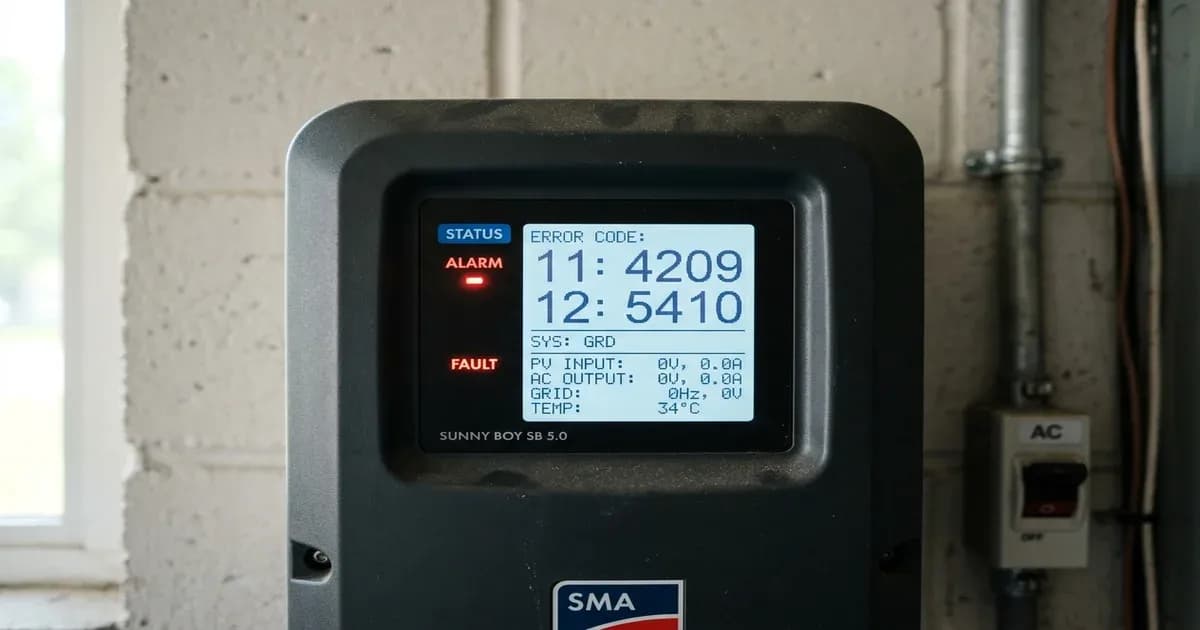
Key Takeaways
- Inverters sold in Pakistan speak three unrelated code languages, and a number alone means nothing until you know which one your unit uses.
- Code 58 is an AC output current condition on Voltronic-style firmware and a battery BMS communication fault on Deye-style firmware, which are completely different repairs.
- Three Deye-family codes mean stop rather than reset. F08 is a GFDI relay failure, F24 is a DC insulation impedance failure, and F63 is an arc fault flagged as a fire risk.
- Inverex Nitrox displays a Deye-style F01 to F64 set, while Axpert-derived Inverex lines display two-digit numbers, so two inverters from one brand need two different tables.
- Every code in this index routes to a repair path, and the repair-versus-replace ceiling is 40 to 50 percent of a new unit at your written local quote (checked July 2026).
How do you work out which code language your inverter speaks?
Before reading any code table, identify the format on your screen. This one step prevents most of the wrong repairs in this market.
Code family | Format on screen | Lines commonly seen in Pakistan | Where the code appears |
|---|---|---|---|
Voltronic-style | Two digits, such as 01, 05, 51, 58 | Growatt SPF off-grid and hybrid, Axpert-derived Inverex lines, SolarMax, Fronus and other locally badged off-grid units | LCD panel and the brand app |
Deye-style | F prefix, F01 through F64 | Deye hybrids and Inverex Nitrox | Colour touchscreen and Solarman |
Solis | Four digits plus a mnemonic, such as 1010 OV-G-V | Solis grid-tied and hybrid units by Ginlong | LCD panel and SolisCloud |
Two rules follow. A code list that does not name the firmware family is worth nothing, so ignore any forward that gives you "error 58" without saying which inverter it came from. And a brand is not a family, because Inverex ships both Deye-style and two-digit units.
What do the two-digit Voltronic-style codes mean?
These definitions come from the Voltronic Axpert fault reference tables, and apply across locally badged units using the same numbering.
Code | Manual definition | First move | Where it usually lives |
|---|---|---|---|
01 | Fan is locked or fan failed | Power down, inspect the fan grille | Outside the box |
02 | Over temperature, inverter part above 100°C or DC/DC part above 75°C | Check clearances, shade, and vent dust | Outside the box |
03 | Battery voltage too high, above 63V while AC charging | Check charger settings against the bank | Settings |
05 | Output short circuited, INV voltage below 50V RMS or current above 20A RMS | Isolate circuits one at a time | House wiring or an appliance |
07 | Overload time out, 110 percent for 10s or 150 percent for 5s | Stagger the heavy loads | Your load profile |
08 | Bus voltage too high, over 500V for 1s | Workshop diagnosis | Inside the box |
51 | Over current, internal components failed | Workshop diagnosis | Inside the box |
52 | Bus voltage too low, below 260V | Battery bank, lugs and cable gauge first | Battery side |
55 | Over DC voltage in AC output, above 400mV for 20s | Workshop diagnosis | Inside the box |
56 | DC voltage low | Battery bank and connections | Battery side |
58 | AC output current condition, appears when a heavy or high-impedance load is connected | Reduce load, then inspect the output stage | Load, then the box |
Codes 08, 51 and 55 belong on a bench. Everything else here starts with a check that needs no opening of the case.
What do the Deye-style F codes mean?
Code | Meaning | Urgency |
|---|---|---|
F08 | GFDI relay failure, ground-fault protection | Stop, call a professional |
F13 | Working or grid mode changed | Usually self-clears |
F18 | AC overcurrent fault, hardware | Check and restart |
F20 | DC overcurrent fault, hardware | Check and restart |
F22 | Emergency-stop fault | Stop, call a professional |
F23 | AC leakage current, transient overcurrent | Usually self-clears |
F24 | DC insulation impedance failure | Stop, call a professional |
F26 | DC busbar unbalanced | Check and restart |
F29 | Parallel CAN-bus fault | Check and restart |
F34 | AC overcurrent fault | Check and restart |
F35 | No AC grid detected | Usually self-clears |
F41 | Parallel system stop | Usually self-clears |
F42 | AC line low voltage | Usually self-clears |
F46 | Battery defect | Check and restart |
F47 | AC over frequency | Usually self-clears |
F48 | AC under frequency | Usually self-clears |
F55 | DC bus voltage too high | Check and restart |
F56 | DC busbar voltage too low | Check and restart |
F58 | Battery BMS communication fault | Check and restart |
F60 | Battery over or under voltage, BMS protection | Stop, call a professional |
F61 | Battery overcurrent, BMS protection | Stop, call a professional |
F62 | Battery BMS stopped charge or discharge | Stop, call a professional |
F63 | Arc fault detected by AFCI, fire risk | Stop, call a professional |
F64 | Heat sink high temperature | Check and restart |
Compare 56 and 58 across the families. On Voltronic-style firmware, 56 is a low DC voltage condition and 58 is an AC output condition. On Deye-style firmware, F56 is a low DC busbar voltage and F58 is a battery communication failure. A technician reading the wrong table replaces the wrong thing, and you pay for it.
What do the Solis four-digit codes mean?
Solis units by Ginlong pair a four-digit number with a short mnemonic. Memorise the mnemonic, since that is what appears on the screen and in SolisCloud.
Code | Mnemonic | Meaning | Urgency |
|---|---|---|---|
1010 | OV-G-V | Grid overvoltage | Usually self-clears |
1011 | UN-G-V | Grid undervoltage | Usually self-clears |
1012 | OV-G-F | Grid over frequency | Usually self-clears |
1013 | UN-G-F | Grid under frequency | Usually self-clears |
1015 | NO-Grid | No grid detected | Usually self-clears |
1016 | G-PHASE | Unbalanced three-phase grid | Check and restart |
1020 | OV-DC | DC overvoltage | Stop, call a professional |
1023 | UN-BUS | DC bus voltage too low | Check and restart |
1027 | DC-INTF | Abnormal DC input current | Check and restart |
1028 | Reve-DC | DC reversely connected | Stop, call a professional |
1030 | GRID-INTF | Grid interference | Check and restart |
1032 | OV-TEM | Over temperature | Check and restart |
1033 | PV-ISO-PRO | Low PV insulation or ground fault | Stop, call a professional |
1034 | ILeak-PRO | Leakage current protection | Check and restart |
1035 | RelayChk-FAIL | Relay self-check failure | Check and restart |
1041 | ARC-FAULT | DC arc fault, fire risk | Stop, call a professional |
One correction is worth making in public. Several circulated Solis lists put isolation faults in a 2000 series and control faults in a 3000 series. Ginlong's own service portal and the indexed alarm list both place insulation protection at 1033 and arc fault at 1041, with no 2000 or 3000 series (checked 26 July 2026). If your screen shows a code outside the 1010 to 1041 band, check model and firmware before acting on any table.
Grid overvoltage is the alarm Pakistani net-metered households see most, because afternoon feed-in on a weak feeder pushes line voltage up. Ginlong's official steps for 1010 run from AC cable connectivity and gland polarity, to grid standard selection, to cable size against Solis limits, since line impedance produces the same symptom. It is a cabling problem before it is an inverter problem.
Which codes mean stop rather than reset?
Four situations end the session. A ground-fault code such as Deye F08, an insulation code such as Deye F24 or Solis 1033 PV-ISO-PRO, an arc-fault code such as Deye F63 or Solis 1041 ARC-FAULT, and any burning smell, crackle or hiss whatever the screen says.
These are not nuisance alarms. They report leakage to earth, degraded insulation and arcing, the conditions that precede a rooftop fire. Resetting them clears the message and leaves the fault. The full framework, including what to do in the first minute after you smell burning, is in when to call a solar technician.
Which brand database or symptom guide should you open next?
Brand or line | Code family | Guide |
|---|---|---|
Growatt | Voltronic-style two-digit | |
Solis | Four-digit | |
Inverex Nitrox | Deye-style F codes | |
SolarMax | Voltronic-style two-digit | |
Fronus | Voltronic-style two-digit | |
Knox and Deye | Deye-style F codes | Database in preparation |
Huawei | Brand-specific alarm IDs | Database in preparation |
GoodWe | Brand-specific alarm IDs | Database in preparation |
Crown | Voltronic-style two-digit | Database in preparation |
Sorotec | Voltronic-style two-digit | Database in preparation |
Symptom-first guides are being added here as they publish, for cases where the screen shows nothing useful. They cover an error with no output, continuous beeping, batteries that will not charge from solar, overload and OP codes, earth-fault and leakage errors, grid overvoltage above 250V, monitoring setup, summer overheating, tripping during the load-shedding transition, and lithium BMS protocol mismatches.
What will the fix cost and who should carry it out?
The code tells you where the fault lives, so anything outside the box (fan, load, battery cabling, grid voltage) gets checked before anyone quotes for a board. The ceiling on a repair quote is 40 to 50 percent of what your model costs new, measured against a written local quote rather than a price page (checked July 2026). A generic local four-IGBT driver PCB sells over the counter in Lahore for Rs 860 (July 2026), which tells you how much of a five-figure board quote is labour and margin. The full breakdown, including what warranty cover survives an unauthorised repair, is in the inverter repair cost guide. If the code appeared after a generator was added, start with generator and hybrid inverter wiring problems, because many AC-side codes on Pakistani installs are a genset settings issue rather than a fault.
Frequently asked questions
Why does the same error code mean different things on different inverters?
Pakistani inverters run three unrelated code sets. Voltronic-style two-digit numbers, Deye-style F01 to F64, and Solis four-digit numbers. Fault 58 is an AC output condition on one and a BMS communication fault on another.
Which inverter error codes should never be reset and ignored?
Ground-fault, insulation and arc-fault codes. On Deye-style firmware these are F08, F24 and F63. They report the conditions that precede a roof fire, so the system should be left off.
How do I know which code family my inverter uses?
Look at the code format. Two digits means Voltronic-style firmware, an F prefix up to F64 means Deye-style, and four digits starting at 1010 means Solis. Match the family before reading any table.
References
- ManualsLib — accessed 26 July 2026
- Inverter Error Codes — accessed 26 July 2026
- Inverter Error Codes — accessed 26 July 2026
- Voltronic Power — accessed 26 July 2026
- Facebook — accessed 26 July 2026
- AEVA Forums — accessed 26 July 2026
- Power Forum — accessed 26 July 2026
- Power Forum — accessed 26 July 2026
- Voltacon Solar — accessed 26 July 2026
- Scribd — accessed 26 July 2026
- PriceCity — accessed 26 July 2026
- ManualsLib — accessed 26 July 2026
- Scribd — accessed 26 July 2026
- Solar Inverters PK — accessed 26 July 2026
- Solis Support — accessed 26 July 2026
- Solis Support — accessed 26 July 2026
- Inclusive Inc — accessed 26 July 2026
- Watts247 — accessed 26 July 2026
- Digilog local 4 IGBT solar inverter PCB board — accessed 26 July 2026
- GreenLancer solar inverter repair costs and replacement rules — accessed 26 July 2026
Related guides
More from inverter errors & fixes.