SolarEdge Home Hub Single-Phase Inverter Setup Guide for Pakistan
Updated 7 September 2026 · By SolarNevs Research Desk, Dealer surveys + verified sources · 10 sources · Method ↗
Key Takeaways
- Match on the Europe/RoW part number SEXXXXH-RWBMNBF54, not the North American US pattern.
- The DC bus is fixed at 380 Vdc nominal, 480 Vdc maximum, so power optimizers are mandatory.
- Commissioning is SetApp-only, and a wrong Country & Grid selection stops production.
- Storage is DC-coupled to the Home Battery 400V (BAT-10K1P) at firmware 4.19 and above.
Match the part number before you quote
The Europe/Rest-of-World datasheet is "Applicable to inverters with part number SEXXXXH-RWBMNBF54" — eight single-phase SKUs, from the SE2500H at 2.5 kW to the SE10000H at 10 kW. The SE2500H is footnoted "Only available in Poland, France, and Hungary", and the SE8000H and SE10000H "Only available in the United Kingdom, Spain, and France", so a grey-import unit may be a country-restricted variant.
Parameter | Published figure (EU Home Hub, single phase) |
|---|---|
AC output | 220–230 Vac nominal, 184–264.5 Vac range, 50 ± 5 Hz (50/60 ± 5 Hz on SE8000H/SE10000H) |
Maximum DC input | 480 Vdc (380 Vdc nominal), 600 kΩ isolation detection |
Maximum DC PV power | 200% of AC rating (an SE5000H accepts 10,000 W) |
Battery | Home Battery 400V, up to 3, 5000 W each |
AC protection | 28 A to SE6000H; 50 A from SE8000H |
That 264.5 Vac ceiling matters on Pakistani feeders, where an over-boosted transformer can trip the inverter on grid overvoltage.
Why the architecture forces optimizers and a 400 V battery
The fixed 380 Vdc bus is why optimizers are not optional. The trade-off is oversizing headroom: the maximum DC PV power row runs 5000, 6000, 7360, 8000, 10,000 and 12,000 W for SE2500H–SE6000H, then 16,000 and 20,000 W for SE8000H and SE10000H, so a 5 kW machine legitimately carries 10,000 W of modules — the strongest economic argument in a high-irradiance market.
Storage rides the same bus — "DC coupling: refers to a case when the inverter is connected to PV and Battery." The documented charge and discharge window is 350-450 Vdc, so the 48 V lithium packs common in Pakistani hybrid installs cannot be connected. The EU model is BAT-10K1P at firmware 4.19 or above; beyond one battery SolarEdge Energy Net is mandatory, and RS485-2 is reserved for leader-to-follower links, RS485-1 for meters.
Commissioning with SetApp
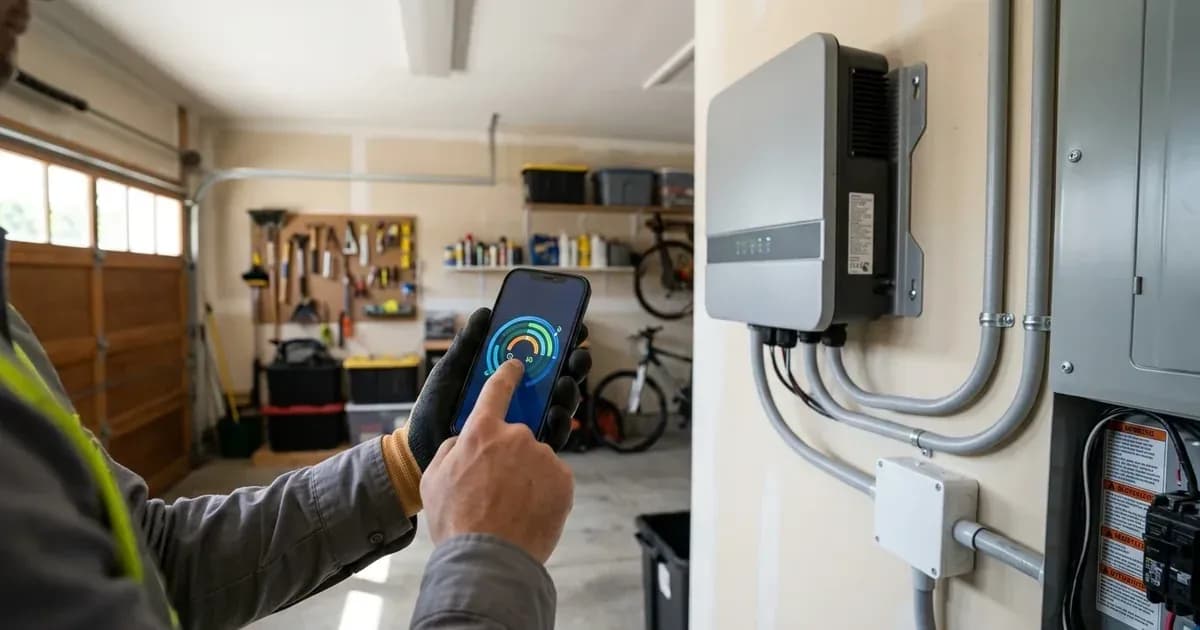
There is no LCD or laptop tool: "Inverter commissioning is possible only with a smartphone using the SetApp mobile application." Internet is needed once, to register SetApp; afterwards the inverter raises its own Wi-Fi, so the site visit needs no data.
The sequence is fixed — AC breaker on, DC safety switch on, scan the QR code, then hold ON/OFF/P at P for two seconds. Four tasks follow: select the country grid name, pair the power optimizers, configure monitoring communications, add every installed device. Our SetApp commissioning guide and S-Series optimizer guide go deeper.
Get the country wrong and nothing runs: "If these settings are not correct, the inverter will not start production." The Status Summary must then show S_OK next to Server Comm., so open prodssl.solaredge.com on TCP 443 both ways. Backup stays off until enabled under Power Control > Energy Manager > Backup Configuration, and a battery install ends with a Battery Self-Test under Diagnostics.
Reading faults without a phone
The three LEDs are a full field diagnosis: blue means the inverter is reaching the monitoring platform, steady green means production, blinking green means AC present but no production, red means a system error. On the switch, two seconds shows status, five or more starts pairing (about three minutes), over thirty resets the communication board.
Code | Meaning | First action |
|---|---|---|
2x2C (legacy 44) | No Country Selected | Select the grid profile in SetApp |
2x1F / 2x21 | Grid voltage above the country limit | Verify country setting, then measure AC |
2x19 (legacy 25) | Isolation Fault — array not isolated from earth | Inspect DC wiring and moisture ingress |
3x6B | Battery communication error | Check the RS485 and En wires to the battery |
3x6C | Battery internal fault | Escalate with the battery serial |
SolarEdge reports "an error number (in firmware version 3.18xx and before) or a code (in firmware version 3.19xx and later)", so old and new units name the same fault differently.
AC protection, earthing and mounting
- Overcurrent: 28 A up to the SE6000H and 50 A from the SE8000H, never rated above 50 A (80 A from SE8000H).
- Residual current: a certified internal RCD at 30 mA and 300 mA; any external RCD type-A at 100 mA or 300 mA, one per inverter.
- Earthing: "Functional electrical earthing of DC-side negative or positive poles is prohibited" — frames and racking only.
- Cables: PV DC at 6 mm² 1000 V double insulation up to 300 m; battery DC at 6-10 mm² 600 V.
- Clearances: 20 cm above, 10 cm below and each side, 40 cm between stacked units — the derating margin in a Pakistani summer.
- Firmware: a matched set across four processors plus battery and accessory firmware, checked in SetApp's Information screen and pushed remotely one inverter at a time.
What you can check yourself, and what you cannot
System task | Homeowner scope | Accredited installer scope |
|---|---|---|
LED diagnosis | Read blue / green / red from outside | Interpret SetApp codes and act |
Country & Grid | None | Select and change the grid profile |
Optimizer pairing | None | Pair via SetApp or the P switch |
Battery and backup | Observe backup in an outage | Enable backup, self-test, wire RS485 |
Isolation | None | Isolate PV, battery and AC before work |
Opening the main AC breaker does not de-energise a backed-up load panel, so "the inverter must also be turned off, either through the RSD switch or by switching the P/1/0 switch, of the Inverter or the BUI, to the '0' position." Backup needs the BI-EU1P Backup Interface at firmware 4.19 and above (the three-phase BI-EU3P was pending firmware); see our Backup Interface wiring guide. Battery-only backup is capped at 5000 W from one battery and 7500 W from two or three, and any undocumented configuration "voids the warranty."
What the published sources do not tell you
- SolarEdge publishes no Pakistani grid profile. Its EU grid-connection list is entirely European — VDE-AR-N 4105, EN 50549-1, CEI 0-21, G98, RD 1699, C10/11, G100 among them. Confirm with your supplier that a usable profile exists before the unit ships.
- SolarEdge states off-grid behaviour only for North America, whose datasheet says the inverter is "Not designed for standalone applications and requires AC for commissioning" and supports backup only on a 240 V grid. It publishes no EU equivalent.
- SolarEdge publishes no open BAT-10K1P detail: usable capacity, depth of discharge, efficiency, cycle life and temperature limits are absent, and its only published 350-450 Vdc window is in the 2021 Energy Bank guide.
- SolarEdge publishes its error-code reference only as a North American addendum framed on firmware 3.18xx/3.19xx, with no Rest-of-World edition, so firmware-4.x, Home Network and battery codes beyond 3x6B and 3x6C may differ. Its "4.19 and above" minimums date from November 2023.
- SolarEdge publishes the full manual only for North America (240 V split-phase, AWG conductors, NEC rapid shutdown), so its wire-gauge and torque figures do not transfer. Its EU counterpart is a three-page quick guide whose cover prints SEXXXXH-RWMBNBF54 against the datasheet's SEXXXXH-RWBMNBF54, and it publishes no guide for BI-EU1P.
- SolarEdge publishes no Pakistani price, import duty or AEDB/PSQCA status for any of these SKUs.
Related Guides
See the SetApp commissioning architecture guide, the S-Series power optimizer setup guide and the Backup Interface wiring and setup guide.
Still showing the fault? Book a technician
If the steps above did not clear it, tell us the inverter or battery and the exact code. We pass it to a technician who covers your city; visit charges are quoted before they come.
How this pays for the site: the technician or verifier pays SolarNevs a fixed introduction fee. Nobody pays to be recommended, and you are free to use our free guides instead.
Frequently asked questions
Which SolarEdge Home Hub part number should a Pakistani installer buy?
Match on the Europe/Rest-of-World pattern SEXXXXH-RWBMNBF54, which covers eight single-phase SKUs from SE2500H (2.5 kW) to SE10000H (10 kW). The North American -US part numbers are a different product family and should not be substituted (September 2026).
Can a 48 V lithium battery be connected to a SolarEdge Home Hub inverter?
No. SolarEdge's DC-coupled storage runs on a high-voltage bus with a documented charge and discharge window of 350-450 Vdc, and the inverter's supported battery model is the SolarEdge Home Battery 400V. Common 48 V packs cannot be paired with it (September 2026).
Do you need a smartphone to commission a SolarEdge Home Hub inverter?
Yes. SolarEdge states that inverter commissioning is possible only with a smartphone using the SetApp mobile application. Internet access is needed once, to download and register SetApp; after that the inverter provides its own local Wi-Fi to the phone (September 2026).
Why does a newly installed SolarEdge inverter show no production at all?
The most common cause is the Country & Grid setting. SolarEdge states the inverter will not start production if these settings are not correct, and code 2x2C (legacy error 44) is the explicit 'No Country Selected' message telling you to choose a grid profile in SetApp (September 2026).
How much backup power does one SolarEdge Home Battery deliver in an outage?
From the battery alone, 5000 W per single connected battery, rising to a maximum of 7500 W with two or three batteries, and never exceeding the inverter's rated maximum backup power. Backup also requires a separate Backup Interface and must be enabled in SetApp (September 2026).
References
- SolarEdge Home Hub Inverter Single Phase — Datasheet, Europe (DS-000198-EU, Oct 2024) (official SolarEdge PDF, Wayback capture) — accessed 6 September 2026
- SolarEdge Home Hub Inverter Single Phase — Quick Installation Guide, Europe (Rev 1.2, July 2023) (official SolarEdge PDF, Wayback capture) — accessed 6 September 2026
- SolarEdge Home Hub Inverter Single Phase — Installation Guide, North America (Version 1.6, June 2024) (official SolarEdge PDF, Wayback capture) — accessed 6 September 2026
- SolarEdge Home Hub Single Phase Inverter — Supported Use Cases for Storage and Backup Installations (v1.0, Nov 2023) (official SolarEdge PDF, Wayback capture) — accessed 6 September 2026
- SolarEdge SetApp Mobile Application FAQs (Version 2, September 2019) (official SolarEdge PDF, Wayback capture) — accessed 6 September 2026
- Troubleshooting SolarEdge Systems, Addendum (North America) — error codes, MAN-01-00332-1.1 (official SolarEdge PDF, Wayback capture) — accessed 6 September 2026
- SolarEdge Release Notes — Portia Linux 4.13.125, Energy Hub Inverters with Energy Bank (Rev 1.1, Oct 2021) (official SolarEdge PDF, Wayback capture) — accessed 6 September 2026
- SolarEdge Energy Bank Installation Guide (official SolarEdge PDF, Wayback capture) — accessed 6 September 2026
- Single Phase Energy Hub Inverter with Prism Technology — Datasheet, North America (official SolarEdge PDF, Wayback capture) — accessed 6 September 2026
- Remote Inverter Firmware Update in the Monitoring Platform — Application Note (v2.0, Dec 2023) (official SolarEdge PDF, Wayback capture) — accessed 6 September 2026
Related guides
More from inverter errors & fixes.