SolarMax SM-ONYX-UL-10KW 10kW Single-Phase Hybrid Inverter
Rs 440,000 verified 2 Aug 2026 — prices in Pakistan move weekly
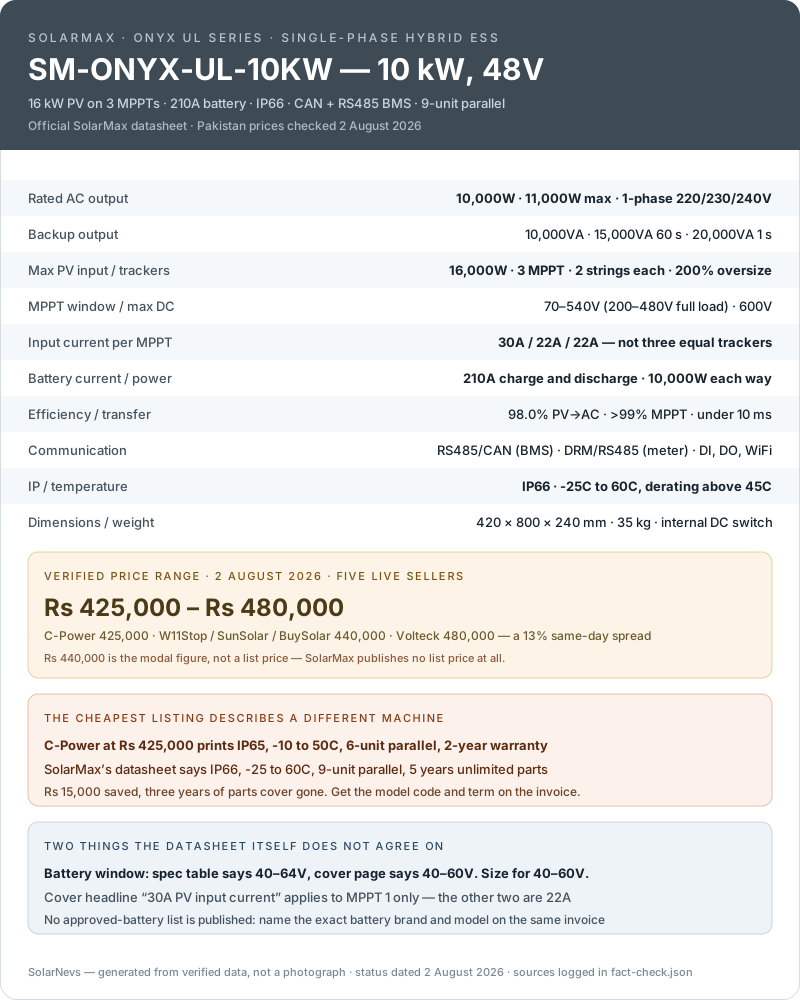
Specifications
| type | Hybrid energy-storage inverter (grid, PV, battery, generator, AC-coupled input) |
|---|---|
| ratedOutputPower | 10,000W (11,000W maximum, 11,000VA apparent) |
| phases | Single phase, 220V / 230V / 240V, 50/60 Hz |
| backupPower | 10,000VA nominal; 15,000VA for 60 s; 20,000VA for 1 s; 230V |
| maxPvInputPower | 16,000W (up to 200% oversizing on 3 MPPTs) |
| mpptTrackers | 3 (2 strings per MPPT) |
| mpptRange | 70-540V; 200-480V at full load |
| maxDcVoltage | 600V |
| maxInputCurrentPerMppt | 30A / 22A / 22A (short circuit 40A / 30A / 30A) |
| batteryVoltage | 48V nominal, 40-64V range (the datasheet cover page says 40-60V - see page) |
| batteryTypes | Lithium-ion and lead-acid; lithium charge curve self-adapts to the BMS |
| maxChargeDischargeCurrent | 210A / 210A |
| maxChargeDischargePower | 10,000W / 10,000W |
| acInputMaxPower | 15,000W (max input current 65.3A, max output current 50A) |
| maxEfficiency | 98.0% PV to AC; >99% MPPT (battery to AC) |
| transferTime | seamless backup transition under 10 ms (cover page claim) |
| thd | 3% resistive, 5% RCD load |
| parallel | up to 9 units |
| bmsCommunication | RS485 / CAN for BMS; DRM / RS485 for meter; DI and 1x DO |
| monitoring | Bluetooth + app + LED + LCD; Wi-Fi module supplied in the box; LAN optional |
| ipRating | IP66 |
| operatingTemperature | -25C to 60C, derating above 45C |
| noise | 45 dB |
| altitude | up to 4,000 m |
| topology | Transformerless PV-to-grid; transformer battery-to-grid |
| protection | Anti-islanding, AC overcurrent, AC short circuit, AC overvoltage, insulation detection, GFCI, GEN; SPD DC Type 2 / AC Type 2 |
| dimensions | 420 x 800 x 240 mm (W x H x D) |
| weight | 35 kg |
| dcSwitch | internal |
| compliance | IEC 62109-1, IEC 62109-2, IEC 61683, IEC 62116, IEC 61727; EN 61000; OVC DC II / AC III |
| warranty | 5 years unlimited inverter parts + lifetime free service (official datasheet) |
| Warranty | The official SM-ONYX-UL-10KW datasheet prints "5 YEARS unlimited inverter parts warranty" plus "Lifetime Free Service Warranty (Terms and Conditions Apply)" - but the terms and conditions are not published anywhere, and no warranty policy document is downloadable from solarmax.pk. A SolarMax blog post of 2 November 2025 describes what the service warranty covers, but it states no exclusions, no claim procedure and no voiding conditions - it is marketing copy, not terms. Retailers vary the cover - SunSolar's listing title carries "(5Y)", while c-power.pk sells the same model under its own 2-year replacement warranty. Get the model code, the parts term in years, and the workshop that honours it written on the invoice. |
| Monitoring app | SolarMax Onyx (Google Play, developer POWER HIGHWAY, Lahore; updated 14 July 2026) |
The SM-ONYX-UL-10KW is SolarMax's flagship single-phase hybrid and the only machine in the range that is not an Axpert-family design: IP66, three MPPTs, 16kW of PV input, 210A of battery current, nine units in parallel, and a real BMS handshake over CAN or RS485. It sells in Pakistan for Rs 425,000-480,000 as of 2 August 2026 - five live sellers, with three of them (W11Stop, SunSolar, BuySolar) at Rs 440,000, c-power.pk cheapest at Rs 425,000 and Volteck highest at Rs 480,000.
Two things to fix before you shop. It is single-phase, whatever a price-comparison page tells you - SolarMax's own datasheet says "220V/230V/240V (Single Phase)", and the three-phase ONYX models start at 12kW. And the cheapest listing is also the least accurate one: c-power.pk's page prints IP65, -10 to 50C and 6-unit parallel against the datasheet's IP66, -25 to 60C and 9-unit parallel, and sells the unit under c-power's own 2-year replacement warranty rather than the 5-year parts term printed on SolarMax's datasheet. Rs 15,000 saved, three years of parts cover gone.
Specifications
Spec | Value |
|---|---|
Rated AC output | 10,000W (11,000W max, 11,000VA), single phase 220/230/240V, 50/60 Hz |
Backup output | 10,000VA nominal; 15,000VA for 60 s; 20,000VA for 1 s; THD 3% (R), 5% (RCD) |
Max PV input | 16,000W - up to 200% oversizing on 3 MPPTs |
MPPT trackers / strings | 3 trackers, 2 strings each |
MPPT window | 70-540V (200-480V at full load); 600V max DC |
Max input current per MPPT | 30A / 22A / 22A (short circuit 40A / 30A / 30A) |
Battery | 48V nominal; range 40-64V per spec table, 40-60V per cover page (conflict) |
Battery current / power | 210A charge and discharge; 10,000W each way |
Battery types | Lithium-ion and lead-acid; lithium curve self-adapts to BMS |
AC input | 15,000W max; max input current 65.3A, max output current 50A |
Efficiency | 98.0% max PV to AC; >99% MPPT (battery to AC) |
Transfer time | under 10 ms (cover page) |
Parallel | up to 9 units |
Communication | RS485 / CAN (BMS), DRM / RS485 (meter), DI, 1x DO, Wi-Fi module supplied, LAN optional |
Display | Bluetooth + app + LED + LCD |
Protection / IP | Anti-islanding, AC overcurrent, AC short circuit, AC overvoltage, insulation detection, GFCI, GEN; SPD DC Type 2 / AC Type 2; IP66 |
Operating temperature | -25C to 60C, derating above 45C; altitude to 4,000 m; 45 dB |
Topology | Transformerless PV-to-grid, transformer battery-to-grid |
Dimensions / weight | 420 x 800 x 240 mm / 35 kg; internal DC switch |
Compliance (claimed) | IEC 62109-1/-2, IEC 61683, IEC 62116, IEC 61727, EN 61000; OVC DC II / AC III |
Warranty (datasheet) | 5 years unlimited parts + lifetime free service |
The 210A battery figure is the one that separates this from the rest of the SolarMax range: at 48V that is the full 10kW drawn from the pack alone, so the inverter is not the bottleneck in a lithium-backed whole-house backup. Your battery bank has to be able to deliver it, which most single 5kWh modules cannot.
Honest assessment
Pros. This is a modern ESS-class inverter at a Pakistani-brand price. Three MPPTs with 16kW of PV means you can oversize hard and split a roof across three orientations without a second inverter - unusual below Rs 500,000 here. IP66 and a -25 to 60C envelope are genuine outdoor ratings, not marketing. 210A of charge and discharge, 9-unit parallel, AC-coupling support and generator input cover essentially every residential and small-commercial topology in Pakistan. The BMS talks CAN and RS485 with a self-adapting lithium charge curve, so a lithium bank runs under BMS control rather than on hand-set voltages. And the datasheet is published, free, complete, with named IEC standards - a low bar that most badge brands still fail.
Cons. Nothing about the warranty is enforceable on paper. The datasheet's "5 YEARS" carries a "Terms and Conditions Apply" footnote and those terms are published nowhere; no warranty policy PDF exists on solarmax.pk, and no user manual is downloadable at all - the downloads page states customer care can send you one on request. The datasheet contradicts itself on the battery window (40-64V in the table, 40-60V on the cover). No approved-battery list is published, so "compatible with lithium" is your installer's problem to prove, not the brand's to document. And at Rs 440,000 you are paying Rs 50,000 more than a Solis 10kW single-phase hybrid in the same store, for a brand with no published compatibility list, no verifiable service network and no resale market.
Who should buy. Someone with a big, awkward roof and a real lithium bank who has read this datasheet, is buying from a seller whose listing matches it, and is getting "SM-ONYX-UL-10KW, 5 years parts" written on the invoice. Someone who wants documentation, firmware support and a warranty they can appeal to should buy Solis or Goodwe and pay the difference. Someone who just needs 10kW cheaply should look at Knox's Krypton 13002 at Rs 270,000 and accept a lesser machine honestly.
Pakistan reality check
Check the listing against the datasheet before you check the price. This model is sold under at least four names - SolarMax's own "ONYX UL 10kW", W11Stop's "ONYX-DUAL 10KW PV16000", SunSolar's "Onyx DUAL (PV16000)", c-power's "Onyx 10KW" with the model code written as SM-ONYX-DUAL-10KW. Volteck and SunSolar quote the datasheet correctly (16,000W PV, 3 MPPT, 210A, IP66, 35 kg, 420x800x240 mm, 9 parallel). C-Power does not: IP65, -10C to 50C, six units parallel. Those are Orion Ultra numbers pasted onto an Onyx page. A seller who cannot describe the machine will not be much help when it faults.
The warranty you are actually buying. SolarMax's own datasheet: 5 years unlimited parts, lifetime free service. SunSolar encodes that in its product title - "(5Y)". C-Power sells it with "2 years (Replaced Warranty)" of its own. Both are Rs 425,000-440,000. The difference between those two invoices, three years in, is the entire cost of a power board. Ask which entity is on the hook, and get the answer in ink.
Derating is the specification Pakistan actually cares about. The datasheet's temperature line reads "-25C-60C (>45C Derating)". Ambient inside a closed utility room in Multan or Jacobabad in June clears 45C easily, and this is a 35 kg sealed IP66 box relying on smart cooling. Plan the installation for the derate: shaded, ventilated, wall-mounted at height, not in the same cupboard as the battery bank. IP66 means you may mount it outdoors; it does not mean you should mount it in the sun.
No approved-battery list exists, so make the seller commit. Deye publishes a ~120-pack approved battery list with per-brand setup codes. Pylontech publishes a versioned inverter compatibility list. SolarMax publishes neither. The Onyx UL will self-adapt to a BMS over CAN or RS485, which is the right architecture, but "will it talk to this specific pack" is an open question that you should close in writing with the seller before delivery - naming the battery brand and model on the same invoice as the inverter.
Three MPPTs, but not three equal MPPTs. The cover page headline is "Support high Power Module with 30A PV Input Current". The spec table says 30A / 22A / 22A. If your installer designs three identical high-current strings on the assumption of 30A per tracker, two of them are over-specified against the datasheet. Put the biggest, highest-current string on MPPT 1.
Price context vs rivals (August 2026)
Same store, same day - W11Stop, 2 August 2026:
10kW-class hybrid | Price (2 Aug 2026) |
|---|---|
Knox Krypton 13002 10kW (PV13000) | Rs 270,000 |
Solis 10kW single-phase hybrid (LV) | Rs 390,000 |
SolarMax ONYX UL 10kW (PV16000) | Rs 440,000 |
Inverex Nitrox 10kW | Rs 475,000 |
SolaX 10kW three-phase IP65 | Rs 575,000 |
Solis 12kW single-phase hybrid (LV) | Rs 480,000 |
The Onyx UL sits in the middle of a shelf where its paper spec is arguably the best under Rs 475,000 - and where its documentation is the worst. Note the last row: Rs 40,000 more than the Onyx buys a Solis 12kW, 20% more inverter from a manufacturer with a published compatibility list and a global service structure. That is the trade this page exists to make explicit. For the cheaper Axpert-class alternative inside the same brand, see the ORION ULTRA 11kW at Rs 245,000-345,000, and the brand hub for who SolarMax actually is.
Frequently asked questions
What does the SolarMax Onyx UL 10kW cost in Pakistan?
Rs 425,000-480,000, verified across five live Pakistani sellers on 2 August 2026. Rs 440,000 is the figure three of them show (W11Stop, SunSolar, BuySolar); c-power.pk is cheapest at Rs 425,000 and Volteck highest at Rs 480,000. That is a 13% spread on one model on one day, and SolarMax publishes no list price to anchor against - quote all three before paying.
Is the SolarMax Onyx 10kW single-phase or three-phase?
Single-phase. The official SM-ONYX-UL-10KW datasheet states "Nominal Voltage 220V/230V/240V (Single Phase)". SolarMax's three-phase machines start at the ONYX UL 12kW - and we could not find a single live Pakistani listing for the 12kW, 15kW or 20kW today. Our older SolarMax price guide describes a "10.0kW Hybrid Three Phase"; that is wrong.
How much PV can I put on it?
16,000W maximum PV input across three MPPTs, which SolarMax describes as up to 200% oversizing on a 10kW inverter. Per-MPPT input current is 30A on the first tracker and 22A on the other two (short-circuit 40A/30A/30A), two strings each, with a 70-540V tracking window, 200-480V at full load, and a 600V DC ceiling. The uneven 30A/22A/22A split matters when you lay out strings - the cover page's headline "30A PV Input Current" applies to one tracker only.
What battery does it take?
A 48V nominal pack, lithium-ion or lead-acid, with the lithium charge curve self-adapting to the BMS over RS485 or CAN. Charge and discharge are both rated 210A / 10,000W, so a single 10kW inverter can pull its full rating from one adequately sized lithium bank. Note the datasheet contradicts itself on the window - the spec table says 40V-64V, the cover page says 40-60V. Size for the narrower 40-60V figure and confirm with the seller in writing.
Is it suitable for a Pakistani summer?
Better than most, with caveats. It is rated -25C to 60C, IP66 sealed, and 45 dB - but the datasheet explicitly derates above 45C, so a 10kW nameplate is not 10kW in an unventilated store-room in June. IP66 permits outdoor mounting; direct sun on the casing is still a bad idea. Mount it shaded, ventilated and off the roofline.
How does it compare with a Solis or Inverex 10kW at the same shop?
On W11Stop's shelf on 2 August 2026 the Onyx UL 10kW is Rs 440,000, against Solis 10kW single-phase hybrid at Rs 390,000, Knox Krypton 13002 10kW at Rs 270,000 and Inverex Nitrox 10kW at Rs 475,000. The Onyx has the better paper spec of the three cheaper machines (3 MPPT, 16kW PV, IP66, 210A). What it does not have is a published warranty policy, a documented battery compatibility list, or a service network anyone outside SolarMax can verify.
References
- SolarMax official datasheet - SM-ONYX-UL-10KW (full spec table, 5-year parts warranty) — accessed 2 Aug 2026
- SolarMax Pakistan - product index, ONYX section (10kW is described only as 'Flagship 10 kW hybrid solar inverter for high-demand households' - the site never states its phase; the 12kW, 15kW and 20kW — accessed 2 Aug 2026
- SolarMax Pakistan - downloads (22 datasheets; manuals only on request from customer care) — accessed 2 Aug 2026
- W11Stop - SolarMax category, ONYX-DUAL 10KW PV16000 Rs 440,000 live — accessed 2 Aug 2026
- W11Stop - all solar inverters (Solis/Knox/Inverex/SolaX same-day rival prices) — accessed 2 Aug 2026
- C-Power - SolarMax Onyx 10KW product page, Rs 425,000, In Stock, retailer 2-year replacement warranty, retailer specs conflict with datasheet — accessed 2 Aug 2026
- Volteck - SolarMax Onyx 10kW, Rs 480,000, model code SM-ONYX-UL-10KW, specs match datasheet — accessed 2 Aug 2026
- SunSolar.pk - SolarMax 10kW Onyx DUAL (PV16000) (5Y), Rs 440,000 — accessed 2 Aug 2026
- BuySolar.pk - SolarMax lineup incl. Onyx 10kw Rs 440,000 — accessed 2 Aug 2026
- NEGATIVE CHECK - SolarPanelMarket.pk's SolarMax price page lists no 10kW model at all. Its SolarMax table is seven rows ending at Rs 385,000 (ONYX Ultra 6kw PV9000) and its own FAQ dates the range to — accessed 2 Aug 2026