SolarMax SM-ORION-ULTRA-11KW 11kW Dual-AC Hybrid Inverter
Rs 245,000–345,000 verified 2 Aug 2026 — the spread is real, not an estimate; see the table below for what sits at each end
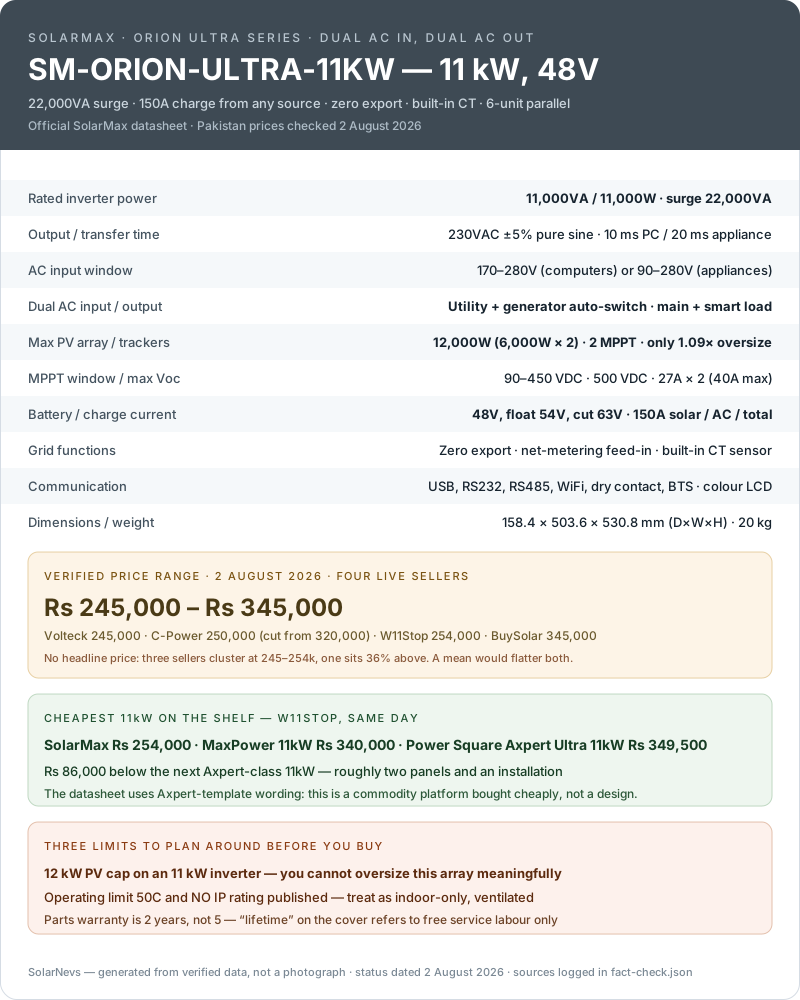
Specifications
| type | Hybrid inverter with dual AC input (utility plus generator, switched automatically) and dual AC output (main load plus smart load) |
|---|---|
| ratedInverterPower | 11,000VA / 11,000W |
| phases | Single phase, 230 VAC output +/- 5% in battery mode |
| surgePower | 22,000VA |
| waveform | Pure sine wave |
| transferTime | 10 ms (computer setting) / 20 ms (home-appliance setting) |
| acInputVoltage | 230 VAC; selectable 170-280 VAC (computers) or 90-280 VAC (home appliances); 50/60 Hz auto-sensing |
| dualAcOutput | 11,000W across main load plus smart load |
| batteryVoltage | 48 VDC; float 54 VDC; overcharge protection 63 VDC |
| worksWithoutBattery | Yes |
| maxPvArrayPower | 12,000W (6,000W x 2) |
| mpptTrackers | 2 |
| mpptRange | 90-450 VDC |
| maxPvOpenCircuitVoltage | 500 VDC |
| maxPvInputCurrent | 27A x 2 (40A maximum) |
| maxSolarChargeCurrent | 150A |
| maxAcChargeCurrent | 150A |
| maxTotalChargeCurrent | 150A |
| parallel | 6 units, single phase and three phase |
| bms | Built into the inverter; RS485 and CAN-BUS ports reserved for battery BMS (retailer-stated) |
| gridFeatures | Zero export built in, net-metering feed-in, built-in CT sensor for self-consumption |
| communication | Built-in USB, RS232, RS485, Wi-Fi, dry contact, BTS; optional GFCI, rapid shutdown, AFCI detection |
| display | Colored LCD with slide operation plus power-status LED lighting |
| humidity | 5-95% RH non-condensing |
| operatingTemperature | -10C to 50C (storage -15C to 60C) |
| ipRating | not published on the datasheet |
| dimensions | 158.4 x 503.6 x 530.8 mm (D x W x H) |
| weight | 20 kg |
| warranty | 2 years unlimited parts replacement + lifetime free service (official datasheet) |
| Warranty | The official Orion Ultra 8KW-11KW datasheet prints "LIFETIME WARRANTY - 2 Years Unlimited Parts Replacement - Life time Free Service Warranty" with a "Terms and conditions apply" asterisk, and those conditions are published nowhere - a SolarMax blog post of 2 November 2025 describes the service warranty in marketing terms but lists no exclusions, no claim procedure and no voiding conditions. This is half the parts term of the SM-ONYX-UL-10KW (5 years) from the same brand - the 2-5 year band on solarmax.pk is a real range, not a rounding. C-Power's product page repeats the 2-year parts figure. No warranty policy document and no user manual are downloadable from solarmax.pk; customer care sends them on request. Get "2 years unlimited parts" and the servicing workshop written on the invoice. |
| Monitoring app | SolarMax Onyx (Google Play, developer POWER HIGHWAY, Lahore; updated 14 July 2026) |
The SM-ORION-ULTRA-11KW is the cheapest 11kW hybrid inverter on any Pakistani shelf we opened today: Rs 245,000-345,000, with three of four live sellers clustered at Rs 245,000 (Volteck), Rs 250,000 (C-Power) and Rs 254,000 (W11Stop) on 2 August 2026. On the same W11Stop shelf, the same day, MaxPower's 11kW is Rs 340,000 and the Power Square Axpert Ultra 11kW is Rs 349,500. That is a Rs 86,000-95,000 gap for a comparable class of machine.
What you get for it is a well-specified Axpert-family hybrid with genuinely useful load management: two AC inputs (utility and generator, switched automatically), two AC outputs (main load and a schedulable smart/heavy load), 22,000VA of surge, 150A of charge current from any source, zero export and a built-in CT for self-consumption. What you do not get is headroom or documentation - PV input caps at 12,000W on an 11kW inverter, the operating range stops at 50C, no IP rating is published, and the parts warranty is two years, not the five printed on the ONYX UL 10kW datasheet from the same brand.
Specifications
Spec | Value |
|---|---|
Rated inverter power | 11,000VA / 11,000W |
Surge power | 22,000VA |
Output waveform / voltage | Pure sine wave; 230 VAC +/- 5% in battery mode |
Transfer time | 10 ms (computer setting) / 20 ms (home-appliance setting) |
AC input | 230 VAC; selectable 170-280 VAC (computers) or 90-280 VAC (home appliances); 50/60 Hz auto-sensing |
Dual AC input | Two independent sources (utility and generator), switched automatically |
Dual AC output | 11,000W across main load plus smart/heavy load |
Battery | 48 VDC; float 54 VDC; overcharge protection 63 VDC; works with or without battery |
Max PV array power | 12,000W (6,000W x 2), 2 MPPTs |
MPPT window / max Voc | 90-450 VDC; 500 VDC maximum open circuit |
Max PV input current | 27A x 2 (40A maximum) |
Charge current | 150A solar, 150A AC, 150A maximum total |
Parallel | 6 units, single phase and three phase |
Grid functions | Zero export built in, net-metering feed-in, built-in CT sensor |
Communication | USB, RS232, RS485, Wi-Fi, dry contact, BTS built in; optional GFCI, rapid shutdown, AFCI |
Display | Colored LCD with slide operation, LED power-status indicators |
Operating temperature | -10C to 50C (storage -15C to 60C); humidity 5-95% RH non-condensing |
IP rating | not published on the datasheet |
Dimensions / weight | 158.4 x 503.6 x 530.8 mm (D x W x H) / 20 kg |
Warranty (datasheet) | 2 years unlimited parts replacement + lifetime free service |
The 150A charge current is the standout number. On a 48V bank that is roughly 7.2kW of charging from solar, from the grid, or from a generator - enough to refill a 10kWh lithium bank inside two hours of a genset run, which is exactly the use case dual AC input exists for.
Honest assessment
Pros. Price. At Rs 250,000 this is the cheapest way to get 11kW of hybrid capacity with automatic generator changeover in Pakistan today, by a wide margin against its direct shelf-mates. The dual-input, dual-output design is not a gimmick here: it is the correct architecture for a market with unreliable grid, common gensets and heavy discretionary loads (AC, pump, motor) that you genuinely want to schedule or shed. 150A of charge from any source, 22,000VA of surge for motor starting, six-unit parallel in single or three phase, zero export and net-metering feed-in built in, and a colour LCD with real settings rather than a two-digit display. At 20 kg it is a one-person wall mount. And the datasheet, unlike much of this market segment, is published, complete and internally consistent.
Cons. The PV ceiling is the design flaw: 12,000W maximum array on an 11kW inverter is 1.09x, where the modern expectation is 1.3-2.0x. You cannot oversize this machine meaningfully, which costs you morning and evening yield in exactly the hours Pakistani households need it. The 50C operating ceiling with no published IP rating makes it an indoor-only unit in a country where indoor frequently means 45C+. The parts warranty is two years - half the Onyx UL's, from the same brand, which tells you what SolarMax itself thinks of the platform's longevity relative to its flagship. And there is no approved-battery list, no user manual and no warranty policy document published anywhere, so every compatibility and claim question has to be settled in writing with the seller before delivery.
Who should buy. A household or small shop with a genset, a real load-shedding problem, heavy motor loads and a modest roof - say 10-12kW of panels - who wants the most inverter per rupee and is buying from a seller who will put the model code and "2 years unlimited parts" on the invoice. Anyone planning to oversize the array, mount outdoors, or keep the machine ten years should look at the ONYX UL 10kW or at Solis instead and pay the difference.
Pakistan reality check
The price cluster is the real price. Three of four sellers at Rs 245,000-254,000 is about as tight as this market gets, and it is a useful anchor precisely because SolarMax publishes no list price at all. BuySolar's Rs 345,000 sits 36% above that cluster - and BuySolar lists the *8kW* Orion Ultra at the same Rs 345,000, which is the signature of a page where the numbers were filled in rather than researched. C-Power's Rs 250,000 is shown as a cut from Rs 320,000, so the "original" price is itself close to BuySolar's. Walk in with three printouts.
Do not oversize the array. 12,000W maximum, 6,000W per MPPT, 27A per string (40A absolute), 90-450V window, 500V maximum open circuit. On 585W N-type modules that is roughly ten panels per tracker and twenty in total, and the 500V Voc ceiling constrains string length harder than the 450V tracking window suggests once cold-morning voltage rise is allowed for. An installer who designs this like a Deye or Solis with 1.5x oversizing will clip you or, worse, exceed Voc on a January morning.
Fifty degrees is a hard number, and there is no IP rating. The ONYX UL publishes IP66 and 60C with derating above 45C. This datasheet publishes 50C and no IP figure at all. Indoors, ventilated, wall-mounted, not in the same sealed cupboard as a lead-acid bank, not on an exterior west wall. If a seller tells you it is outdoor-rated, ask which line of the datasheet says so - there isn't one.
Two years, not five. SolarMax advertises "2-5 Years unlimited parts warranty" on its site, and buyers read that as five. On this model it is two - printed on SolarMax's own cover page next to the word LIFETIME, which refers only to the free service (labour) warranty. C-Power's product page repeats the 2-year figure honestly. Since no warranty policy document is downloadable and no user manual is published either, the invoice is the only enforceable record: model code, parts term, service term, and the named workshop.
It is a platform, not a design. The Axpert-family fingerprints are all over the datasheet - the "170-280 VAC (For Computers) / 90-280 VAC (For Home Appliances)" input selector is Axpert manual wording, and W11Stop sells a directly comparable 11kW one row away branded "Power Square Axpert Ultra 11KW". That is not a reason to avoid it; commodity platforms are why this machine costs Rs 250,000 instead of Rs 400,000. It is a reason to treat the badge as a service promise rather than an engineering one, and to price the service promise accordingly. Our error-code glossary classifies SolarMax as Voltronic/Axpert-style two-digit codes, which fits this line - though it does not fit the ONYX UL, which is a different architecture entirely.
Price context vs rivals (August 2026)
Same store, same day - W11Stop, 2 August 2026:
11kW-class hybrid | Price (2 Aug 2026) |
|---|---|
SolarMax ORION ULTRA 11kW | Rs 254,000 |
Knox Krypton 13002 10kW (PV13000) | Rs 270,000 |
MaxPower 11kW (PV-12000) | Rs 340,000 |
Power Square Axpert Ultra 11kW | Rs 349,500 |
Solis 10kW single-phase hybrid (LV) | Rs 390,000 |
SolarMax ONYX UL 10kW (PV16000) | Rs 440,000 |
Inverex Nitrox 10kW | Rs 475,000 |
The Orion Ultra is the floor of this shelf, and the gap to the next Axpert-class 11kW is Rs 86,000 - roughly the cost of two more solar panels and an installation, which is a real decision rather than a rounding error. What Rs 186,000 more buys you inside the same brand is the ONYX UL 10kW: one kilowatt less rated output, but 16kW of PV across three MPPTs, IP66, 60C, 210A of battery current and five years of parts cover instead of two. See the SolarMax brand hub for who is behind the badge and why the name is not the German one.
Frequently asked questions
What does the SolarMax Orion Ultra 11kW cost in Pakistan?
Rs 245,000-345,000 across four live sellers on 2 August 2026 - but three of the four cluster tightly at Rs 245,000 (Volteck), Rs 250,000 (C-Power, cut from Rs 320,000) and Rs 254,000 (W11Stop). BuySolar's Rs 345,000 is the outlier, and it lists the 8kW Orion Ultra at the identical Rs 345,000, which suggests the number was not researched for either. Budget around Rs 250,000 and treat anything above Rs 260,000 as negotiable.
Is the Orion Ultra 11kW really 11kW?
Yes, and the datasheet is unusually clean about it - 11,000VA / 11,000W rated, 22,000VA surge, and 11,000W available across the two AC outputs. The catch is PV - maximum array power is 12,000W split 6,000W per MPPT, so there is almost no oversizing headroom on an 11kW machine. If you want 200% oversizing, that is the [ONYX UL 10kW](/inverters/solarmax/solarmax-onyx-ul-10kw/) with 16,000W across three trackers.
What is "dual AC input, dual AC output" actually for?
Two independent AC sources - utility on one input, generator on the other - switched automatically, so the inverter can ride through a grid outage onto a genset without manual changeover. Dual output splits your circuits into a main load and a smart (heavy) load, so an air-conditioner or water pump can be scheduled or shed independently by voltage, state of charge, discharge time or a time window. It is the single most useful feature on this machine in a load-shedding market.
Does it support net metering and lithium batteries?
It has zero-export control, net-metering feed-in and a built-in CT sensor for self-consumption, and it runs on a 48V bank - flooded, lead-acid or lithium - with 150A of charge current from solar, from AC, or in total. C-Power's listing states RS485 and CAN-BUS ports are reserved for a battery BMS. SolarMax publishes no approved-battery list, so name the exact battery brand and model on the invoice alongside the inverter.
How hot can it run?
The datasheet stops at 50C operating (storage 60C), and no IP rating is published for this model at all - unlike the ONYX UL's IP66. Treat it as an indoor-only machine, ventilated, off the roofline, away from the battery bank. A closed store-room in a Punjab or Sindh June will exceed 50C.
Is it a SolarMax design?
Nothing suggests it is. The datasheet uses the Axpert-family template down to the wording - "Selectable Voltage Range 170-280 VAC (For Computers) / 90-280 VAC (For Home Appliances)" - and W11Stop sells the same 11kW class on the same shelf as "Power Square Axpert Ultra 11KW" at Rs 349,500 and "MaxPower 11KW PV-12000" at Rs 340,000. Buy it as a competently specified commodity platform at the cheapest price on the shelf, which is exactly what it is.
References
- SolarMax official datasheet - Orion Ultra 8KW-11KW (full spec table, 2-year parts warranty) — accessed 2 Aug 2026
- SolarMax Pakistan - product index, ORION section: 'ORION ULTRA 8 to 11 kW - High-output hybrid flagship of the ORION platform'. The legacy /shop/inverters/orion-series.html URL redirects here — accessed 2 Aug 2026
- SolarMax Pakistan - downloads (22 datasheets; no user manuals, sent by customer care on request) — accessed 2 Aug 2026
- W11Stop - SolarMax category, SM-ORION-ULTRA-11KW Rs 254,000 and SM-ORION-ULTRA-8KW Rs 234,000 live — accessed 2 Aug 2026
- W11Stop - all solar inverters (MaxPower 11kW Rs 340,000, Power Square Axpert Ultra 11kW Rs 349,500, same day) — accessed 2 Aug 2026
- C-Power - SolarMax Orion Ultra 11KW product page, Rs 250,000 from Rs 320,000, In Stock, 2-year parts + lifetime service — accessed 2 Aug 2026
- Volteck - SolarMax price page, Orion Ultra 11KW from Rs 245,000 — accessed 2 Aug 2026
- BuySolar.pk - SolarMax lineup, Orion 11kw Ultra Rs 345,000 (and Orion 8kw at the same Rs 345,000) — accessed 2 Aug 2026