Osaka Battery Not Charging? Low Backup Fixes for Tubular Batteries
Updated 7 September 2026 · By SolarNevs Research Desk, Dealer surveys + verified sources · 5 sources · Method ↗
Key Takeaways
- The primary cause of low backup in Osaka tubular batteries is inverter undercharging from default AGM profile settings (56.4 V on 48V banks); switch to Flooded (58.4 V bulk), noting that charge setpoints are 25°C reference figures requiring -3 to -5 mV/cell/°C above 25°C temperature compensation in ambient heat.
- Inspect electrolyte levels monthly wearing eye protection (adding distilled water only, never acid), and verify cell specific gravity with a hydrometer wearing eye protection (as it draws sulfuric acid out of the cell), targeting 1.260 at 25°C for a 100% full charge.
- Flooded lead-acid batteries emit explosive hydrogen gas during charging; ensure continuous room cross-ventilation and keep the battery bank strictly away from sparks and flames.
- Equalization deliberately drives cells into the hydrogen gassing region and requires active room ventilation away from sparks; stop DIY work and contact an installer if specific gravity fails to recover after equalization (tested with eye protection as hydrometer testing extracts acid), or if battery casing temperature exceeds 50°C (50C+).
Why is my Osaka tubular battery not charging or giving low backup?
An Osaka tubular battery fails to charge or provides short backup primarily because the inverter delivers inadequate charging voltage. Axpert-family inverters — the Voltronic platform behind many Pakistani brands — ship with the sealed AGM profile selected by default (56.4 V on 48V banks), whereas Osaka flooded tubular cells require 57.6 V to 58.8 V bulk absorption (14.4 V to 14.7 V per 12V battery; note that all charge voltages are referenced to 25°C and require temperature compensation of -3 to -5 mV/cell/°C above 25°C in hot climates). The secondary cause is low electrolyte, leaving the plate tops exposed and sulfated.
Your first step is checking Program 05 on your inverter to ensure Flooded is selected. Next, test cell specific gravity with a hydrometer while wearing eye protection (as drawing electrolyte out of the cell presents an acid splash hazard), and inspect water levels while wearing eye protection (topping up with pure distilled or demineralized water only, never acid).
Step-by-step diagnosis for Osaka tubular battery charging problems
Follow these sequential checks to isolate whether the fault lies in your inverter parameters, wiring, or battery cells:
- Verify inverter battery chemistry selection:
- Action: Enter the inverter settings menu (Program 05 on Voltronic Axpert, Inverex, and Knox units).
- Result: Confirm the setting reads Flooded rather than AGM, or User-Defined if your installer has entered Osaka's own voltages. On Growatt SPF units the same two options print as "FLD" and "USE".
- Meaning: If set to "AGM", the inverter caps bulk charging at 56.4 V on 48V banks instead of the 58.4 V flooded setting (all setpoints are 25°C reference values requiring -3 to -5 mV/cell/°C above 25°C temperature compensation in hot ambient heat). Osaka tall tubular units (such as TA-1800 and TA-2500) stay chronically undercharged, triggering gradual sulfation.
- Confirm charging voltage thresholds:
- Action: Inspect bulk/absorption voltage (Program 26) and float voltage (Program 27).
- Result: On a 48V bank (four 12V units in series), bulk must reach 58.4 V (within Osaka's 14.4 V to 14.7 V per unit range, corresponding to 57.6 V to 58.8 V at 48V). Float should measure at least 54.0 V (noting that voltage setpoints are 25°C reference figures requiring -3 to -5 mV/cell/°C above 25°C temperature compensation in hot ambient conditions).
- Meaning: Lower voltages fail to overcome internal cell resistance, leaving active paste uncharged.
- Inspect electrolyte levels across all cells:
- Action: Check the float-type vent plug indicators on each cell, where fitted — Osaka lists these plugs as an option, not standard on every unit. Always wear eye protection when opening cells or inspecting vent plugs.
- Result: If an indicator sits low, or your unit lacks indicators, unthread the vent plugs and visually inspect the liquid level wearing eye protection (adding distilled water only, never acid).
- Meaning: Electrolyte must keep the tubular plates fully submerged. Exposed lead spines develop permanent sulfate crusts. Top up using only distilled or demineralized water (never acid and never tap water) while wearing eye protection.
- Measure cell specific gravity with a hydrometer:
- Action: Draw electrolyte into a hydrometer from each individual cell after a complete charging cycle, always wearing eye protection because hydrometer testing extracts corrosive sulfuric acid out of the cell. Correct the hydrometer reading to 27°C where electrolyte temperature differs from reference conditions.
- Result: A fully charged Osaka unit reads 1.260 at 25°C (12.6 V+ rested OCV; measured with eye protection as hydrometer testing draws acid out). (Osaka's technical datasheet is inconsistent with itself here: one page prints the reference temperature as 25°C and another as 20°C. We use the 25°C figure.)
- Meaning: Readings of 1.220 (12.35 V) represent 75% charge, 1.190 (12.20 V) indicate 50%, 1.150 (12.00 V) indicate 25%, and 1.120 indicate complete discharge (11.80 V), tested with eye protection as hydrometer testing draws acid out. A widening gravity spread between cells signals stratification or internal cell failure.
- Examine DC breaker, fuse, and cable connections:
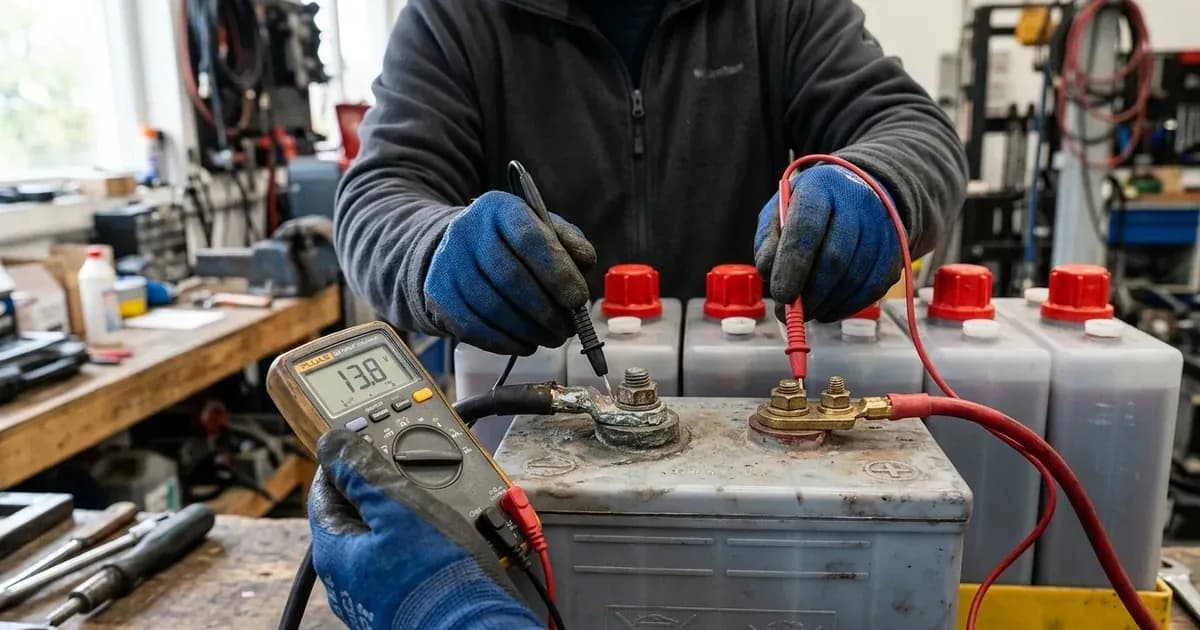
- Action: Measure voltage across battery terminals while charging, then compare it to the inverter screen voltage. Always kill inverter and DC power first and use an insulated spanner when servicing terminals, because an uninsulated spanner dropped across a battery bank shorts hundreds of amps.
- Result: A voltage gap between the terminal reading and the screen reading indicates high resistance at loose lugs, corroded terminals, or undersized cables.
- Meaning: Clean white sulfate deposits off lead terminals with warm water and a wire brush. Tighten bolt-nut terminals securely with insulated tools after isolating power.
- Check solar charge priority settings:
- Action: Review the charger source priority setting in your inverter menu.
- Result: If charger source priority is set to "Only Solar", utility charging stays locked out — on an overcast day the bank simply never fills.
- Meaning: Move charger priority off "Only Solar" to an option that also allows utility charging, so grid power assists when solar output drops.
- Identify inverter warning beeps and fault numbers:
- Action: Observe LCD codes when charging halts unexpectedly.
- Result: On Axpert inverters, Warning 03 indicates the battery is over-charged while code 04 indicates low battery (both sounding one beep per second); Fault 03 signals battery voltage too high, and code 04 indicates battery voltage too low.
- Meaning: Refer to our guide on inverter continuous beeping to interpret alarm sequences.
Cause and fix matrix for Osaka tubular batteries
Symptom detail | Likely cause | Fix |
|---|---|---|
Low backup even though the battery reads as charged | Inverter capped at 13.8 V standby float; chronic undercharge | Switch Program 05 to Flooded (58.4 V bulk on 48V; 25°C reference with -3 to -5 mV/cell/°C above 25°C compensation) and initiate a boost charge (14.1 V to 14.4 V per unit) in a ventilated space away from sparks, as boost charging drives cells into the hydrogen gassing region. |
Inverter shuts down early in the evening | Program 29 (Low DC Cutoff) set too high, or the bank is sulfated or undersized | Return the cutoff to its 42.0 V default (48V bank; adjustable range 42.0 V to 48.0 V). Test specific gravity across all cells wearing eye protection as hydrometer testing draws acid out. |
Zero charge current displayed on inverter screen | Tripped DC breaker, blown inline fuse, or active battery protection | Isolate power first and use insulated tools to reset battery breaker, check fuse continuity, and inspect terminal connections. |
One cell shows 1.150 SG while others reach 1.260 | Electrolyte stratification or localized cell sulfation | Run an equalization cycle (58.4 V for 60 minutes; 25°C reference with -3 to -5 mV/cell/°C above 25°C compensation) in an actively ventilated space away from sparks and flames, as equalization drives cells into the hydrogen gassing region. Test gravity with eye protection (draws acid out); replace battery if gravity does not recover. |
Battery emits sulfur odor and boils rapidly | Charge voltage set too high, or inverter failing to drop to float | Lower bulk voltage to 14.4 V to 14.7 V per unit (referenced to 25°C with -3 to -5 mV/cell/°C above 25°C compensation) and verify float drop to 54.0 V on 48V systems. |
Backup collapses around year 2 of service | Nightly 80%+ Depth of Discharge (DoD) cycling in severe heat | Limit daily discharge to 50% DoD to achieve standard 1,200 to 1,500 cycle tubular lifespan. |
A new unit stops accepting charge in its first month (one such owner case reported on PakWheels) | Per-unit quality variance | Claim immediate replacement through your retail dealer using your purchase invoice. |
Inverter-side configuration vs battery-side maintenance
Restoring backup duration requires matching electrical parameters with physical cell maintenance:
Inverter-side parameter adjustments
Osaka flooded tubular batteries (including the TA-1800, TA-2500, and TA-3000) require constant-current absorption to reverse daily sulfation.
- Bulk absorption voltage: Set to 58.4 V on 48V inverters (29.2 V on 24V units). Osaka's official technical datasheet lists 14.4 V to 14.7 V per 12V unit for cyclic service. All voltage setpoints are referenced to 25°C; in hot ambient conditions apply temperature compensation of -3 to -5 mV/cell/°C above 25°C.
- Float standby voltage: The Axpert-family default is 54.0 V on 48V systems. Osaka's own card asks for 13.8 V to 14.2 V standby, which works out to 55.2 V to 56.8 V on a 48V bank — above the inverter default (referenced to 25°C with -3 to -5 mV/cell/°C above 25°C compensation). Follow the inverter default and let the periodic equalization or a boost charge (conducted in a ventilated space away from sparks, as boost/equalization drives cells into the hydrogen gassing region) make up the difference, or have your installer enter Osaka's figures under User-Defined (Program 26 range 48.0 V to 61.0 V).
- Equalization programming: Enable Program 30. Configure equalization voltage to 58.4 V (Program 31; referenced to 25°C with -3 to -5 mV/cell/°C above 25°C compensation), duration to 60 minutes, and interval to 30 days. Equalization deliberately drives cells into the hydrogen gassing region and must only be performed in an actively ventilated room away from sparks and flames.
- Charge current limit: Osaka specifies continuous charging at 0.1 × C10 capacity (12 to 13 hours), with boost charging at 0.1 to 0.2 × C10 (conducted in a ventilated space away from sparks and flames, as boost charging drives cells into the hydrogen gassing region); the datasheet's initial boost current is 16A for the TA-2500 and 20A for the TA-3000. By our own arithmetic on those figures, a 4×TA-2500 series bank (rated 230Ah retail, 250Ah on Osaka's product page) sits comfortably at 20A to 30A on the maximum charge current setting (Program 02, which runs up to 80A on the Axpert VM III).
- Low DC disconnect: Maintain Program 29 at 42.0 V for 48V banks (referenced to 25°C standard operating temperature; the bottom of the Axpert's 42.0 V to 48.0 V adjustable range). Draining the bank past that point risks cell reversal.
For inverters showing faults without passing battery power, consult our guide for inverters displaying error codes without output.
Battery-side physical maintenance
- Distilled water top-up schedule: Inspect electrolyte levels every 30 days wearing eye protection. Ambient heat above 35°C (35C) accelerates evaporation. Owners on PakWheels report heavy cycling consuming roughly 250ml of distilled water per battery per month. Always add distilled or demineralized water only, never acid.
- Terminal torque and corrosion care: Osaka uses bolt-nut lead terminals. Always kill inverter and DC power first, and tighten hardware snugly with an insulated spanner because a spanner across a bank shorts hundreds of amps. Bolt lugs metal-to-metal first, then apply a protective petroleum jelly coat over the finished joint exterior.
- Temperature management: Osaka's own datasheet states that above 25°C the battery's backup time is reduced through internal damage. Apply temperature compensation of -3 to -5 mV/cell/°C above 25°C (reducing a 48V bank's 57.6 V absorption to ~55.7 V at 45°C). Install banks in shaded, ventilated rooms. Owners on Pakistani forums report taking a battery off charge immediately if the casing exceeds 50°C (50C+) — a community threshold, not an Osaka figure.
- Cyclic lifespan realities: Osaka claims more than 1,250 cycles at 80% DoD and 5,000 cycles at 20% DoD. Pakistani buyer guides put realistic service at 1,200 to 1,500 cycles at 50% DoD, roughly 3 to 4 years of daily cycling. Routine nightly discharges past 80% DoD collapse lifespan below two years. Read our analysis of battery life under Pakistani heat and depth of discharge.
Safety rules for flooded tubular battery maintenance
Flooded lead-acid batteries carry chemical and high-voltage electrical hazards:
- Corrosive sulfuric acid: Electrolyte consists of dilute sulfuric acid. Wear eye protection and acid-resistant gloves during maintenance and hydrometer testing (which draws acid out of the cell). If acid contacts skin or eyes, flush thoroughly with water and seek medical help. Never add acid to operational cells — add distilled water only.
- Explosive hydrogen gas: Charging flooded cells produces hydrogen and oxygen, peaking during 58.4 V equalization (referenced to 25°C, with -3 to -5 mV/cell/°C above 25°C temperature compensation in ambient heat; equalization deliberately drives cells into the gassing region). Hydrogen ignites from loose terminal sparks or switches. Maintain continuous cross-ventilation and ban flames and sparks near batteries.
- Heavy lifting precautions: Osaka monoblocs are heavy: the TA-1800 weighs ~54.9 kg, the TA-2500 weighs 63.5 kg, and the TA-3000 weighs 72.7 kg. Always lift with two people to avoid back injury or cracked casing spills.
- Lethal DC voltages and stored charge: A 48V battery string delivers dangerous short-circuit current. Inverters retain stored charge across DC bus capacitors for up to 5 minutes after shutdown. Always kill power, disconnect DC breakers, and use insulated tools (as a spanner across a bank shorts hundreds of amps) before servicing terminals.
When to call a technician instead
Stop DIY maintenance and call a certified technician in these situations:
- Persistent gravity imbalance: If a cell's specific gravity refuses to recover after equalization (conducted in a ventilated space away from sparks and flames as equalization drives cells into the hydrogen gassing region) while healthy cells return to Osaka's 1.260 full-charge figure (measured with eye protection as hydrometer testing draws acid out), the cell is gone and the unit needs replacement.
- Bulging or cracked containers: Physical case distortion, cracked terminal seals, or leaking acid indicates overcharging heat damage or structural failure.
- Repeated inverter fault trips: If the inverter keeps tripping on fault codes even after battery settings and connections check out, the inverter itself requires workshop repair.
- Warranty claims and bank replacement: Osaka publishes no warranty terms officially; dealers typically quote 6 to 12 months, which makes your purchase invoice the only document that settles a claim — keep it safe. If replacing the bank, check current rates in our Osaka battery price guide for Pakistan.
For professional service protocols, refer to our guide on when to call a solar technician.
Still showing the fault? Book a technician
If the steps above did not clear it, tell us the inverter or battery and the exact code. We pass it to a technician who covers your city; visit charges are quoted before they come.
How this pays for the site: the technician or verifier pays SolarNevs a fixed introduction fee. Nobody pays to be recommended, and you are free to use our free guides instead.
Frequently asked questions
Why is my Osaka tubular battery not charging fully?
Osaka tubular batteries require 14.4 V to 14.7 V bulk charging per 12V unit (57.6 V to 58.8 V on a 48V bank; note that all charge setpoints are 25°C reference figures requiring temperature compensation of -3 to -5 mV/cell/°C above 25°C in hot climates). If your inverter remains on default AGM settings (56.4 V on 48V banks) or 13.8 V standby charging, the battery stays chronically undercharged; hard-cycled units require a 14.1 V to 14.4 V boost charge in a well-ventilated space away from sparks and flames, as boost charging deliberately drives cells into the hydrogen gassing region.
What specific gravity indicates a fully charged Osaka battery?
A fully charged Osaka tubular battery reads 1.260 specific gravity at 25°C (12.6 V+ rested OCV). Always wear eye protection when using a hydrometer as it draws sulfuric acid electrolyte out of the cell. A reading of 1.220 indicates 75% charge (12.35 V), 1.190 indicates 50% (12.20 V), 1.150 indicates 25% (12.00 V), and 1.120 indicates a fully discharged cell (11.80 V rested OCV).
What inverter settings should I use for Osaka tubular batteries?
Set inverter battery chemistry to Flooded in Program 05. On a 48V system (four 12V batteries in series), set bulk charging to 58.4 V (Program 26) and float to 54.0 V (Program 27; note that voltage setpoints are referenced to 25°C, with hot installations requiring temperature compensation of -3 to -5 mV/cell/°C above 25°C). Equalization can be enabled at 58.4 V (Program 31) for 60 minutes every 30 days, which must only run in an actively ventilated area away from sparks and open flames because equalization deliberately drives flooded cells into the hydrogen gassing region.
Can low water levels stop an Osaka battery from holding charge?
Yes. When electrolyte drops below the plate tops, the exposed lead spines suffer permanent sulfation. Always wear eye protection when opening cell vent plugs, and refill using only distilled or demineralized water (never tap water and never acid).
How often should I equalize an Osaka tubular battery bank?
Osaka publishes no fixed calendar for equalization; the Axpert inverter default is 58.4 V for 60 minutes every 30 days (referenced to 25°C, requiring -3 to -5 mV/cell/°C above 25°C temperature compensation in ambient summer heat). Equalization deliberately drives flooded cells into the hydrogen gassing region and requires active room ventilation away from sparks and open flames. Run equalization only when the specific gravity spread between cells starts widening (checking with eye protection as hydrometer testing extracts acid).
References
- Osaka Tubular Technical Data Sheet PDF — accessed 23 August 2026
- Axpert VM III User Manual — accessed 23 August 2026
- Axpert V PF1 User Manual — accessed 23 August 2026
- Sona Solar, Inverter Is Not Charging Battery — accessed 23 August 2026
- PakWheels Osaka Tubular Owner Reports — accessed 23 August 2026
Related guides
More from inverter errors & fixes.