Tubular Battery Water Topping and Specific Gravity Guide
Updated 7 September 2026 · By SolarNevs Research Desk, Dealer surveys + verified sources · 4 sources · Method ↗
Key Takeaways
- Wear eye protection and top up flooded tubular batteries with pure distilled or demineralized water only; never add tap water or raw sulfuric acid.
- Osaka's tubular datasheet puts full-charge specific gravity at 1.260 (25°C) and a flat cell at 1.120; other makers publish 1.240–1.250 at full charge (wear eye protection when drawing electrolyte samples to verify).
- Wear eye protection when using a hydrometer since drawing electrolyte out of the cell exposes you to sulfuric acid. Adjust hydrometer readings for temperature by adding 4 points of specific gravity for every 6°C above the 27°C baseline (or instrument reference), and allow a full charge cycle after topping up with distilled water (never acid) before testing.
- Perform a controlled equalization charge in a well-ventilated space away from sparks and flames when cell specific gravity spread widens, because equalization deliberately drives cells into the explosive hydrogen gassing region.
- Check the float indicators monthly. For heavy cycling, community-reported figures put consumption at roughly 250ml of distilled water (never acid, wearing eye protection) per 12V battery per month — no manufacturer publishes a fixed number.
Why are water topping and specific gravity testing essential for tubular batteries?
Flooded deep-cycle tubular lead-acid batteries (manufactured in Pakistan by Osaka, Phoenix, Exide, AGS, Volta, and Daewoo) rely on a liquid sulfuric acid electrolyte to facilitate chemical energy storage. During daily solar charging and evening discharge cycles, water molecules inside the electrolyte are broken down into hydrogen and oxygen gases through normal electrolysis.
If lost water is not replenished using pure distilled water only (never acid, while wearing eye protection), positive tubular plates are exposed to air, causing rapid plate oxidation, active material shedding, and irreversible capacity destruction. Measuring electrolyte Specific Gravity (SG) with a hydrometer (always wearing eye protection against sulfuric acid splashes) is the one direct physical measurement of chemical State of Charge (SOC) you can take on a flooded battery.
Official Specific Gravity and State of Charge Table
The ladder below comes from the Osaka Tubular Technical Data Sheet — electrolyte specific gravity paired with rested open-circuit voltage for a 12V block. Treat it as the reference for Osaka-class tubulars; other makers set full charge a little lower, at 1.240–1.250:
State of Charge (SOC) | Specific Gravity (at 25°C) | Resting Open Circuit Voltage (12V Block) | Chemical Condition |
|---|---|---|---|
100% Fully Charged | 1.260 | ≥ 12.6 V (12.6 V+) | Full acid concentration, fully active plates |
75% Charged | 1.220 | 12.35 V | Normal cycling range |
50% Charged | 1.190 | 12.20 V | Recommended maximum depth of discharge limit |
25% Charged | 1.150 | 12.00 V | Deeply discharged, prone to early sulfation |
0% Fully Discharged | 1.120 | ≤ 11.80 V (11.8 V) | Acid depleted into plates, immediate recharge mandatory |
Note: Osaka's datasheet prints the gravity reference at both 25°C and 20°C, and hydrometers are commonly calibrated to 27°C — go by what your own instrument states. Always wear eye protection when drawing electrolyte samples. True gravity varies with electrolyte temperature.
Step-by-Step Water Topping Procedure
Follow this sequence when topping up tubular battery banks:
- Inspect Float Level Vent Indicators:
- Examine the visual float indicators built into the cell caps — every tubular family sold here ships with some version of them.
- When a float sinks toward its lower mark, that cell needs water. Read the markings on your own caps rather than assuming a colour code: the PK brands publish no common standard for indicator colours, and they differ between makers and even between production runs.
- Top Up ONLY After Full Charging:
- Crucial Rule: Always add distilled water after the battery has completed charging (unless plates are completely exposed, in which case add just enough distilled water to cover the plates before charging). Always wear eye protection against sulfuric acid.
- Why: Electrolyte expands during charging. Adding water to a discharged battery causes acid to boil over and spill onto the battery casing during absorption charging.
- Use Certified Distilled Water Only:
- Wear eye protection and add clean distilled or demineralized water using a clean plastic funnel.
- Never Add Acid: Acid does not evaporate; only water is lost during electrolysis. Adding acid alters the chemical stoichiometry and destroys the lead grid.
- Never Add Tap Water: Tap water introduces chlorine, iron, and calcium salts, which poison negative sponge lead plates and trigger rapid self-discharge.
- Do Not Overfill:
- Fill each cell until the float indicator reaches the maximum level line. Overfilling causes acid mist to vent through caps, causing severe battery terminal corrosion.
How to Test Specific Gravity with a Hydrometer
Follow these sequential steps to perform accurate hydrometer testing:
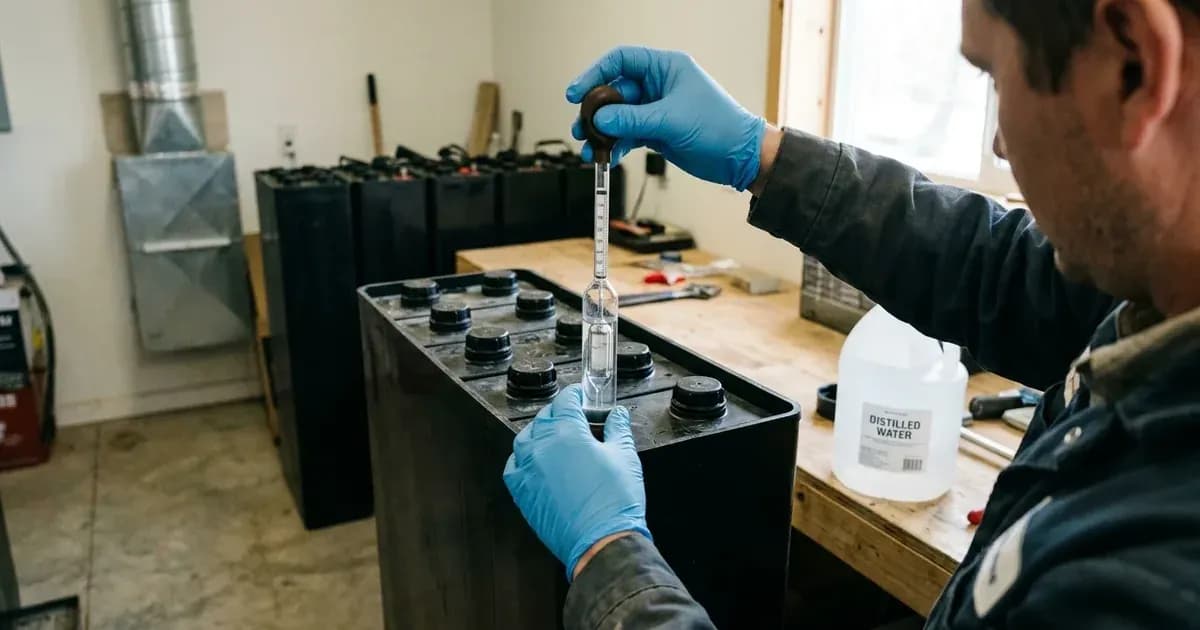
- Wear Protective Equipment: Wear safety goggles (eye protection) and neoprene gloves to protect against sulfuric acid splashes, as hydrometer testing draws liquid electrolyte out of the cell.
- Draw Electrolyte Sample: Insert the hydrometer nozzle vertically into the cell vent. Squeeze and release the rubber bulb to draw enough liquid to freely suspend the internal glass float.
- Read at Eye Level: Hold the hydrometer perfectly vertical and read the scale at the liquid meniscus level. Avoid air bubbles clinging to the float.
- Apply Temperature Correction Math:
- Hydrometers are calibrated to a reference temperature printed on the barrel — usually 27°C, sometimes 25°C or 20°C. Use whichever reference your instrument specifies.
- Correction Rule: For every 6°C above the reference baseline, add 4 points of specific gravity to the reading. For every 6°C below it, subtract 4 points.
- Hydrometer Timing Caveat: Never test specific gravity immediately after adding water. Fresh distilled water (add distilled water only, never acid) floats on top of the acid; allow the battery to complete a charge cycle so the electrolyte mixes before taking readings while wearing eye protection.
- Compare Cell Spread: Repeat across every cell in the bank and write the readings down. What matters is the spread between cells, not any single number: a healthy bank reads consistently cell to cell, and the odd one out is the cell to watch. No PK maker publishes an allowable spread figure, so judge each cell against its own siblings and against last month's readings rather than against a fixed tolerance.
If one or more cells sit clearly below the rest, perform a controlled equalization charge in a well-ventilated space away from sparks and open flames, as equalization deliberately drives the cell into the hydrogen gassing region (as outlined in our guide on deep cycle battery care, DoD, and equalization). Equalization is the documented remedy for exactly this: a gravity spread that ordinary charging no longer closes.
Environmental Factors and Summer Maintenance in Pakistan
Maintaining flooded tubular batteries in extreme Pakistani summer heat requires active oversight:
- Evaporation Acceleration: Heat drives water loss, and Osaka's datasheet separately warns that running above 25°C costs you backup time. Charge setpoints are 25°C figures; hot installations require temperature compensation of -3 to -5 mV per cell per °C above 25°C. Nobody publishes a water-loss multiplier for a hot battery room, so do not work from a formula — keep to the monthly float-indicator check, and if your cells are running low before the month is out, look more often through May to September (adding distilled water only, never acid, and wearing eye protection).
- Depth of Discharge Discipline: Limit daily depth of discharge to 50% (SG ≥1.190) to get the 800–1,200 real cycles a tubular is good for. Compare life cycle expectations in our guide on battery life under Pakistani heat and depth of discharge.
- Pricing Comparison: To evaluate tubular replacement costs across brands, consult our tubular battery price comparison table.
Safety: Working with Flooded Battery Electrolyte
Observe these mandatory safety protocols when maintaining flooded lead-acid batteries:
- Hydrogen Gas Explosion Danger: Flooded batteries emit explosive hydrogen gas during charging and equalization (which deliberately enters the gassing region ~2.4V/cell). Never produce open flames, sparks, or smoke near battery banks. Ensure battery rooms are well-ventilated.
- Sulfuric Acid Handling and Eye Protection: Electrolyte is liquid sulfuric acid. Always wear eye protection when opening cells or drawing samples with a hydrometer, and add distilled water only, never acid. Keep a box of baking soda (sodium bicarbonate) nearby to neutralize acid splashes before rinsing with clean water.
- Eye Wash Immediate Action: If acid contacts eyes, flush immediately and keep flushing with clean running water, then get emergency medical help. Do not stop to finish the job first.
- Terminal Work Safety: When tightening or disconnecting terminals, kill power first and use insulated tools to prevent accidental shorts across battery posts (a spanner across a bank shorts hundreds of amps). Disconnect the negative terminal first.
When to call a technician instead
Contact a certified solar technician or battery service center under the following conditions:
- One or more cells produce zero gravity rise after a controlled equalization charge in a well-ventilated space away from sparks and flames (as equalization deliberately drives cells into the hydrogen gassing region), indicating a shorted or dead cell.
- Electrolyte appears dark brown or black, indicating positive plate mudding and structural breakdown.
- Battery casing exhibits structural bulging or physical cracks (deformation indicates internal pressure at dangerous levels and a fire hazard; isolate and replace).
- Inverter capacitors hold lethal charge up to 5 min after shutdown; PV conductors remain live in daylight — stop DIY and consult our guide on when to call a solar technician.
For professional maintenance standards, consult our guide on when to call a solar technician.
Figures as of August 2026.
Still showing the fault? Book a technician
If the steps above did not clear it, tell us the inverter or battery and the exact code. We pass it to a technician who covers your city; visit charges are quoted before they come.
How this pays for the site: the technician or verifier pays SolarNevs a fixed introduction fee. Nobody pays to be recommended, and you are free to use our free guides instead.
Frequently asked questions
What water should I add to a tubular lead-acid solar battery?
Wear eye protection and add ONLY pure distilled or demineralized water. Never add tap water, mineral water, or acid. Tap water contains dissolved minerals and chlorides that contaminate electrolyte and permanently destroy tubular lead plates.
What is the correct full-charge specific gravity for tubular batteries in Pakistan?
When checking specific gravity with a hydrometer, always wear eye protection against sulfuric acid. Osaka's Tubular Technical Data Sheet gives 1.260 at 25°C as the full-charge figure, and 1.120 for a fully discharged cell (with reference temperature noted at both 25°C and 20°C). Other makers publish slightly lower full-charge values, in the 1.240 to 1.250 band (such as Leader 1.250±0.005 at 27°C), so check the datasheet for your specific brand.
When is the correct time to measure specific gravity with a hydrometer?
Wear eye protection whenever measuring specific gravity because using a hydrometer draws liquid sulfuric acid electrolyte out of the cell. Measure specific gravity only after the battery has completed a full charge and has settled. Never measure gravity immediately after topping up water: fresh distilled water (which must always be distilled water only, never acid) sits on top of the acid until a charge cycle mixes it, so charge first and read afterwards.
How do I correct hydrometer readings for hot summer temperatures in Pakistan?
Always wear eye protection when testing with a hydrometer because drawing electrolyte out of the cell exposes you to sulfuric acid. Hydrometers are commonly calibrated to a reference temperature of 27°C (or 25°C). For every 6°C above the reference baseline, add 4 points of specific gravity to your hydrometer reading (and subtract 4 points for every 6°C below) to determine true temperature-corrected specific gravity. Always complete a charge cycle after adding distilled water (never acid) before testing.
What should I do if one cell has a much lower specific gravity than the others?
If one cell reads clearly lower than its neighbours after a full charge (checked while wearing eye protection), give the bank a controlled equalization charge in a well-ventilated space away from open flames and sparks, as equalization deliberately drives the cell into the hydrogen gassing region. A gravity spread that ordinary charging no longer closes is the documented trigger for equalization, and a cell that still refuses to come up after it is the classic dead-cell signature — that battery is due for service or replacement.
References
- Osaka Tubular Technical Data Sheet — accessed 23 August 2026
- Trojan Battery User's Guide — accessed 23 August 2026
- Voltronic Axpert V PF1 Manual PDF — accessed 23 August 2026
- Battery University Sulfation and Prevention BU-804b — accessed 23 August 2026
Related guides
More from inverter errors & fixes.