Deep Cycle Battery Care: DoD, Equalization, and Float Voltage Guide
Updated 6 September 2026 · By SolarNevs Research Desk, Dealer surveys + verified sources · 8 sources · Method ↗
Key Takeaways
- Plan flooded tubular lead-acid banks around 50% Depth of Discharge (DoD) — the basis of the 800 to 1,200 real cycles they deliver; LiFePO4 is rated for 90% to 95% DoD (Pylontech US-series: 95%) and ≥6,000 cycles, though Pylontech paired with a Growatt SPF must be held to ≤80% DoD.
- For 48V tubular banks, the battery datasheet specifies 57.6 V to 58.8 V (14.4 V to 14.7 V per 12V unit) on cycle charge and float at 54.0 V (Axpert/Growatt default) to 55.0 V (Deye Wet); note that all charge setpoints are 25°C reference values requiring -3 to -5 mV/°C per cell temperature compensation above 25°C in ambient heat.
- Flooded equalization runs every 30 days at the inverter's flooded setting (58.4 V on Axpert, 59.0 V on Deye's Wet profile; referenced to 25°C with -3 to -5 mV/°C per cell temperature compensation in ambient heat); equalization deliberately drives cells into the hydrogen gassing region and requires an actively ventilated space away from sparks and flames.
- Never equalize a lithium (LiFePO4) pack — equalization charging is strictly prohibited on lithium chemistry; applying elevated voltages triggers BMS over-voltage protection rather than cell balancing.
- Apply negative temperature compensation of -3 to -5 mV/°C per cell above 25°C during hot Pakistani summers (derating a 48V bank's 57.6 V target to ~55.7 V at 45°C, with setpoints referenced to 25°C); Deye exposes this as a TEMPCO field defaulting to -5 mV/°C/cell.
- Wear eye protection and inspect electrolyte levels monthly (topping with pure distilled or demineralized water only, never acid); wear eye protection when using a hydrometer since drawing electrolyte out of the cell exposes you to sulfuric acid, targeting 1.260 at 25°C at full charge.
Why is specialized care essential for deep-cycle solar batteries?
Solar energy storage batteries operate under severe cyclical stress: discharging deeply each evening to power domestic appliances during load-shedding and recharging rapidly each morning from solar PV arrays. Unlike automotive starter batteries designed for brief high-current bursts, deep-cycle batteries are engineered to deliver steady energy over extended hours.
Achieving the full multi-year design life of your storage bank requires rigorous operational care: establishing appropriate Depth of Discharge (DoD) boundaries, programming exact multi-stage charging voltages (Bulk, Absorption, Float referenced to 25°C with -3 to -5 mV/°C per cell temperature compensation in heat), executing periodic equalization on flooded units (which deliberately drives cells into the hydrogen gassing region and requires active room ventilation away from sparks and flames), and adjusting voltage targets for seasonal temperature extremes across Pakistan.
In Pakistan, solar installations predominantly utilize two distinct battery families:
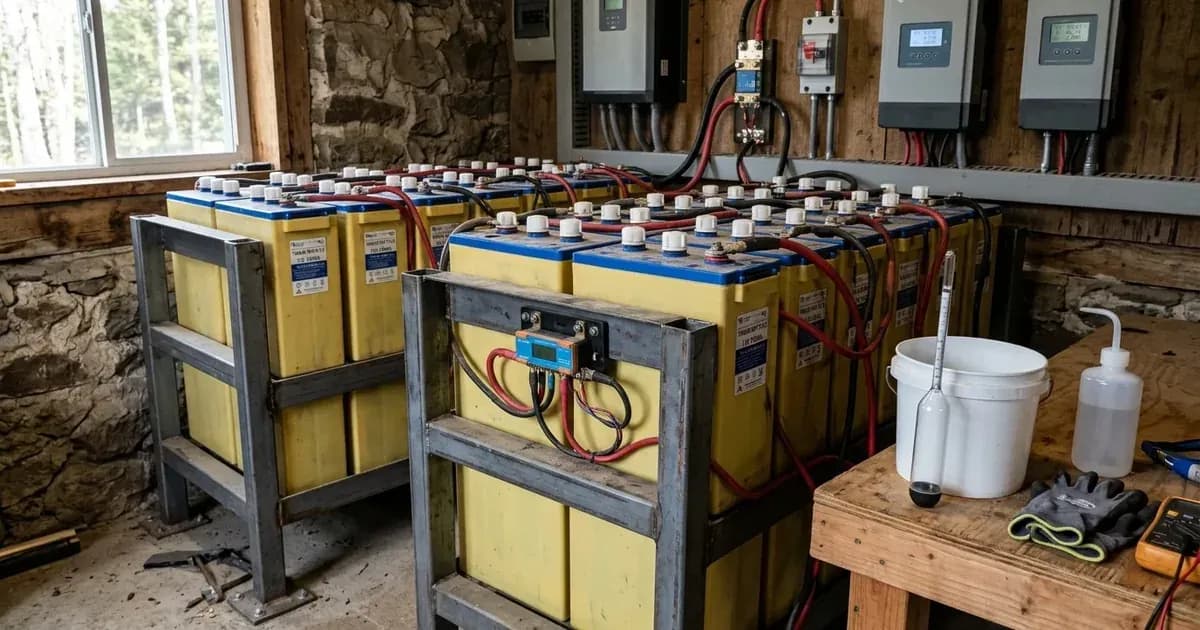
- Family A — Flooded tubular lead-acid: Manufactured locally by Osaka & Volta (Pakistan Accumulators, Hattar), Phoenix, Exide Pakistan, AGS (Atlas Battery), and Daewoo. Built with tubular positive plates, flooded electrolyte, bolt-nut terminals (which require insulated tools and power disconnect when servicing, as short circuits across a battery bank short hundreds of amperes), and float vent indicators, these batteries contain no BMS and no digital communications.
- Family B — LiFePO4 rack/wall modules: Imported lithium units from Pylontech (US3000C 3.55kWh/74Ah, US5000 4.8kWh/100Ah), Dyness, Livoltek, and local-brand-badged modules (such as Inverex IP21 5.1 = 51.2 V/100Ah, Fronus, Maxpower, and Osaka lithium). These 48V-class systems (51.2 V nominal with 16×3.2 V cells, or 15-cell 48V architecture on Pylontech US series) feature integrated BMS protection, CAN/RS485 communications, and 90% to 95% usable DoD.
Comprehensive Chemistry Comparison and Charging Parameters Table
The table below compiles verified charging voltage setpoints, DoD limits, and maintenance parameters across both major solar battery families sold in Pakistan:
Parameter / Charging Stage | Flooded Tubular Lead-Acid (48V Bank) | LiFePO4 Lithium (15-Cell / 48V Nominal) | LiFePO4 Lithium (16-Cell / 51.2 V Nominal) |
|---|---|---|---|
Bulk / Cycle Voltage | 57.6 V – 58.8 V (14.4 V–14.7 V per 12V block; 25°C ref, -3 to -5 mV/°C/cell above 25°C) | Governed by the BMS. Victron caps a 15-cell Pylontech string at 52.4 V | Governed by the BMS |
Float / Standby Voltage | 54.0 V (Axpert/Growatt default) to 55.0 V (Deye Wet; 13.8 V–14.2 V per block card ref; 25°C ref, -3 to -5 mV/°C/cell above 25°C) | Governed by the BMS — no float figure published | Governed by the BMS — no float figure published |
Equalization Voltage | 58.4 V (Axpert) to 59.0 V (Deye Wet), every 30 days (referenced to 25°C with -3 to -5 mV/°C/cell compensation; requires active ventilation away from sparks; drives cells into gassing region) | Off — strictly prohibited on lithium (triggers BMS protection) | Off — strictly prohibited on lithium (triggers BMS protection) |
Recommended Operational DoD | 50% DoD (SG 1.190; rested OCV 12.20 V per 12V unit) | 90% – 95% rated (Pylontech US-series: 95%); ≤80% when paired with a Growatt SPF | 90% – 95% rated, BMS controlled |
Cycle Life | 800 – 1,200 real cycles at 50% DoD | ≥ 6,000 cycles | ≥ 6,000 cycles |
Low DC Cutoff Voltage | Axpert Program 29 default 42.0 V (range 42.0 V–48.0 V; referenced to 25°C) | Governed by BMS — cell UVP is 2.50 V absolute, commonly set 2.8 V–3.0 V (typical values) | Governed by BMS — cell UVP 2.50 V absolute, setpoint 2.8 V–3.0 V (typical values) |
Max Charge Current | 0.1 × C10 (≤10% of Ah rating). Axpert Program 02 sets ceiling up to 80A on VM III (utility 60A) | Locked by the BMS — on Growatt SPF, battery type LI locks current to BMS limit | Locked by the BMS — on Growatt SPF, battery type LI locks current to BMS limit |
Every figure above traces to a manufacturer document: the Osaka Tubular technical data sheet, the Voltronic Axpert VM III and V PF1 manuals, the Growatt SPF 5000 ES manual, the Deye hybrid manual, Pylontech's US5000 datasheet and official compatibility list, and Victron's Pylontech compatibility documentation. All lead-acid charging voltages are referenced to 25°C and require temperature compensation of -3 to -5 mV/°C per cell above 25°C in ambient heat.
Stage-by-Stage Charging Architecture Explained
To properly configure off-grid and hybrid solar inverters, understand the physical role of each charging stage:
1. Bulk Charging Stage
- Action: Inverter supplies maximum allowable charging current while battery voltage rises steadily toward the absorption threshold.
- Tubular Current Rule: Charge current must not exceed 10% of the C10 capacity — 0.1 × C10 (constant-current charging) — to prevent violent gassing and plate overheating.
- Lithium Current Rule: On a lithium pack you do not set this manually. The BMS manages the limit; a Growatt SPF set to battery type LI locks its maximum charge current to whatever the BMS reports.
2. Absorption (Constant Voltage) Stage
- Action: Inverter holds voltage constant at the cycle setpoint (57.6 V–58.8 V for a 48V tubular bank; referenced to 25°C with -3 to -5 mV/°C per cell above 25°C temperature compensation) while current gradually tapers down as the plates saturate.
- Importance: This is the stage that reconverts deep plate lead sulfate, and it is the stage a UPS-style charger skips. A bank parked at a 13.8 V-per-block float (referenced to 25°C with -3 to -5 mV/°C per cell temperature compensation in ambient heat) never finishes the job, which is exactly how a cycled tubular slides into chronic undercharge. On lithium packs, the BMS uses the time near full charge to balance cells against each other. Soft sulfation in lead-acid batteries can be reversed by early controlled charging, whereas hard crystallized sulfation is non-recoverable per Battery University BU-804b.
3. Float (Maintenance) Stage
- Action: Inverter drops voltage to a lower standby level to counteract internal self-discharge without consuming electrolyte. Osaka's datasheet puts 12V tubular float/standby at 13.8 V–14.2 V per block, while inverters ship with lower defaults — Axpert and Growatt SPF both default to 54.0 V, and Deye's Wet profile floats at 55.0 V (all setpoints are 25°C reference values requiring -3 to -5 mV/°C per cell above 25°C compensation in ambient heat).
4. Equalization (Flooded Tubular Only)
- Action: A controlled overcharge applied every 30 days at the inverter's own flooded setting — 58.4 V on an Axpert, held for 60 minutes; Deye's Wet profile equalizes at 59.0 V for 3.0h (referenced to 25°C with -3 to -5 mV/°C per cell above 25°C compensation; this deliberately drives cells into the hydrogen gassing region and requires active room ventilation away from sparks and flames).
- Safety & Purpose: Equalization deliberately drives cells into the hydrogen gassing region (~2.4 V/cell and above) to dissolve soft sulfate crystals and violently bubble electrolyte to eliminate acid stratification (where dense acid settles at the bottom of tall tubular containers). Equalization must strictly be performed in an actively ventilated space away from sparks and flames. Learn more in our battery sulfation and desulfation guide.
Temperature Compensation in Pakistani Climates
Every charge table on this page — and on your battery's label — is written for a 25°C baseline. Battery rooms across Punjab, Sindh, and Khyber Pakhtunkhwa spend the summer well above that temperature:
- The Physics: High temperatures accelerate chemical reaction rates, lowering internal resistance. If charging voltages remain at fixed 25°C baselines, the battery experiences chronic overcharging, boiling electrolyte, and accelerated water loss.
- Compensation Math: Solar inverters should apply negative temperature compensation of -3 to -5 mV/°C per cell above 25°C. On a Deye hybrid this is a field on the unit called TEMPCO, defaulting to -5 mV/°C per cell.
- Worked Example on a 48V Bank at 45°C: Temperature delta is 20°C above baseline. At -3 to -5 mV/cell/°C above 25°C, a 48V bank operating at 45°C sees its 57.6 V cycle target derated to roughly ~55.7 V (with setpoints referenced to 25°C).
- Lithium Temperature Boundaries: LiFePO4 packs operate with a charge temperature window of 0°C to 55°C (0-55°C). Charging below 0°C triggers irreversible lithium plating and permanent damage; the BMS low-temperature charge cutoff is correct protection working.
Understand temperature degradation impacts in our guide on battery life under Pakistani heat and depth of discharge.
Routine Maintenance Schedule for Maximum Lifespan
Follow this structured maintenance schedule:
- Water Inspection (Flooded Only): A monthly look at the float indicator on every cell is the standard practice. Under heavy cycling, community reports indicate consumption of roughly ~250ml per 12V battery per month. Always wear eye protection when opening cells or inspecting vent plugs, and top up with pure distilled or demineralized water only — never tap water and never acid, as detailed in our tubular battery water topping guide.
- Equalization Charge (Flooded Only), Every 30 Days: Run the inverter's flooded equalization routine (58.4 V for 60 minutes on Axpert; 59.0 V for 3.0h on Deye Wet; referenced to 25°C with -3 to -5 mV/°C/cell above 25°C compensation). Equalization deliberately drives cells into the hydrogen gassing region and requires active cross-ventilation away from sparks and flames. Always wear eye protection if verifying specific gravity before or after equalization, as hydrometer testing draws corrosive sulfuric acid out of the cell.
- Terminal Check and Torque: Confirm bolt-nut joints are tight. Always kill inverter and DC power first and use an insulated spanner (as an uninsulated tool dropped across a battery bank shorts hundreds of amps). Trojan specifies 95–105 in-lb (≈11–12 Nm) as a US reference; Pakistani manufacturers publish no torque figure, so tighten securely. For cleaning, disconnect the negative lead first, scrub with a baking-soda solution, rinse, dry, retorque, and apply a thin coat of petroleum jelly or terminal grease over the exterior of the joint after tightening — never inside the contact joint.
- Periodic Full Charge (Lithium): Give the pack one full, uninterrupted charge to tail current so the BMS can reset its 100% state-of-charge reference. Vendor recommendations on calibration frequency range from monthly to quarterly; maintain a consistent cadence.
- Seasonal Inverter Setting Review: Re-check inverter bulk and float voltages at the onset of summer and winter to ensure temperature settings match local room conditions (25°C baseline with -3 to -5 mV/°C/cell compensation above 25°C).
Safety: Handling High-Voltage DC Storage
Observe these mandatory safety protocols during battery maintenance:
- Hydrogen Explosion Hazard: Flooded lead-acid batteries emit explosive hydrogen gas during charging, and equalization deliberately enters the gassing region (~2.4 V/cell and above). Maintain continuous room ventilation and eliminate all spark and flame sources. Electrolyte is dilute sulfuric acid: wear eye protection and protective gloves during maintenance and hydrometer testing (which draws acid out of the cell). Add pure distilled water only — never acid.
- Thermal Cutoff: A battery casing that feels hot to the touch — around 50°C (50°C+) — must come off charge immediately. This community-reported threshold prevents thermal runaway.
- Electrical Isolation & Insulated Tools: Always disconnect the negative lead first when servicing terminals. Use insulated tools, because a spanner across a bank shorts hundreds of amps.
- Inverter Stored Energy: Inverter DC bus capacitors hold a lethal charge for up to 5 minutes after shutdown, and PV conductors remain energized in daylight. This is where DIY stops.
- Heavy Lifting: Tall tubular batteries weigh 55–73kg (55-73kg) and lithium rack modules like the US5000 weigh 39.7 kg. Always perform a two-person lift to prevent physical injury or casing damage.
When to call a technician instead
Contact a certified solar technician or professional installation company under the following conditions:
- Persistent Cell Imbalance: Specific gravity readings fail to rise or a widening cell spread persists despite repeated equalization charging (which deliberately drives cells into the hydrogen gassing region and requires active room ventilation away from sparks and flames; tested with eye protection as hydrometer testing draws sulfuric acid out).
- Swollen or Bulging Battery Casing: A swollen battery case of either chemistry indicates dangerous internal pressure and severe fire hazard; stop charging immediately, isolate the pack, do not puncture or burp a swollen lithium unit, and arrange safe replacement.
- Inverter Firmware Faults: Inverter charging parameters cannot be adjusted due to locked or corrupted firmware.
For professional maintenance standards, consult our guide on when to call a solar technician.
Figures as of August 2026.
Still showing the fault? Book a technician
If the steps above did not clear it, tell us the inverter or battery and the exact code. We pass it to a technician who covers your city; visit charges are quoted before they come.
How this pays for the site: the technician or verifier pays SolarNevs a fixed introduction fee. Nobody pays to be recommended, and you are free to use our free guides instead.
Frequently asked questions
What is the recommended Depth of Discharge for tubular vs lithium batteries?
For flooded tubular lead-acid batteries, plan on 50% Depth of Discharge (DoD) — that is the basis for the 800 to 1,200 real cycles a tubular bank delivers. LiFePO4 packs are rated for 90% to 95% DoD (Pylontech's US-series datasheet prints 95%) and ≥6,000 cycles. Pairing rules can override the rating: Pylontech paired with a Growatt SPF must be held to ≤80% DoD, per Pylontech's official compatibility list.
What are the correct bulk, float, and equalization voltages for tubular batteries?
On a 48V tubular lead-acid bank (four 12V batteries in series), Osaka's technical datasheet specifies bulk/cycle charging at 57.6 V to 58.8 V (14.4 V to 14.7 V per 12V block) and float/standby at 13.8 V to 14.2 V per block, while inverters typically float at 54.0 V (Axpert/Growatt default) or 55.0 V (Deye Wet). All voltage setpoints are 25°C reference values requiring temperature compensation of -3 to -5 mV/°C per cell above 25°C in hot Pakistani summers. Equalization runs every 30 days at your inverter's flooded setting (58.4 V on Axpert, 59.0 V on Deye's Wet profile); equalization deliberately drives cells into the hydrogen gassing region and must only occur in an actively ventilated space strictly away from sparks and open flames.
Why is equalization strictly prohibited on lithium batteries?
Never equalize a lithium pack — equalization charging is strictly prohibited on lithium (LiFePO4) batteries because lithium cells do not tolerate overcharging and have no liquid electrolyte to de-stratify; elevated charging voltages will trigger the BMS over-voltage protection (typical cell OVP is ~3.60 V to 3.65 V) rather than balancing cells. Equalization is exclusively a flooded lead-acid maintenance procedure. Inverters strictly limit equalization settings to Flooded and User-Defined battery modes.
How does high ambient temperature affect solar battery charging voltages?
High temperatures lower internal chemical resistance in lead-acid batteries. To prevent electrolyte boiling and thermal runaway, charging voltages must be derated by -3 to -5 mV/°C per cell above 25°C baseline (reducing a 48V bank's 57.6 V absorption target to ~55.7 V at 45°C, with setpoints referenced to 25°C). Always wear eye protection when inspecting electrolyte levels (adding pure distilled or demineralized water only, never acid), and wear eye protection when using a hydrometer as it draws sulfuric acid electrolyte out of the cell.
How often should flooded tubular batteries be equalized?
Every 30 days is the standard automatic interval configured on Axpert (58.4 V for 60 minutes) and Deye (59.0 V for 3.0h) flooded profiles. Beyond the calendar, perform equalization when a widening specific gravity spread between cells is no longer restored by normal charging. Equalization deliberately drives flooded cells into the hydrogen gassing region and requires active room cross-ventilation away from sparks and open flames. All charging setpoints are referenced to 25°C and require -3 to -5 mV/°C per cell above 25°C temperature compensation during hot summer months. Always wear eye protection when testing cell gravity with a hydrometer as it extracts corrosive sulfuric acid.
References
- Osaka Tubular Technical Data Sheet PDF — accessed 23 August 2026
- Voltronic Axpert VM III User Manual — accessed 23 August 2026
- Voltronic Axpert V PF1 User Manual — accessed 23 August 2026
- Growatt SPF 5000 ES User Manual — accessed 23 August 2026
- Pylontech US5000 Technical Datasheet — accessed 23 August 2026
- Pylontech Compatibility List of Inverters Ver 2.40 — accessed 23 August 2026
- Trojan Battery User's Guide — accessed 23 August 2026
- Battery University Sulfation BU-804b — accessed 23 August 2026
Related guides
More from inverter errors & fixes.