AGS Battery Care and Lifespan: Extend Your Tubular Battery's Life
Updated 6 September 2026 · By SolarNevs Research Desk, Dealer surveys + verified sources · 10 sources · Method ↗
Key Takeaways
- Always wear eye protection when opening cells and top up with distilled water only (never add tap water or acid) to keep plates fully submerged.
- Check specific gravity regularly with a hydrometer wearing eye protection because testing draws corrosive sulfuric acid out of the cell; fully charged tropical tubular cells read 1.210–1.250 ± 0.005 at 27°C.
- Configure inverter battery type to "Flooded" rather than default "AGM" to avoid a standing 2V undercharge on 48V banks (58.4V bulk absorption vs 56.4V at 25°C reference, requiring −3 to −5 mV/cell/°C temperature compensation above 25°C).
- Equalization deliberately drives cells into the hydrogen gassing region and requires an actively ventilated space away from sparks and flames; trigger only when cell-to-cell SG spread exceeds 0.030 after full charge.
How to Maximize Your AGS Tubular Battery's Lifespan
The lifespan of your AGS tubular battery depends heavily on consistent maintenance and correct inverter operating conditions. Deep-cycle AGS models belong to the EC "Energy Core" tall tubular series (type IT500), which use flooded lead-acid chemistry. Unlike maintenance-free or lithium batteries, flooded tubular batteries require active electrolyte care, routine hydrometer measurements, and proper inverter charging parameters to deliver their full service life.
Diagnosis: Checking Your AGS Battery's Health
To monitor your battery bank's condition and detect issues early, carry out these physical and electrical checks routinely.
- Check Electrolyte Level:
- Observation: Remove vent caps wearing protective eye goggles to inspect fluid levels (always add distilled water only, never acid). The electrolyte must cover the internal plates in every cell.
- Meaning: Exposed plates dry out and cannot participate in the chemical reaction, causing permanent capacity loss and damage.
- Action: Always wear eye protection and add distilled water only (never tap water, never acid) until plates are fully covered. Trojan's flooded deep-cycle guidance recommends filling to 1/8" below the fill well after charging. If plates are already exposed before charging, add distilled water immediately to cover them.
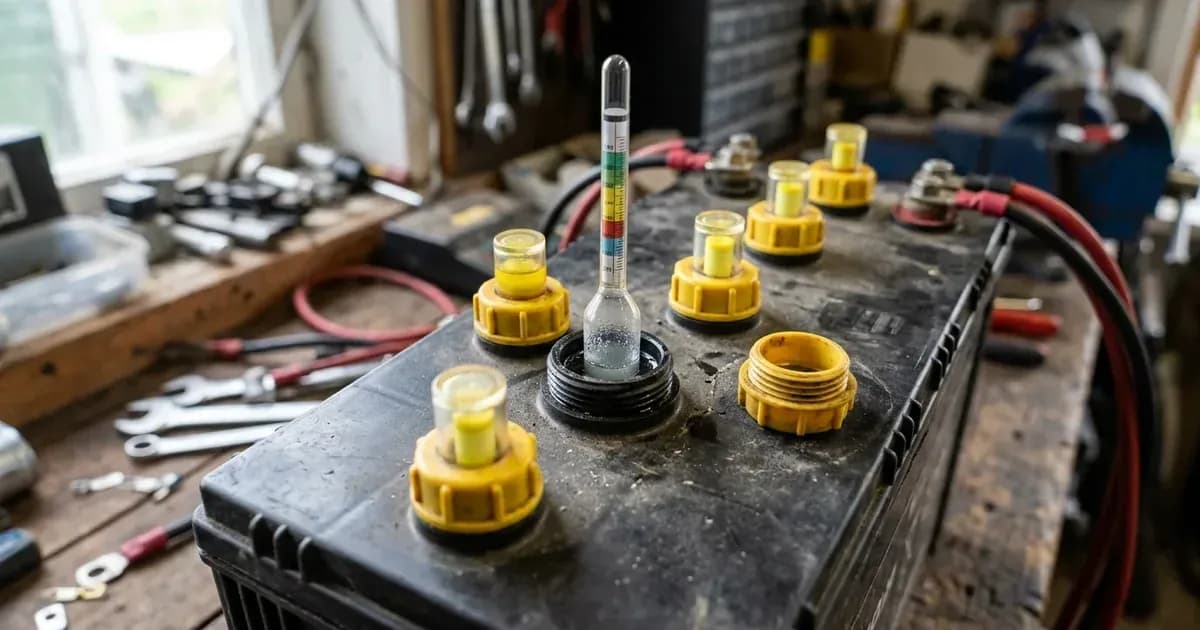
- Measure Specific Gravity (SG) with Eye Protection:
- Observation: Use a hydrometer wearing eye protection to measure the specific gravity of the electrolyte in each cell when the bank is fully charged and rested, as drawing electrolyte pulls corrosive sulfuric acid out of the cell.
- Meaning: A healthy, fully charged tubular cell in subcontinent tropical service reads 1.210–1.250 ± 0.005 at 27°C (~1.240 typical). This benchmark comes from Exide (India) engineering documentation, as Atlas publishes no official SG specification of its own.
- Action: If all cells read low, the bank is chronically undercharged. If a single cell remains persistently lower than the others after charging, that cell is weak. Always wear eye protection and correct hydrometer readings to 27°C, which is Microtex's standard practice for tubular cells. If cell-to-cell SG spread exceeds 0.030 after a full charge, an equalization charge is Trojan's published trigger; conduct equalization only in a well-ventilated space away from sparks and flames because it deliberately drives cells into the hydrogen gassing region.
- Inspect Terminals and Connections:
- Observation: Inspect battery terminal posts and cable lugs for green or white corrosion buildup and loose bolt connections.
- Meaning: Corrosion and loose lugs increase contact resistance, causing voltage drop, charge throttling, and excessive localized heat.
- Action: Kill power first and use an insulated tool to service terminal posts, because a metal spanner dropped across a 48V bank shorts hundreds of amps. Clean terminal corrosion using AGS's official recipe of 1 tablespoon baking soda per cup of water (applied externally only, rinsed, and dried thoroughly). Coat posts with petroleum jelly or grease to inhibit corrosion. AGS guidance recommends connections be clean and snug fitting without forcing; for reference, Trojan flooded deep-cycle specifications cite 95–105 in-lb (11–12 Nm) for standard posts (overtightening risks post breakage, meltdown, or fire).
- Monitor Battery Temperature:
- Observation: Feel battery casings during heavy charging and discharge cycles to detect excessive warming.
- Meaning: High ambient heat accelerates electrolyte evaporation and positive grid corrosion. Operating above 25°C without charge voltage reduction overcharges the cells.
- Action: Ensure ample airflow and room ventilation. Standard charge voltages are referenced to 25°C; in hot ambient conditions, reduce charge voltage by 3–5 mV/cell/°C above 25°C. If using an inverter with a temperature sensor (such as Deye, which exposes a TEMPCO setting defaulting to −5 mV/°C/cell), enable it. On inverters without auto-compensation (like Growatt SPF or Axpert-class units), lower charge voltage manually during summer.
Common Causes of Shortened Lifespan and Their Fixes
The table below details typical failure modes affecting AGS tubular batteries and their direct fixes.
Symptom detail | Likely cause | Fix |
|---|---|---|
Frequent water loss, battery drying out | Overcharging — charge voltage left uncorrected during high summer temperatures, causing continuous gassing on every cycle. AGS's official care page treats frequent water additions as an overcharging warning sign. | Apply temperature compensation: reduce charge voltage by 3–5 mV/cell/°C above 25°C from standard 25°C setpoints. Deye exposes a TEMPCO field (default −5 mV/°C/cell); on Growatt SPF and Axpert-class units, reduce charge voltage manually in summer. Top up wearing eye protection with distilled water only; never add acid. |
Low backup time, battery never reaches full charge | Chronic undercharge caused by inverter left on default AGM mode, or charging current set too low for bank capacity. | Change inverter battery type to "Flooded" (Program 05 on Growatt SPF and Axpert-class units, where default is AGM). Verify bulk/absorption voltage reaches 58.4V on 48V banks (charge setpoints are 25°C reference values, requiring −3 to −5 mV/cell/°C temperature compensation above 25°C in hot installations). Set charging current to 10%–20% of C20 Ah capacity (18–37A for EC-2200 185Ah; 23–46A for EC-3000 230Ah). |
Battery dies after 1–2 years | Habitual deep discharge from low DC cutoff settings, or accidental purchase of flat-plate models (SP-140 / SP-180 / SP-250, GX-200F / GX-260F — not deep-cycle and the wrong buy for daily cycling) or budget SP-Tall units rather than EC deep-cycle models. | Raise low DC cutoff voltage so the bank is not habitually deep-discharged (Growatt Prog 21 default 42.0V, range 40.0–48.0V; Axpert Prog 29 default 42.0V, range 42.0–48.0V). Ensure your bank uses authentic AGS EC "Energy Core" series tall tubular deep-cycle batteries. |
Backup collapses every summer | Absence of thermal voltage derating in hot conditions. | Lower charge voltage by 3–5 mV/cell/°C above 25°C from the standard 25°C setpoints. On a 48V (24-cell) bank at 45°C, this equals a ~1.9V reduction to prevent gassing, rapid water loss, and plate corrosion. |
Warranty claim refused | Electrolyte dry-out resulting from low water level. | Maintain water levels diligently wearing eye protection using distilled water only; never add acid. Electrolyte dry-out is the standard refusal reason across the flooded battery market. |
AGS Tubular Battery Maintenance Schedule
Adhering to a systematic maintenance schedule is vital to achieving maximum operating life from your AGS tubular bank. Atlas Battery provides official maintenance tutorials highlighting these essential practices.
Water Level and Specific Gravity
- Water Type: Always wear eye protection and use distilled water only. AGS officially warns: "Using other water may add undesirable minerals… reducing the life of the battery." Never add acid.
- Electrolyte Level: Keep plates fully submerged, wearing eye protection when inspecting or filling cells. Trojan recommends filling to 1/8" below the fill well. Add distilled water only (never acid) after charging is complete, unless plates are exposed before charge.
- Inspection Frequency: Inspect water levels regularly wearing eye protection, checking more frequently during hot Pakistani summer months when evaporation accelerates. Frequent water consumption indicates excessive charge voltage. Top up with distilled water only, never acid.
- Specific Gravity (SG): Check cell SG with a hydrometer wearing eye protection, as testing draws corrosive sulfuric acid out of the cell. A fully charged battery reads 1.210–1.250 ± 0.005 at 27°C (Exide India subcontinent convention; Atlas publishes no SG spec). Correct all hydrometer readings to 27°C following Microtex tubular practice.
Equalization Charge
- Purpose: An equalization charge is a controlled periodic overcharge that removes lead sulfate crystals from plates and equalizes specific gravities across all series cells. Because equalization deliberately drives the cell into the hydrogen gassing region, conduct it only in an actively ventilated space away from sparks, flames, or open ignition sources.
- Trigger: Perform an equalization charge in an actively ventilated area away from sparks and open flames (equalization deliberately drives cells into the hydrogen gassing region) whenever cell-to-cell SG spread exceeds 0.030 after full charge — Trojan's published flooded deep-cycle trigger.
- Voltage: Equalization deliberately drives cells into the hydrogen gassing region (~2.4 V/cell and above); ensure active room ventilation without sparks or flames. Microtex specifies typical equalization at 2.4 V/cell (14.4V on 12V units, 57.6V on 48V banks). Inverter defaults are 58.4V on Growatt and Axpert-class units, while Deye's recommended "Wet" row uses 59.0V. These voltage setpoints are referenced to 25°C and require temperature compensation of −3 to −5 mV/cell/°C above 25°C in hot ambient conditions.
- Duration: Perform in a ventilated space away from sparks and flames (hydrogen gassing region). Growatt defaults to 60 minutes, while Deye defaults to 3.0 hours. Stop equalization when SG stops rising across successive hourly readings during the gassing stage.
- Interval: Inverter firmware typically sets an automatic equalization interval of every 30 days. Because equalization generates hydrogen gas, verify active room ventilation away from sparks and open flames.
Terminal Care
- Cleaning: Kill power first and use an insulated tool (a dropped spanner across a 48V bank shorts hundreds of amps). Neutralize corrosion with baking soda solution (AGS's recipe: 1 tablespoon per cup of water, applied externally only, rinsed and dried).
- Corrosion Barrier: Kill power first and use an insulated tool to apply petroleum jelly or grease over clean, tight terminal posts and lugs.
- Tightness: Kill power first and use insulated tools to maintain clean and snug-fitting connections without over-tightening. Trojan deep-cycle reference torque is 95–105 in-lb (11–12 Nm) for standard posts; overtightening causes post breakage, meltdown, or fire.
Charging Practices
- Charge Profile: On a 12V basis, absorption is ~14.4V and float is ~13.8V generic defaults (tubular deep-cycle recommended 14.4V). These voltage setpoints are referenced to 25°C; in hot Pakistani conditions, apply negative temperature compensation of −3 to −5 mV/cell/°C above 25°C.
- Max Charge Current: Sizing recommendations sit between 10% of C20 Ah (Suvastika guideline) and 20% of Ah (Deye manual rule for AGM/Flooded). For an AGS EC-2200 (185Ah), set current to 18–37A; for an EC-3000 (230Ah), set current to 23–46A.
- Temperature Compensation: Charge voltage must decrease by 3–5 mV/cell/°C above 25°C (Deye provides a dedicated TEMPCO field, default −5 mV/°C/cell); uncorrected charging in heat causes severe gassing, water loss, and plate corrosion.
Storage
- Environment: Store disconnected batteries in a cool, dry area.
- Maintenance Charge: AGS official guidance specifies storing cool and recharging monthly to combat self-discharge and plate passivation.
For a detailed analysis of climate degradation mechanisms in Pakistan, see our guide on battery life in Pakistan's heat.
Safety: Working with Flooded Lead-Acid Batteries
Flooded lead-acid batteries involve sulfuric acid and explosive gas generation. Strict safety precautions are essential.
- Ventilation: Charging releases hydrogen and oxygen gases, and equalization deliberately gasses the electrolyte. Maintain active room ventilation and eliminate open flames or sparks.
- Electrolyte Protection: Electrolyte is corrosive sulfuric acid (~1.24 SG service strength). Wear protective goggles and gloves. Flush accidental skin or eye contact with water immediately and seek medical attention. Neutralize external acid spills with baking soda solution.
- Insulated Tools: A 48V battery bank delivers hundreds of amps into a dropped metal tool. Use insulated spanners and remove metal rings or watches.
- Heavy Lifting: AGS EC-2200 weighs 55.79 kg filled, and EC-3000 weighs 64.90 kg filled. Always use a two-person lift and transport units upright to prevent acid spillage.
- Never Add Acid: Always wear eye protection and add distilled water only to top up electrolyte; never add sulfuric acid to an in-service battery.
- Inverter Capacitors: Inverter capacitors hold lethal voltage up to 5 minutes after disconnection; wait before servicing DC terminals.
When to Call a Technician Instead
Routine electrolyte topping and gravity checks are straightforward DIY tasks, but certain failure modes require professional technician support.
- Persistent Capacity Loss: If your bank fails to deliver expected backup despite correct "Flooded" inverter settings (58.4V bulk / 54.0V float referenced to 25°C with −3 to −5 mV/cell/°C temperature compensation) and topped electrolyte (distilled water only, never acid, handled with eye protection), individual cells may have suffered internal shorting or irreversible sulfation.
- Physical Case Bulging or Cracking: Physical deformation, cracked containers, or active acid leaks require immediate isolation and professional decommissioning.
- Warranty Evaluation: If you suspect an internal manufacturing fault within the warranty period, consult your authorized dealer. Atlas Battery operates ~250 named dealers across 160+ cities, and warranty claims require presenting your dealer-stamped warranty card and original purchase invoice. Note that electrolyte dry-out from neglected water levels is the standard claim refusal reason across the market. Official AGS warranty terms are not published online. For brand warranty comparisons, see our battery warranty comparison guide.
- End of Operational Life: Tubular batteries eventually reach end of life. Owner-reported life on Pakistani forums is ~3 years maintained, with observed spans between 1 to 4 years. Retailer listings publish a 1250 cycles @ 80% DoD rating, though this is absent from official Atlas pages. When replacement is due, evaluate lifecycle economics using our lithium vs tubular cost-per-cycle guide, and check current pricing in our AGS battery review.
Still showing the fault? Book a technician
If the steps above did not clear it, tell us the inverter or battery and the exact code. We pass it to a technician who covers your city; visit charges are quoted before they come.
How this pays for the site: the technician or verifier pays SolarNevs a fixed introduction fee. Nobody pays to be recommended, and you are free to use our free guides instead.
Products mentioned
Frequently asked questions
What is the expected lifespan of an AGS tubular battery?
Owner reports suggest AGS tubular batteries, when properly maintained, typically last around 3 years, with observed lifespans ranging from 1 to 4 years depending on water, heat, and cutoff settings. Retailers publish a cycle rating of 1250 cycles at 80% Depth of Discharge for these batteries, though Atlas Battery does not publish cycle ratings on its official pages.
What kind of water should I add to my AGS battery?
Always wear safety goggles or eye protection when opening cells or inspecting electrolyte levels to protect against sulfuric acid. You must only add distilled water to your AGS tubular battery; never add tap water and never add acid to an in-service battery. AGS's official maintenance tutorials warn that using other water may add undesirable minerals reducing the life of the battery. Frequent water additions are an overcharging warning sign.
What is the correct specific gravity for a fully charged AGS tubular battery?
Always wear eye protection when using a hydrometer because testing draws corrosive sulfuric acid out of the cell. For tubular batteries in tropical service, fully charged specific gravity is 1.210–1.250 ± 0.005 at 27°C (~1.240 typical). This figure is drawn from Exide (India) engineering documentation as a subcontinent convention, as Atlas Battery publishes no official specific gravity specifications.
How often should I equalize my AGS tubular battery?
Equalization deliberately drives cells into the hydrogen gassing region (~2.4 V/cell and above) and must only be performed in an actively ventilated space away from sparks and open flames. Equalization is triggered when the cell-to-cell specific gravity spread exceeds 0.030 after a full charge, which is Trojan's published benchmark for flooded deep-cycle cells. Solar inverters (such as Growatt and Axpert-class units at 58.4V, or Deye 'Wet' at 59.0V) typically default to an automatic equalization interval of 30 days. Note that charge setpoints are 25°C reference values, requiring temperature compensation of −3 to −5 mV/cell/°C above 25°C in hot ambient conditions.
What causes AGS battery warranty claims to be refused?
Electrolyte dry-out from low water is the standard refusal story across the flooded battery market. Diligent water maintenance wearing eye protection with distilled water only (never acid) protects your battery and warranty standing. Official AGS warranty terms are not published online; the dealer-stamped warranty card and purchase invoice serve as your contract.
References
- Atlas Battery Limited - About Us — accessed 23 August 2026
- Atlas Battery Limited - Battery Maintenance Tutorials — accessed 23 August 2026
- Atlas Battery Limited - EC-2200 Product Page — accessed 23 August 2026
- Growatt SPF 3500/5000 ES User Manual — accessed 23 August 2026
- Voltronic Axpert VM III Manual — accessed 23 August 2026
- Deye SUN-(3.6–6)K-SG03LP1-EU User Manual — accessed 23 August 2026
- Exide Industries - Battery Tips — accessed 23 August 2026
- Trojan Battery - Battery Maintenance — accessed 23 August 2026
- Microtex - Equalizing Charge — accessed 23 August 2026
- PakWheels Forum - Average Life of AGS Battery — accessed 23 August 2026
Related guides
More from inverter errors & fixes.