Osaka Battery Care: Water Levels, Specific Gravity, and Lifespan
Updated 7 September 2026 · By SolarNevs Research Desk, Dealer surveys + verified sources · 3 sources · Method ↗
Key Takeaways
- Check electrolyte levels monthly wearing eye protection; top up with distilled or demineralized water only (never acid) to prevent plate damage.
- Monitor specific gravity with a hydrometer wearing eye protection as testing draws acid out of the cell; 1.260 at 25°C indicates a full charge.
- Equalize only in a well-ventilated space away from sparks and flames because equalization drives cells into the hydrogen gassing region (~2.4 V / cell and above); the 58.4 V setting (48 V bank) is referenced to 25°C and requires temperature compensation (-3 to -5 mV / cell / °C above 25°C) in hot environments.
- Avoid routine deep discharges (80%+ DoD nightly) to prevent sub-2-year bank failure; plan around 50% DoD for 3-4 years service.
How do I maintain my Osaka tubular battery for maximum lifespan?
Maintaining your Osaka tubular battery involves regular checks of its electrolyte levels wearing eye protection (topping up with distilled water only, never acid), specific gravity testing with a hydrometer wearing eye protection (as drawing electrolyte pulls sulfuric acid out of the cell), and periodic equalization in a well-ventilated space away from sparks and flames (since equalization drives cells into the hydrogen gassing region). These steps prevent common issues like sulfation and premature capacity loss, ensuring the battery delivers its expected service life.
Osaka batteries are manufactured by Pakistan Accumulators (Pvt) Ltd (PAL) at Hattar Industrial Estate using flooded lead-acid chemistry with tubular positive plates, polyester gauntlets, and bolt-nut terminals (OPzS 12 V class; when servicing terminals, always kill power first and use insulated tools because an accidental short across a battery bank releases hundreds of amps). If your installation utilizes an Osaka lithium system instead, note that flooded care steps do not apply.
Diagnosis: Checking Your Osaka Battery's Health
To properly maintain your Osaka tubular battery, you need to regularly check its electrolyte and charge status:
- Check Electrolyte Level:
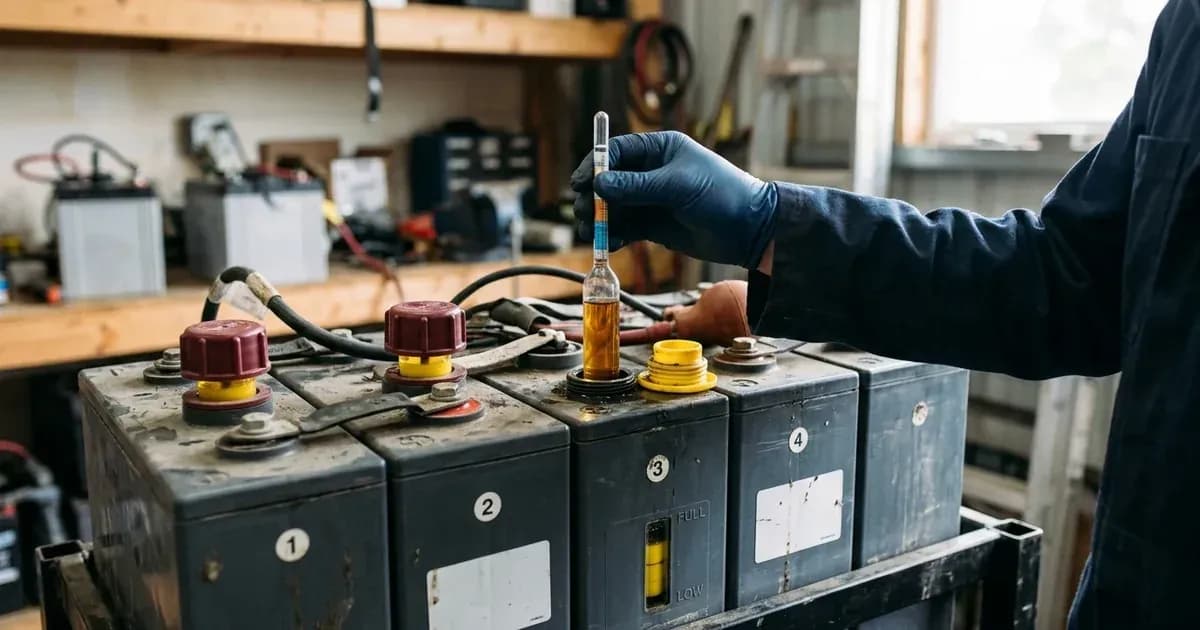
- Method: Open the vent caps wearing eye protection. Look for the float indicators if present, or visually inspect the electrolyte level. It should be above the plates but below the fill line. Under heavy cycling, water consumption is approximately 250 ml per battery monthly (community-reported).
- Meaning: If the level is low, the battery is losing water, usually due to gassing during charging or evaporation. Low electrolyte exposes plates, leading to permanent plate damage. Top up with distilled or demineralized water only—never add tap water and never acid—while wearing eye protection.
- Measure Specific Gravity (SG wearing eye protection against acid splashes):
- Method: Use a hydrometer wearing eye protection, as drawing electrolyte pulls sulfuric acid out of the cell. Read the scale at eye level and record the reading for each cell. Correct readings to 27°C (~4 points per 6°C). Do not measure immediately after watering (adding distilled water only, never acid, wearing eye protection)—allow a full charge cycle first.
- Meaning: Specific gravity indicates the battery's state of charge (SOC) and individual cell health. A fully charged Osaka battery reads 1.260 at 25°C (measured with eye protection against acid splashes). Osaka publishes no individual cell tolerance figure; a reading in one cell noticeably below the others that charging does not restore suggests acid stratification or a failing cell.
- Check Battery Temperature:
- Method: Feel the battery casing or measure surface temperature with an infrared thermometer.
- Meaning: Excessive heat during or after charging indicates overcharging or an internal fault. Stop charging immediately if the battery is hot to touch (50°C+, community-reported threshold). High ambient temperatures (above 35°C) accelerate water loss and self-discharge. Osaka's datasheet notes that operating above 25°C reduces backup time due to internal damage of the battery, and charge voltages referenced to 25°C require temperature compensation of -3 to -5 mV / cell / °C above 25°C.
Osaka Tubular Battery Care Schedule
Proper maintenance is crucial for the longevity of your Osaka tubular battery. Follow these guidelines for water top-ups, specific gravity checks, and equalization:
Maintenance Item | Frequency | Detail |
|---|---|---|
Water Level Check | Monthly | Inspect monthly wearing eye protection via float indicators or visually. Top up with distilled or demineralized water if low (~250 ml / battery / month heavy cycling, community-reported); never add acid. |
Water Type | As needed | Distilled or demineralized water ONLY. Wear eye protection; never use tap water or add acid. |
Specific Gravity (SG) Check | When backup drops, and after equalization (ventilated area, no sparks or flames, hydrogen gassing region) | Always wear eye protection when using a hydrometer (it draws corrosive acid out of the cell). Full charge SG: 1.260 at 25°C (datasheet note: p4 lists 20°C). |
Equalization Charge | When SG spread widens, or after deep discharge | Perform in a well-ventilated space away from sparks and flames (drives cells into hydrogen gassing region ~2.4 V / cell and above). Axpert: 58.4 V for 48 V bank (25°C reference, requiring -3 to -5 mV / cell / °C compensation above 25°C), 60 min default, every 30 days default (range 0-90 days, Flooded/User mode). |
Terminal Inspection | At each water check | Kill power first and use an insulated tool (a spanner across a bank shorts hundreds of amps). Osaka publishes no torque figure; ensure bolt-nut connections are snug with the correct spanner; apply petroleum jelly after tightening, not inside the joint. |
Temperature Monitoring | During charging, especially in summer | Ensure battery room is ventilated. If battery is hot to touch (50°C+, community-reported threshold), take it off charge immediately. |
Specific Gravity (SG) and State of Charge (SOC) for Osaka Batteries
Always wear eye protection when testing specific gravity with a hydrometer because drawing electrolyte pulls corrosive sulfuric acid out of the cell. Osaka's own technical data sheet provides the following correlation between rested open circuit voltage, specific gravity, and battery charge level:
Open Circuit Voltage (12 V) | Specific Gravity (at 25°C) | State of Charge (SOC) |
|---|---|---|
12.6 V+ | 1.260 | 100% |
12.35 V | 1.220 | 75% |
12.20 V | 1.190 | 50% |
12.00 V | 1.150 | 25% |
11.80 V | 1.120 | Discharged |
Note: The Osaka datasheet has an internal inconsistency regarding the reference temperature for SG, listing both 25°C on p2 and 20°C on p4. We use 25°C as the primary reference.
Equalization Charge for Osaka Tubular Batteries
Equalization is a controlled overcharge that helps balance cell voltages and break down sulfate crystals that form on the plates. Because equalization deliberately drives the cell into the hydrogen gassing region (~2.4 V / cell and above), always conduct it in a well-ventilated space away from open flames, sparks, and smoking.
- When to Equalize (conducted in a well-ventilated space away from sparks and flames, as equalization drives cells into the hydrogen gassing region):
- When specific gravity readings between cells start to widen (tested wearing eye protection as hydrometer testing draws sulfuric acid out).
- When regular charging no longer restores specific gravity to the full-charge value (1.260 at 25°C, tested with eye protection against acid splashes).
- After deep discharge or extended periods where the battery has been operating at partial state of charge ("no calendar — the logbook decides").
- As a preventative measure, Axpert-family inverters allow scheduled equalization; the interval defaults to 30 days (range 0-90 days), which must only run in an actively ventilated space away from sparks and flames because equalization deliberately drives cells into the hydrogen gassing region (~2.4 V / cell and above).
- How to Equalize (conducted in a well-ventilated space away from sparks and flames, as equalization drives cells into the hydrogen gassing region):
- Ensure your inverter is set to "Flooded" or "User-Defined" (Program 05).
- On the Axpert family, equalization voltage for a 48 V bank is 58.4 V (29.2 V on 24 V), held for 60 min default, with the interval defaulting to 30 days (range 0-90 days). This 58.4 V setpoint is referenced to 25°C; in hot environments, apply temperature compensation of -3 to -5 mV / cell / °C above 25°C. Osaka's 12 V cycle use charge voltage is 14.4-14.7 V (referenced to 25°C with -3 to -5 mV / cell / °C above 25°C compensation, corresponding to 57.6-58.8 V on a 48 V bank, inside which Axpert's 58.4 V flooded setting sits). Standby float is 13.8-14.2 V (55.2-56.8 V on 48 V, above Axpert 54.0 V float; referenced to 25°C with -3 to -5 mV / cell / °C compensation). Osaka initial boost current is 12 A on TA1800, 16 A on TA2500, and 20 A on TA3000 (0.1-0.2×C10, conducted in a well-ventilated space away from sparks and flames as boost charging drives cells into the hydrogen gassing region).
- Ensure proper ventilation during equalization, as hydrogen gas evolves and deliberately drives the cell into the gassing region (~2.4 V / cell and above: microtex.com/equalizing-charge/). Keep all sparks and flames away.
For detailed inverter settings, refer to our guide on Osaka Battery Inverter Settings and Pairing.
Lifespan of Osaka Tubular Batteries
The lifespan of your Osaka tubular battery depends heavily on how it is used and maintained:
- Manufacturer Claims: Osaka states its tubular batteries can achieve >1,250 cycles at 80% Depth of Discharge (DoD) and up to 5,000 cycles at 20% DoD.
- Real World Expectations in Pakistan: Local buyer guides commonly cite 1,200-1,500 cycles at 50% DoD. For daily cycling, this translates to approximately 3-4 years of service. When replacement time comes, check current rates in our Osaka battery price in Pakistan guide.
- Factors Affecting Lifespan:
- Depth of Discharge (DoD): Consistently discharging the battery deeply (80%+ DoD nightly) sulfates the bank and significantly reduces cycle life, leading to documented sub-2-year failure (<2 yrs).
- Temperature: High ambient temperatures (above 35°C) accelerate self-discharge, water loss, and internal degradation. Osaka's datasheet notes that temperatures above 25°C reduce backup time due to internal damage. Charge setpoints require temperature compensation of -3 to -5 mV / cell / °C above 25°C.
- Maintenance: Neglecting monthly distilled water top-ups (wearing eye protection; distilled water only, never acid) or specific gravity checks (wearing eye protection as hydrometer testing draws acid out) leads to sulfation and premature capacity loss.
- Charging Practices: Inverters must be configured for Flooded batteries (58.4 V bulk on 48 V, referenced to 25°C with -3 to -5 mV / cell / °C compensation above 25°C) to avoid chronic undercharge and sulfation.
For a broader understanding of battery longevity in local conditions, see our guide on Battery Life in Pakistan: Heat, DoD, and the 23-Year E-Bike Battery Problem.
Safety: Handling Flooded Lead-Acid Batteries
Working with flooded lead-acid batteries like Osaka tubulars requires strict adherence to safety protocols:
- Electrolyte is Sulfuric Acid: Always wear eye protection (safety glasses or goggles) and gloves when handling batteries, especially when checking water levels or specific gravity (which draws corrosive sulfuric acid out of the cell). If acid contacts skin or eyes, flush immediately with plenty of water and seek medical attention. Add water only, never acid.
- Hydrogen Gas: Batteries produce flammable hydrogen gas during charging, particularly during equalization (~2.4 V / cell and above, which deliberately drives cells into the gassing region). Ensure the battery area is well-ventilated to prevent gas accumulation. Never smoke, use open flames, or create sparks near batteries. Never connect panels directly to batteries without a charge controller (documented explosion on PakWheels).
- Terminal Short Circuit Hazard: Kill power first before touching connections and use insulated tools. Dropping an uninsulated spanner across terminals shorts hundreds of amps instantly, creating severe arc flash hazards. Osaka publishes no torque figure; tighten bolt-nut terminals snug with the correct spanner and apply petroleum jelly over the outside of the joint after tightening.
- Weight Hazard: Osaka tubular batteries are heavy. For example, a TA-1800 (185 Ah, 5 plates/cell) weighs ~54.9 kg (~55-56 kg in retail listings), a TA-2500 (230 Ah retail / 250Ah@20HR official, 7 plates) is 63.5 kg (62-63.5 kg in retail listings), and a TA-3000 (260 Ah @10HR) is 72.7 kg. Always use proper lifting techniques and have at least two people for lifting to prevent injury.
- Overheating: If a battery becomes hot to touch (50°C+, a community-reported threshold), immediately take it off charge. Overheating indicates overcharging or a serious internal fault.
When to call a technician instead
While routine maintenance is straightforward for homeowners, certain situations require professional help:
- Persistent Low Specific Gravity: If, after regular charging and equalization (conducted in a well-ventilated space away from sparks and flames, as equalization deliberately drives cells into the hydrogen gassing region), one or more cells consistently show significantly lower specific gravity readings (tested with eye protection as hydrometer testing draws acid out) that do not recover, the cell is sulfated or dead.
- Physical Damage: Any signs of bulging, cracking, or leakage from the battery case indicate severe internal damage. Do not attempt to charge or use such a battery.
- Rapid Water Consumption: If your battery requires water top-ups (handled wearing eye protection, adding distilled water only, never acid) much more frequently than monthly, it indicates chronic overcharging or an internal short.
- Battery Not Accepting Charge: If your Osaka battery refuses to charge despite correct inverter settings, refer to our guide on Osaka Battery Not Charging: Low Backup Fix for initial troubleshooting.
- Inverter Cutoff Shutdowns: If the inverter shuts down early at night, check if the low DC cutoff (42.0 V default on 48 V, range 42.0 V to 48.0 V; 42-48V) is triggered by an undersized bank or a dead cell.
- Warranty Concerns: If your battery is new and exhibiting problems, contact your dealer. Osaka publishes no warranty terms anywhere official; dealers quote 6-12 months, so your invoice and dealer relationship are key.
Remember that solar inverters contain capacitors that hold lethal charge up to 5 min after shutdown. PV conductors are live in daylight. If you need to work on inverter connections or solar wiring, ensure all power sources are disconnected (kill power first and use insulated tools as a short across terminals shorts hundreds of amps). When in doubt, always consult a qualified solar technician via when to call a solar technician.
Still showing the fault? Book a technician
If the steps above did not clear it, tell us the inverter or battery and the exact code. We pass it to a technician who covers your city; visit charges are quoted before they come.
How this pays for the site: the technician or verifier pays SolarNevs a fixed introduction fee. Nobody pays to be recommended, and you are free to use our free guides instead.
Frequently asked questions
What water should I use for my Osaka tubular battery?
Wear eye protection and use only distilled or demineralized water. Never use tap water and never add acid, as adding acid permanently damages plates and disrupts electrolyte chemistry.
How often should I check the water level in my Osaka battery?
Check the water level monthly wearing eye protection when inspecting cells or opening vent caps. Osaka lists float-type vent plug indicators as an option on its tubular line; if fitted, they allow quick visual inspection. When topping up, add distilled or demineralized water only, never acid.
What is the correct specific gravity for a fully charged Osaka tubular battery?
A fully charged Osaka tubular battery reads 1.260 specific gravity at 25°C per Osaka's published datasheet (which also lists 20°C on another page). Always wear eye protection when using a hydrometer because testing draws sulfuric acid out of the cell, and do not test immediately after adding distilled water (never acid)—allow a full charge cycle first.
How long do Osaka tubular batteries typically last?
Osaka claims over 1,250 cycles at 80% Depth of Discharge (DoD) or 5,000 cycles at 20% DoD. In Pakistan, buyer guides suggest 1,200-1,500 cycles at 50% DoD, which translates to about 3-4 years with daily cycling. Routine deep discharge (80%+ DoD nightly) reduces lifespan to under 2 years. Ambient temperatures above 25°C reduce backup time due to internal damage, and temperatures above 35°C accelerate degradation.
When should I equalize my Osaka tubular battery?
Equalize your battery in a well-ventilated area away from sparks and flames when cell specific gravity spreads widen (tested with eye protection as hydrometer testing draws acid out) or regular charging fails to restore 1.260 at 25°C, as equalization deliberately drives the cell into the hydrogen gassing region (~2.4 V / cell and above). On Axpert-family inverters set to Flooded, equalization defaults to 58.4 V for a 48 V bank (29.2 V on 24 V) for 60 min every 30 days (range 0-90 days); this 58.4 V setpoint is referenced to 25°C and hot installations require temperature compensation (-3 to -5 mV / cell / °C above 25°C).
References
- Osaka Tubular Technical Data Sheet PDF — accessed 23 August 2026
- Axpert VM III User Manual — accessed 23 August 2026
- Axpert V PF1 User Manual — accessed 23 August 2026
Related guides
More from inverter errors & fixes.