Battery Sulfation and Desulfation Guide: Reversible vs Permanent
Updated 7 September 2026 · By SolarNevs Research Desk, Dealer surveys + verified sources · 4 sources · Method ↗
Key Takeaways
- Soft sulfation is an ordinary, fully reversible discharge byproduct; hard crystalline sulfation is permanent degradation caused by prolonged undercharging.
- Battery University's BU-804b reference concludes that pulsing cannot reliably reverse established sulfation, and rates the evidence behind retail desulfators anecdotal and inconclusive; valid desulfation relies on controlled equalization charging, which deliberately drives cells into the explosive hydrogen gassing region and requires an actively ventilated space away from sparks and flames.
- Controlled equalization charging — Axpert's 58.4 V flooded setting on a 48 V bank, Deye's Wet-type 14.7 V per 12 V block (59.0 V) — is the part of "desulfation" that has manufacturer settings behind it (referenced to 25°C, with -3 to -5 mV/cell/°C temperature compensation in ambient heat); equalization deliberately drives cells into the explosive hydrogen gassing region and requires an actively ventilated space strictly away from sparks and open flames.
- Preventing chronic partial state-of-charge operation is far more cost-effective than attempting unproven chemical or electronic revive gadgets; wear eye protection whenever checking cell specific gravity with a hydrometer as it draws corrosive sulfuric acid out of the cell.
What is battery sulfation and why does it destroy solar batteries?
Sulfation is one of the main reasons flooded tubular lead-acid solar batteries (manufactured locally in Pakistan by Osaka, Volta, Phoenix, Exide, AGS, and Daewoo) lose capacity early, and it usually traces back to chronic undercharge — a 13.8 V UPS-style float (referenced to 25°C, requiring -3 to -5 mV/cell/°C temperature compensation in ambient heat) will never fully recharge a tubular battery that is being cycled every night. During normal discharge, active lead sponge (negative plate) and lead dioxide (positive plate) chemically react with sulfuric acid to produce fine lead sulfate (\(PbSO_4\)) and water. When the battery is promptly recharged, this soft lead sulfate easily reconverts into active lead and sulfuric acid.
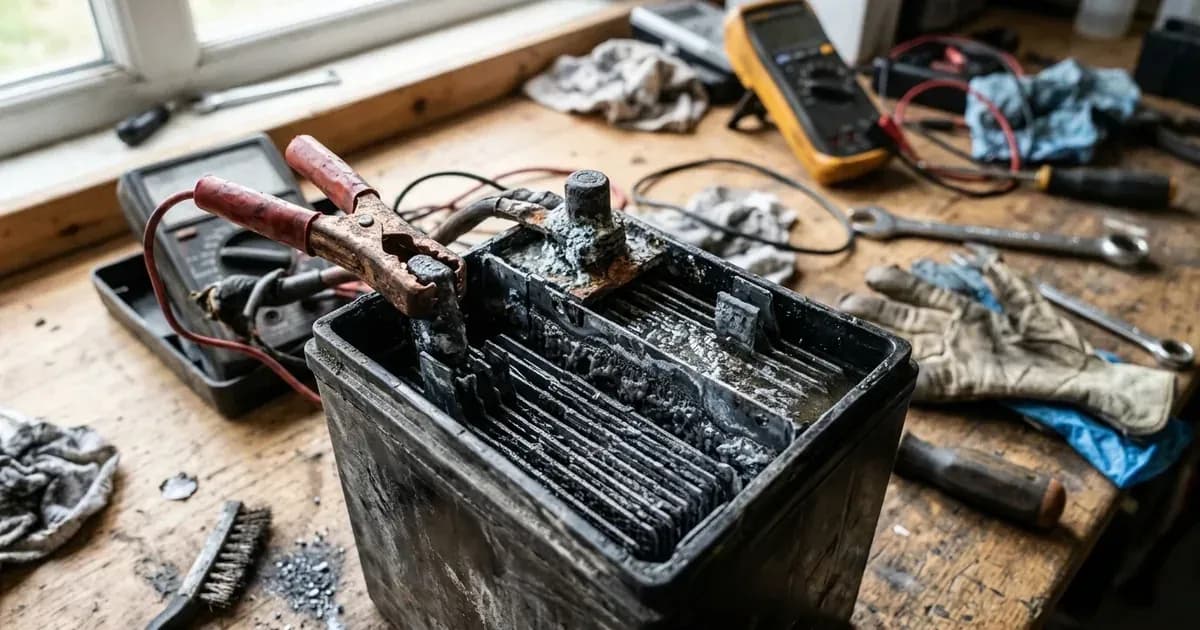
However, if a battery is left in a partially discharged state (common during extended load-shedding or overcast winter days), the amorphous lead sulfate recrystallizes into large, dense, non-conductive crystalline structures. These hardened crystals choke the plate pores, dramatically increase internal resistance, cause voltage to sag prematurely to inverter low-DC cutoffs (such as Axpert's default 42.0 V cutoff on a 48 V basis, settable 42–48 V), and permanently rob the battery of chemical capacity.
Reversible (Soft) vs Permanent (Hard) Sulfation
Distinguishing between the two stages of sulfation is vital for determining whether a battery can be salvaged:
Characteristic | Soft (Reversible) Sulfation | Hard (Permanent) Sulfation |
|---|---|---|
Crystal Structure | Small, fine, amorphous particles | Large, dense, crystallised deposits |
Electrolyte Specific Gravity | Comes back to the maker's full-charge figure after equalization (1.260 at 25°C on Osaka's data sheet; 1.240–1.250 for some other makers; wear eye protection during hydrometer testing as it draws corrosive sulfuric acid out) | Stays stuck around the 1.190 half-charge mark or lower, however long you charge |
Terminal Voltage Behavior | Normal charge curve through the 14.4–14.7 V per-block cycle band (referenced to 25°C, with -3 to -5 mV/cell/°C temperature compensation in ambient heat) | Runs past the 14.4–14.7 V band almost as soon as charging starts (false full), then collapses under load |
Recovery Feasibility | Reversible with a controlled equalization charge (conduct in an actively ventilated area away from sparks and flames as equalization deliberately drives cells into the hydrogen gassing region) | Not recoverable; plan the replacement |
The Truth About Commercial Pulse Desulfator Gadgets
The Pakistani solar market is filled with low-cost "pulse desulfators" (costing Rs 2,500 to Rs 5,000, August 2026) claiming to revive completely dead batteries using high-frequency electrical pulses:
- What BU-804b actually says: Battery University's BU-804b reference is blunt about it. Pulsing may reduce sulfation on a battery that is still healthy, but it cannot reliably reverse sulfation that is already established, and a "one size fits all" pulse pattern is unscientific. The published evidence behind retail desulfators is anecdotal and inconclusive — the success stories you will find are retailer and community perspective, not test data, and we are labelling them as such rather than repeating them.
- Manufacturer position: Most battery manufacturers do not recommend pulsing at all, citing soft shorts and ripple heating inside the cells.
- The Cost Trap: Spending Rs 2,500–5,000 (August 2026) on an electronic revive gadget or an unverified acid additive to rescue a Rs 50,000+ battery is a bet on evidence that does not exist. Prevention and a properly configured equalization charge are the parts of this problem that have manufacturer settings behind them (equalization deliberately drives cells into the hydrogen gassing region and requires an actively ventilated space away from sparks and flames).
Proven Method: How to Dissolve Soft Sulfation via Equalization
To safely remove soft sulfation before it hardens into permanent crystals, execute a controlled equalization cycle:
- Verify Electrolyte Fluid Levels:
- Inspect cell float indicators and ensure plates are fully submerged. If low, top up with distilled water ONLY (never tap water, never acid) wearing eye protection against corrosive sulfuric acid splashes as detailed in our tubular battery water topping guide.
- Fully Charge the Battery First:
- Bring the battery bank to 100% state of charge using normal bulk and absorption stages (14.4 V–14.7 V per 12 V block; 57.6 V–58.8 V on 48 V banks, referenced to 25°C with -3 to -5 mV/cell/°C temperature compensation in ambient heat). Equalization should never be applied to a depleted battery.
- Initiate Inverter Equalization Mode:
- Open the equalization settings in your inverter's battery menu. Axpert units only offer equalization when battery type is set to Flooded or User; on Deye hybrids the figures sit under the Wet battery type (absorption 14.7 V / 59.0 V, float 13.7 V / 55.0 V).
- Use the manufacturer's own number rather than inventing one: Axpert's equalization voltage is 58.4 V on a 48 V bank, and Deye's Wet-type equalize setting is 14.7 V per 12 V block (59.0 V). Both land in the same band (referenced to 25°C with -3 to -5 mV/cell/°C temperature compensation above 25°C in heat). Equalization deliberately drives cells into the explosive hydrogen gassing region and must only be conducted in an actively ventilated space strictly away from sparks and open flames.
- Keep charge current at the normal ceiling of 0.1 × C10 — no more than 10% of the Ah rating.
- Hold for the Manufacturer's Interval, Under Active Ventilation:
- Axpert's equalization runs for 60 minutes; Deye's Wet-type default is 3.0 hours every 30 days. Let the battery gas for the interval your inverter specifies and no longer, strictly in an actively ventilated area away from sparks and flames because equalization deliberately drives cells into the explosive hydrogen gassing region (~2.4 V/cell). That controlled bubbling mixes stratified electrolyte and lifts soft sulfate off the plate lattice.
- Confirm Chemical Recovery:
- Let the bank rest until it stops gassing, then measure cell specific gravities with a hydrometer, wearing eye protection to guard against corrosive sulfuric acid splashes and correcting roughly 4 points per 6°C back to 27°C. A successful recovery brings every cell back to the maker's full-charge figure — 1.260 at 25°C on Osaka's data sheet (noting Osaka documentation prints reference temperatures at both 25°C and 20°C), 1.240–1.250 for some other makers. Never take a reading immediately after topping up water; cycle the battery first.
Learn more about routine equalization scheduling in our guide on deep cycle battery care, DoD, and equalization.
Prevention and Troubleshooting Checklist for Battery Sulfation
Preventing sulfation requires strict operational discipline:
- Avoid Chronic Partial State of Charge (PSoC): Running batteries on insufficient solar arrays where packs never complete the absorption stage causes rapid sulfation. Ensure solar PV capacity is sufficient to fully charge the bank daily.
- Avoid Deep Discharges Below 50% DoD: Discharging tubular batteries below 50% (OCV <12.20 V; SG <1.190) dramatically accelerates crystal growth. Review life cycle impacts in our guide on battery life under Pakistani heat and depth of discharge.
- Prompt Recharging After Outages: Never leave a battery bank sitting discharged overnight after heavy evening load-shedding; recharge immediately from morning solar or off-peak grid power.
- Maintain Routine Monthly Equalization: Both Axpert and Deye default to an equalization interval of every 30 days, so let the inverter run it on schedule rather than waiting for a problem — and remember Axpert only exposes the setting on the Flooded or User battery type (equalization deliberately drives cells into the explosive hydrogen gassing region and requires an actively ventilated space away from sparks and flames; all setpoints are referenced to 25°C with -3 to -5 mV/cell/°C temperature compensation in ambient heat). The condition worth watching for between cycles is a specific-gravity spread across cells that ordinary charging no longer closes (wear eye protection during hydrometer checks as testing draws corrosive sulfuric acid out of the cell).
If your tubular battery shows signs of premature runtime decay, follow this diagnostic checklist:
- Measure individual cell specific gravity using a temperature-corrected hydrometer, wearing eye protection against corrosive sulfuric acid.
- If every cell reads at or below the 1.190 half-charge mark despite a completed full charge, run a controlled equalization charge for your inverter's specified interval — 60 minutes on Axpert (58.4 V), 3.0 hours on Deye's Wet setting (59.0 V) — in an actively ventilated room away from sparks and flames because equalization deliberately drives cells into the explosive hydrogen gassing region (all voltages are 25°C reference values requiring -3 to -5 mV/cell/°C compensation in ambient heat).
- Let the bank rest until gassing stops, then re-test with a hydrometer (wearing eye protection to guard against corrosive sulfuric acid). If gravity climbs back to the maker's full-charge figure (1.260 at 25°C on Osaka's sheet, 1.240–1.250 for some other makers), the soft sulfation cleared.
- If gravity does not move at all and sits near 1.190 or below, treat the sulfation as hard and permanent — the battery needs replacing, not another gadget.
Safety: Working with Equalization Gassing
Observe these mandatory safety protocols during equalization desulfation:
- Explosive Hydrogen Gassing: Equalization deliberately drives cells into the explosive hydrogen gassing region — around 2.4 V per cell — and flooded lead-acid gasses hydrogen on charge. Conduct equalization strictly in an actively ventilated space away from sparks and open flames.
- Temperature Monitoring: Put a hand on the casing periodically through the charge. Pakistani installers commonly treat 50°C — too hot to keep your hand on — as the stop line; that threshold is community-reported rather than a published manufacturer figure, but it is a sensible one. At that point take the battery off charge immediately. All charge setpoints are 25°C references requiring -3 to -5 mV/cell/°C temperature compensation above 25°C in heat.
- Acid Vapor Precautions: The electrolyte is sulfuric acid, so wear safety goggles and gloves against aerosol droplets escaping the vent caps. When you top up afterwards, add distilled water only — never acid.
- Terminal Work: When servicing connections, kill power first, disconnect the negative terminal first, use insulated tools (a spanner across a bank shorts hundreds of amps), torque properly, and never hammer lugs onto terminal posts.
When to call a technician instead
Contact a certified solar technician or battery service center under the following conditions:
- Specific gravity will not climb toward the maker's full-charge figure after a correctly run equalization charge (which deliberately drives cells into the explosive hydrogen gassing region and requires an actively ventilated space away from sparks and flames) — the sulfation is hard, and no setting change will bring the capacity back (wear eye protection whenever testing with a hydrometer as it draws corrosive sulfuric acid out of the cell).
- One cell sits far below the others and charging no longer closes the spread, which points at a single dead cell rather than bank-wide sulfation.
- The case is swollen or hot to the touch. Stop charging, isolate the battery and replace it — deformation means internal pressure at a dangerous level.
- The job needs the inverter opened or the DC strings touched. Inverter capacitors can hold a lethal charge for up to 5 minutes after shutdown, and PV conductors stay live in daylight. Tall tubulars also run 55–73 kg, so treat any move as a two-person lift. Kill power first and use insulated tools whenever disconnecting terminals (a spanner across a bank shorts hundreds of amps).
For professional maintenance standards, consult our guide on when to call a solar technician.
Figures as of August 2026.
Still showing the fault? Book a technician
If the steps above did not clear it, tell us the inverter or battery and the exact code. We pass it to a technician who covers your city; visit charges are quoted before they come.
How this pays for the site: the technician or verifier pays SolarNevs a fixed introduction fee. Nobody pays to be recommended, and you are free to use our free guides instead.
Frequently asked questions
What is the difference between soft sulfation and hard sulfation?
Soft sulfation consists of fine, amorphous lead sulfate particles formed during normal discharge that dissolve readily during immediate charging or a controlled equalization charge (equalization deliberately drives cells into the explosive hydrogen gassing region around 2.4 V per cell and requires an actively ventilated space away from sparks and open flames). Hard sulfation occurs when discharged batteries sit uncharged; crystals grow into large, dense crystalline structures that permanently resist normal recharging and cannot be recovered.
Do electronic pulse desulfators really work on solar batteries?
Battery University's BU-804b reference concludes that pulsing cannot reliably reverse sulfation that is already established, and that a one-size-fits-all pulse pattern is unscientific. Pulsing may reduce sulfation on a battery that is still healthy, but most battery manufacturers do not recommend it, citing soft shorts and ripple heating. The published evidence for retail desulfators is anecdotal and inconclusive; manufacturer-approved desulfation relies on controlled equalization charging, which deliberately drives cells into the explosive hydrogen gassing region and requires an actively ventilated space strictly away from sparks and open flames.
How can I remove soft sulfation from a tubular lead-acid battery?
Soft sulfation is reversed with a controlled equalization charge applied to an already fully charged battery in an actively ventilated space away from sparks and flames (equalization deliberately drives cells into the explosive hydrogen gassing region around 2.4 V per cell). Axpert's flooded equalization setting is 58.4 V on a 48 V bank for 60 minutes; Deye's Wet battery type equalizes at 14.7 V per 12 V block (59.0 V) for 3.0 hours every 30 days. All voltage setpoints are 25°C reference values requiring -3 to -5 mV/cell/°C temperature compensation in ambient heat. Keep charge current at the normal 0.1 × C10 ceiling — no more than 10% of the Ah rating. Always wear eye protection when testing specific gravity with a hydrometer as it draws corrosive sulfuric acid out of the cell.
What are the common symptoms of a sulfated solar battery?
Primary symptoms include battery voltage rising unusually fast during charging (false full), immediate voltage collapse when loads turn on, electrolyte specific gravity that will not climb to the maker's full-charge figure (1.260 at 25°C on Osaka's data sheet; 1.240–1.250 for other makers) despite a complete charge, and severely shortened backup runtime from chronic 13.8 V UPS float undercharging (charge setpoints are referenced to 25°C with -3 to -5 mV/cell/°C temperature compensation in ambient heat). Wear eye protection whenever using a hydrometer to test specific gravity as it draws corrosive sulfuric acid out of the cell.
Can a completely dead, hard-sulfated battery be revived?
No. Once the lead sulfate has crystallised into hard sulfation it is not recoverable — that is the line Battery University's BU-804b reference draws between the reversible early form and the permanent one. Aggressive chemical additives or extreme pulsing risk soft shorts and ripple heating rather than recovery.
References
- Battery University Sulfation and Prevention BU-804b — accessed 23 August 2026
- Osaka Tubular Technical Data Sheet — accessed 23 August 2026
- Voltronic Axpert V PF1 Manual PDF — accessed 23 August 2026
- Trojan Battery User's Guide — accessed 23 August 2026
Related guides
More from inverter errors & fixes.