Battery Swelling Causes and Safety Guide: Lead-Acid and Lithium
Updated 6 September 2026 · By SolarNevs Research Desk, Dealer surveys + verified sources · 5 sources · Method ↗
Key Takeaways
- Battery swelling indicates severe internal chemical breakdown and elevated internal gas pressure; stop using the battery immediately.
- In lead-acid batteries, swelling comes from overcharging or shorted plates: heat, plate expansion, and gassing pressure the case cannot release.
- In lithium batteries, swelling is caused by electrolyte decomposition into trapped gases; never puncture or attempt to vent a swollen pouch.
- Swollen batteries cannot be repaired or restored; they must be isolated and safely decommissioned.
Why do solar batteries swell and bulge?
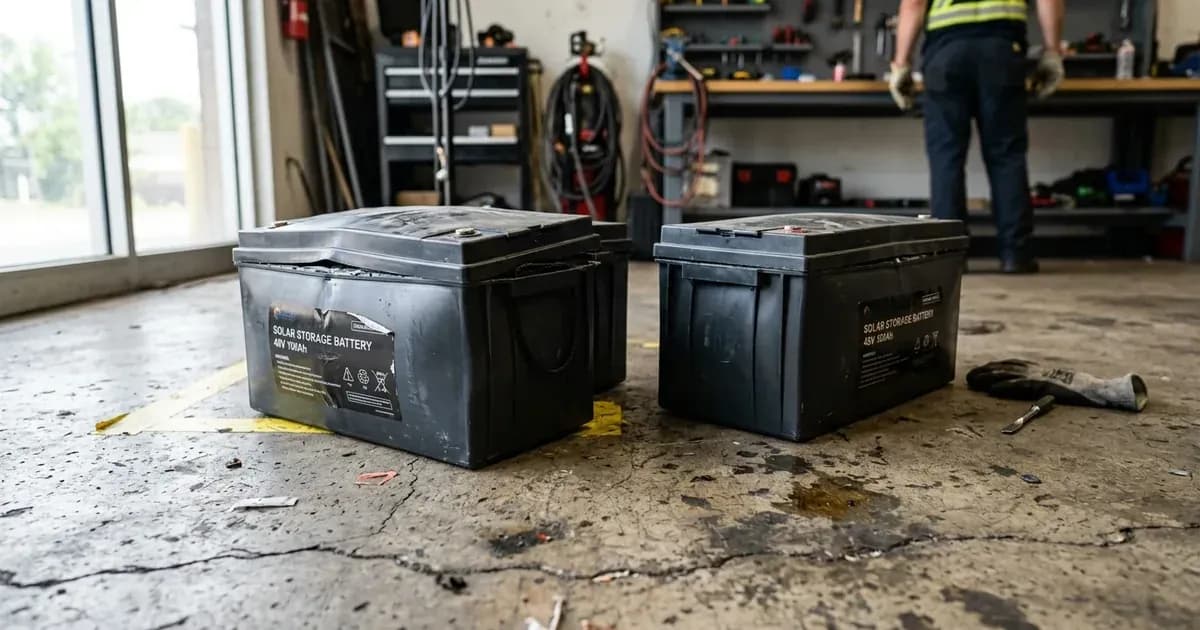
Discovering that a solar battery has physically expanded—a condition commonly described in Pakistan as a "phula hua battery"—is an urgent safety alert. Whether occurring on flooded tubular lead-acid batteries (Osaka, Phoenix, Exide) or LiFePO4 lithium storage packs, structural casing deformation is never normal and cannot be ignored.
Physical swelling occurs when internal electrochemical energy is converted into excessive heat, physical plate expansion, or gaseous chemical byproducts that cannot escape through standard safety vents. Understanding the specific physical mechanisms behind swelling allows you to safely isolate the hazard and prevent electrical fires.
Swelling Mechanisms: Lead-Acid vs Lithium
The table below contrasts the causes, physical symptoms, and hazards of swelling across both battery technologies:
Comparison Factor | Flooded Tubular Lead-Acid | LiFePO4 Lithium (Pouch / Prismatic) |
|---|---|---|
Primary Root Cause | Overcharging or shorted plates, driving heat, plate expansion and gassing pressure | Electrolyte decomposition after overcharge, heat, or deep-discharge damage |
Physical Manifestation | Bulging side walls, warped top lid, stuck caps | Bloated prismatic case or swollen pouch |
Internal Gas Composition | Hydrogen (\(H_2\)) given off on charge | Oxygen (\(O_2\)), carbon monoxide (\(CO\)), carbon dioxide (\(CO_2\)) |
Ventilation Behavior | Escapes through the vent caps of a flooded case — until gas is produced faster than they pass it | Trapped inside the sealed cell; nothing on the outside for you to vent |
Repair Feasibility | Zero (Irreversible structural damage) | Zero (Severe fire and toxic hazard) |
Immediate Action | Disconnect DC power, cool, replace | Isolate in fireproof area, replace immediately |
Deep Dive: What Causes Lead-Acid Batteries to Swell?
In flooded tubular and sealed VRLA/AGM lead-acid batteries, casing expansion results from three primary failure modes:
- Severe Inverter Overcharging: If an off-grid or hybrid inverter holds the bank above the charging band the battery maker publishes, electrolysis runs continuously and the electrolyte gasses without pause. Osaka's tubular data sheet puts cycle charging at 14.4–14.7V and float or standby at 13.8–14.2V on a 12V battery; a charger parked well above that band puts in heat and gas the case was never meant to hold.
- Heat and Plate Expansion: Heat sits behind almost every lead-acid failure, and swelling is no exception. Osaka's own data sheet records backup falling away once a tubular runs above 25°C, and a battery cupboard baking through a Punjab afternoon sits far above that line for hours at a stretch. As the plates expand, the growing stack pushes outward against the plastic casing walls.
- Shorted or Bridged Plates: A cell whose plates short internally dumps charging energy straight into heat instead of storing it. That heat drives further gassing, and gas produced faster than the vent caps can pass it builds pressure that deforms the container from the inside.
Inspect terminal connections for related damage in our guide on battery terminal corrosion and loose fixes.
Deep Dive: What Causes Lithium (LiFePO4) Cells to Swell?
In lithium iron phosphate batteries, cell swelling is driven by irreversible chemical decomposition:
- Electrolyte Decomposition from Over-Voltage: LiFePO4 cells are typically protected at around 3.60–3.65V per cell, which works out to roughly 57.6–58.4V at the terminals of a 16-cell 48V pack — note that some 48V modules are 15-cell rather than 16-cell (Pylontech's US series among them), so their pack-level figures sit lower; this is exactly why your own BMS datasheet, not this rule of thumb, governs. Treat those as typical figures only — your own BMS datasheet governs the real setpoints. If the BMS does not cut charging at that ceiling, the electrolyte decomposes and releases oxygen, carbon monoxide and carbon dioxide inside a cell that has nowhere to vent them.
- Deep-Discharge Damage: A cell taken far below its protection floor is damaged, not merely empty, and the outgassing can show up on the charges that follow. Typical LiFePO4 practice puts the absolute cell floor at 2.50V, with common BMS cutoff setpoints between 2.8V and 3.0V — again, typical values, with your BMS datasheet the authority for your pack.
- An Unknown Charge and Heat History: The drivers above — overcharge, heat, and deep-discharge damage — all degrade a cell long before the case visibly bulges. A pack bought second-hand carries whatever history its previous owner gave it, with no record you can inspect, which is exactly the risk with imported refurbished and second-life modules: you inherit the damage without the paperwork. Learn how to identify questionable imported packs in our guide on used and refurbished lithium grey-market warnings.
Environmental Factors and Prevention in Pakistan
Managing battery ambient conditions in Pakistan's harsh summer climate is essential to prevent thermal swelling:
- Avoid High Ambient Heat: Both chemistries are rated for conditions a sealed Pakistani battery cupboard blows straight past in June. Osaka's tubular data sheet counts backup lost above 25°C, and LiFePO4 rack modules such as the Pylontech US5000 are rated to charge only between 0°C and 55°C. Give the bank shade and continuous airflow rather than a closed store room.
- Verify Inverter Temperature Sensors: Connect the remote battery temperature sensor (RTS) to your solar inverter so charging voltage is compensated as the bank heats up — the usual compensation figure is −3 to −5 mV per cell per °C above 25°C, and Deye hybrids expose it directly as a TEMPCO setting on the unit.
- Avoid Substandard Fast Chargers: Never charge flooded or lithium batteries with unregulated high-current automotive chargers that bypass safety cutoff limits.
Immediate Safety Protocol and Safe Disposal
If you discover a swollen battery in your solar room, follow this mandatory safety procedure:
- Cease Charging Immediately: Turn off all PV array DC isolators and disconnect AC grid utility inputs to remove all electrical energy sources.
- Open the Battery DC Circuit Breaker: Switch off the main external DC isolator between the battery bank and inverter.
- Ensure Ventilation: Open doors and windows in the battery room. Avoid operating light switches or electrical tools that could generate sparks near vented hydrogen.
- Allow the System to Cool: Never touch a hot, swollen battery with bare hands. Allow the bank to cool down for several hours.
- Disconnect Safely: Wearing chemical-resistant gloves and safety goggles, disconnect the negative (black) cable first, followed by the positive (red) cable.
- Never Puncture a Swollen Cell: Never attempt to drill, puncture, press, or "burp" a swollen lithium cell. The deformation is telling you internal pressure is already at a dangerous level; opening the cell turns a contained hazard into a fire.
Two things about the room itself are easy to forget when you are in a hurry. Inverter capacitors can hold a lethal charge for up to five minutes after the unit is switched off, and PV conductors stay live whenever there is daylight on the array — an open DC breaker does not make the wiring safe to grab. Weight is the other hazard: a tall tubular runs 55–73kg and is a two-person lift even when it is healthy, and a rack module such as the Pylontech US5000 is 39.7kg. Do not wrestle a swollen battery out of a rack on your own.
Observe these strict disposal and recycling rules:
- Fireproof Storage: Place swollen lithium packs in a shaded outdoor location away from combustible structures on a concrete or sand floor.
- Hand It Back Through the Supply Chain: Neither chemistry belongs in household waste, and a swollen pack should not go to a roadside scrap buyer who may break the case open. Take it back to the dealer or brand distributor it came from and make them own the disposal. We were not able to verify any published national take-back or recycling scheme for lithium packs in Pakistan, so the chain you bought through is the route we are willing to point you at.
Inspect your inverter for underlying cooling faults using our guide on inverter overheating and fan noise.
When to call a technician instead
Contact a certified solar technician or professional installation company under the following conditions:
- A swollen battery is hissing, giving off visible vapour, or is too hot to keep a hand on. Installers in Pakistani forums treat roughly 50°C — hot enough that you cannot hold your hand on the case — as the point to come off charge immediately. That threshold is community-reported experience rather than a manufacturer figure, but it is a sensible line to hold.
- Liquid sulfuric acid is actively leaking from cracked casing walls.
- Assistance is required to safely decommission and reconfigure remaining healthy battery strings.
For professional escalation standards, consult our guide on when to call a solar technician.
Figures as of August 2026.
Still showing the fault? Book a technician
If the steps above did not clear it, tell us the inverter or battery and the exact code. We pass it to a technician who covers your city; visit charges are quoted before they come.
How this pays for the site: the technician or verifier pays SolarNevs a fixed introduction fee. Nobody pays to be recommended, and you are free to use our free guides instead.
Frequently asked questions
Is a swollen solar battery dangerous?
Yes. Structural deformation of the case means internal pressure has reached a dangerous level, and that makes the battery a fire hazard. On a flooded battery there is sulfuric acid behind that bulging wall as well. Stop charging it, isolate it, and replace it.
What causes a flooded tubular lead-acid battery to swell?
Lead-acid swelling traces back to overcharging or to plates that have shorted internally. Both put heat into the battery, the plates expand, and charging gas that the case cannot release fast enough adds pressure until the walls bulge. Heat makes all of it worse: Osaka's tubular data sheet already counts lost backup once the battery runs above 25°C.
What causes a LiFePO4 lithium battery pouch or prismatic cell to bulge?
Lithium swelling happens when the internal electrolyte decomposes into gases — oxygen, carbon monoxide and carbon dioxide — that stay trapped inside a sealed cell with nowhere to vent. The documented triggers are overcharging, heat, and damage caused by deep discharge.
Can I repair or 'burp' a swollen lithium battery?
No. Never attempt to puncture, press, or vent a swollen lithium battery. The swelling itself tells you internal pressure is already at a dangerous level, so opening the cell is a fire risk rather than a repair. Isolate the pack and replace it.
How should I safely disconnect and dispose of a swollen solar battery?
Turn off all AC and PV inputs, open the external DC breaker, and allow the battery to cool. Using insulated gloves and safety goggles, disconnect cables (negative first). Move the unit to a well-ventilated, fire-safe area away from flammable materials, then hand it back to the dealer or brand distributor it came from for disposal.
References
- BatterySharks Lead Acid Battery Swelling Guide — accessed 23 August 2026
- EcoFlow Lithium Battery Swelling and Safety Guide — accessed 23 August 2026
- Osaka Tubular Technical Data Sheet — accessed 23 August 2026
- Pylontech US5000 Technical Datasheet — accessed 23 August 2026
- Voltronic Axpert VM III Manual PDF — accessed 23 August 2026
Related guides
More from inverter errors & fixes.