Installing Solar Panels on Listed Buildings and Conservation Areas in the UK
Updated 6 September 2026 · By SolarNevs Research Desk, Dealer surveys + verified sources · 5 sources · Method ↗
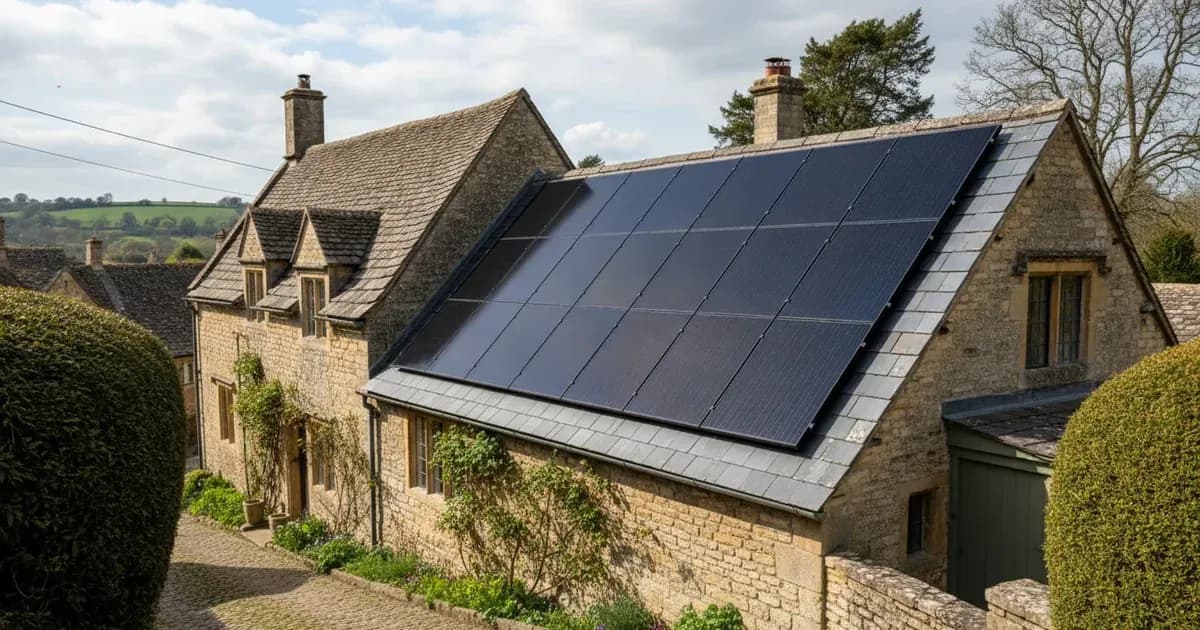
Key Takeaways
- Under Section 7 of the Planning (Listed Buildings and Conservation Areas) Act 1990, altering or extending a listed building in any manner affecting its architectural character without authorisation is prohibited.
- Section 16 imposes a statutory duty on local planning authorities to have special regard to the desirability of preserving listed buildings and their setting.
- Permitted development rights do not apply to installations on listed buildings or buildings situated within the curtilage of a listed building.
- In conservation areas, rooftop solar is generally permitted development unless panels are mounted to a wall fronting a highway or restricted by an Article 4 Direction.
- Where permitted development applies, panels on pitched roofs must project no more than 200mm from the roof slope and cannot rise above the ridge line.
- Local authorities increasingly utilise Local Listed Building Consent Orders (LLBCOs) to streamline rooftop solar approvals for heritage properties.
The Statutory Heritage Framework: Section 7 and Section 16 Duties
Installing microgeneration on designated heritage assets in England and Wales is governed by primary statutory legislation under the Planning (Listed Buildings and Conservation Areas) Act 1990.
Section 7 Prohibition
Section 7 strictly establishes that no person shall execute or cause to be executed any works for the demolition of a listed building or for its alteration or extension in any manner which would affect its character as a building of special architectural or historic interest, unless the works are authorised. Unauthorised alterations constitute a criminal offence.
Section 16 Decision Criteria
When evaluating a formal application for Listed Building Consent (LBC), the local planning authority must adhere to Section 16: in considering whether to grant listed building consent for any works the local planning authority or the Secretary of State shall have special regard to the desirability of preserving the building or its setting or any features of special architectural or historic interest which it possesses.
Permitted Development Rights vs Listed Building Curtilage
Under the Town and Country Planning (General Permitted Development) (England) Order 2015, domestic microgeneration enjoys general permitted development rights under Schedule 2, Part 14, Class A. However, statutory exclusions apply:
Heritage / Property Designation | Planning Permission / Consent Status | Key Restrictions and Dimensional Limits |
|---|---|---|
Listed Building (or within curtilage) | Statutory Listed Building Consent (LBC) required | Permitted development excluded; Section 7 authorization mandatory |
Conservation Area (Pitched Roof) | Permitted Development (Class A) | Max 200mm projection from slope; cannot exceed roof ridge line |
Conservation Area (Flat Roof) | Permitted Development (Class A) | Max 600mm above highest part of roof (excluding chimney) |
Conservation Area (Wall-Mounted) | Conditional Permitted Development | Must not be fitted to any wall fronting a highway |
Scheduled Monument | Permitted development excluded | Full statutory planning and scheduled monument consent required |
LLBCO Designated Area | Blanket Listed Building Consent | Individual LBC waived if meeting local order design criteria |
- Curtilage Exclusion: Development is not permitted if the solar PV equipment would be installed on a building within the curtilage of the dwellinghouse or block of flats if the dwellinghouse or block of flats is a listed building.
- Scheduled Monuments: Solar equipment cannot be installed under permitted development on a site designated as a scheduled monument.
- Visual Amenity Condition: Equipment on a building should be sited, so far as is practicable, to minimise the effect on the external appearance of the building and the amenity of the area.
- Decommissioning Duty: Solar equipment is subject to the mandatory condition that when no longer needed equipment should be removed as soon as reasonably practicable.
Solar Installations in Conservation Areas
Properties located in designated conservation areas benefit from permitted development rights under Class A, subject to specific highway frontage protections:
Wall Mounting Restrictions
- In conservation areas and World Heritage Sites, panels must not be fitted to a wall which fronts a highway.
- Rear wall installations and non-visible side walls not fronting a highway remain permitted development, provided they meet standard dimensional thresholds.
Dimensional Limits on Permitted Roof Installations
- Pitched Roofs: On a pitched roof, panels should not be installed above the highest part of the roof (excluding the chimney) and should project no more than 200mm from the roof slope or wall surface.
- Flat Roofs: On a flat roof the highest part of the solar PV equipment cannot be more than 600mm higher than the highest part of the roof (excluding chimney).
Emerging Mechanisms: Local Listed Building Consent Orders (LLBCOs)
To address the barrier of individual planning applications for energy efficiency measures, national policy encourages local councils to implement Local Listed Building Consent Orders (LLBCOs).
As detailed in the Department for Levelling Up, Housing and Communities review of adapting historic homes for energy efficiency, LLBCOs for solar panels and other measures provide a general grant of listed building consent for these works, removing the need to submit individual applications. Where an LLBCO is in effect, homeowners complying with specified design criteria (such as matte black panels, concealed cabling, and rear roof positioning) can install solar arrays without individual application delays.
Furthermore, Historic England guidance on solar panels has been updated to include advice on mitigating the risk of fire and preserving sensitive historic roof timbers.
Frequently asked questions
Can I install solar panels on a listed building in the UK?
Solar installations on listed buildings require statutory Listed Building Consent under Section 7 of the Planning Act 1990 before any work can proceed.
Are solar panels on listed buildings permitted development?
Standard permitted development rights do not apply to listed buildings or buildings within their curtilage, meaning full consent is always required.
Can I put solar panels on a house in a conservation area?
Solar panels in conservation areas often fall under permitted development, provided they do not mount to a wall fronting a highway and adhere to protrusion limits.
What are Local Listed Building Consent Orders (LLBCOs)?
LLBCOs are orders issued by local authorities granting blanket consent for specified solar installations on certain listed buildings without individual applications.
What projection limits apply to permitted rooftop solar?
Panels on pitched roofs must not project more than 200mm from the roof slope and cannot exceed the highest point of the roof excluding chimneys.
References
- Planning Listed Buildings and Conservation Areas Act 1990 Section 7 — accessed 28 August 2026
- Planning Listed Buildings and Conservation Areas Act 1990 Section 16 — accessed 28 August 2026
- Planning Portal Domestic Solar Equipment Mounted Guidance — accessed 28 August 2026
- GOV.UK Review of Adapting Historic Homes for Energy Efficiency — accessed 28 August 2026
- Town and Country Planning General Permitted Development Order 2015 Part 14 — accessed 28 August 2026
Related guides
More from what to buy — and how not to get cheated.