UK Commercial Solar Carports and EV Charging Hubs Guide
Updated 15 September 2026 · By SolarNevs Research Desk, Dealer surveys + verified sources · 3 sources · Method ↗
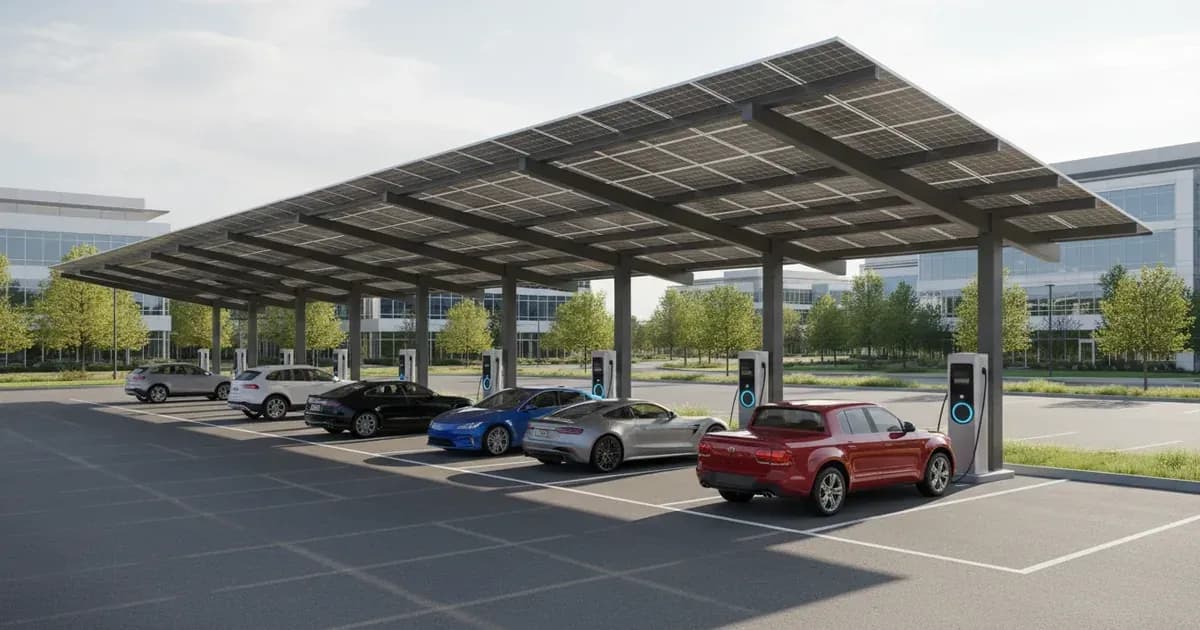
Key Takeaways
- Co-locating solar canopies with EV charging infrastructure allows commercial businesses to generate clean transport electricity on-site.
- Class OA of Schedule 2 Part 14 permits solar canopy construction in lawful off-street parking areas without full planning permission.
- The canopy height must not exceed 4 metres above ground level to comply with permitted development thresholds.
- Installations must remain at least 10 metres away from the curtilage of any dwellinghouse or residential flats.
- Developers must complete construction within a period of 3 years following prior approval determinations.
- Device owners must register chargers and generators with the Distribution Network Operator (DNO) to ensure grid capacity is verified.
Commercial Opportunity: Solar Canopies and Fleet Charging
Deploying solar canopies over commercial car parks delivers a dual benefit: generating on-site solar power while shading parked vehicles and energising fleet or public EV charging bays.
To accelerate rollout across England, planning legislation was updated under Class OA:
- Permitted Scope: The installation, alteration or replacement of a solar canopy within an area lawfully used as off-street parking other than for a dwellinghouse or a block of flats.
- Height Ceiling: Development is not permitted if any part exceeds 4 metres in height above ground level.
- Boundary Buffer: Development is not permitted if any part is within 10 metres of the curtilage of a dwellinghouse or a block of flats.
- Sustainable Drainage: In the case of development above a permeable surface, provision is made to direct run-off water from the solar canopy to a permeable or porous area or surface within the off-street parking area.
Planning Approvals and Lifespan Conditions
Even where full planning permission is bypassed, developers must satisfy formal statutory conditions:
- Prior Approval Determination: The developer must apply to the local planning authority for a determination regarding the solar canopy’s siting, design and external appearance, in particular the impact of glare on the occupiers of neighbouring premises.
- Sensitive Landscapes: In the case of a solar canopy on article 2(3) land, prior approval assesses the impact of the appearance of the solar canopy on that land.
- Three-Year Limit: Development must be completed within a period of 3 years starting with the date on which prior approval is granted or confirmed not required.
- Decommissioning Duty: Where the solar canopy is no longer needed, it is removed as soon as reasonably practicable and the land is restored.
Network Integration and DNO Compliance
Managing substantial charging loads alongside high solar peak generation requires close liaison with the local electricity distributor:
- Registration Duty: If you are planning to install an energy device in your home or small business, you are required to register your energy device with your Distribution Network Operator ( DNO ), the company that is responsible for bringing electricity to the property where you are installing the device.
- Network Capacity: The network operator needs to check if the local electricity network can handle the extra energy that your device will use or produce.
- Contractor Notification: Installation contractors must examine the energy device and required connection to determine whether the Distribution Network Operator needs to be informed before or after installation.
Inclusive Charging Standards: PAS 1899:2022
To help build an inclusive EV charging infrastructure in the UK, PAS 1899:2022 specifies requirements for the provision of accessible public charging for electric vehicles (EVs).
Commercial operators must design charging layouts in accordance with PAS 1899 guidelines:
- The specification addresses the physical aspects of the environment surrounding fixed chargepoints (e.g. kerb height, ground type).
- Canopy supporting columns must not encroach upon accessible parking bays, ensuring wheelchair users have wide transfer areas and unobstructed routes to charging sockets.
Frequently asked questions
What planning class authorises commercial solar canopies?
Class OA of Schedule 2 Part 14 authorises solar canopies within lawful non-domestic off-street parking facilities.
What height cap applies to solar carports under Class OA?
Development is not permitted if any part of the solar canopy exceeds 4 metres in height above ground level.
What separation is required from residential properties?
The development must not be located within 10 metres of the curtilage of a dwellinghouse or a block of flats.
Why must EV charging devices be registered with the network operator?
Registration is mandatory so the network operator can verify whether the local electricity network can handle the extra energy used or produced.
What accessibility standard governs public commercial EV charging?
PAS 1899:2022 provides specifications for accessible public charging for electric vehicles, covering kerbs, ground types, and bay layouts.
References
- Town and Country Planning Permitted Development Amendment No 2 Order 2023 — accessed 28 August 2026
- BSI PAS 1899:2022 Electric Vehicles Accessible Charging Specification — accessed 28 August 2026
- DESNZ Guidance on Registering Energy Devices — accessed 28 August 2026
Related guides
More from what to buy — and how not to get cheated.