UK DNO Substation Witness Testing and Energisation Guide
Updated 6 September 2026 · By SolarNevs Research Desk, Dealer surveys + verified sources · 5 sources · Method ↗
Key Takeaways
- Electricity distributors in Great Britain have a legal duty to connect premises for electricity conveyance.
- Connection is not guaranteed if it breaches regulations or is not reasonable in all circumstances.
- All generators connected to distribution networks in Great Britain require Loss of Mains (LoM) protection.
- Non-compliance with Distribution Code requirements can lead to de-energisation of generation assets.
Understanding DNO Requirements for Generation Connections
Connecting a new generation asset, such as a solar farm or large-scale battery storage, to the electricity distribution network in Great Britain involves adherence to specific technical and legal requirements set by Distribution Network Operators (DNOs). These requirements ensure the safety, stability, and reliability of the grid. The legal basis for connection states that "An electricity distributor is under a duty— (a) to make a connection between a distribution system of his and any premises, when required to do so by— (i) the owner or occupier of the premises; or (ii) an authorised supplier acting with the consent of the owner or occupier of the premises, for the purpose of enabling electricity to be conveyed to or from the premises."
However, this duty has exceptions. A DNO is not required to make a connection "if and to the extent that— (a) he is prevented from doing so by circumstances not within his control; (b) circumstances exist by reason of which his doing so would or might involve his being in breach of regulations under section 29, and he has taken all such steps as it was reasonable to take both to prevent the circumstances from occurring and to prevent them from having that effect; F2 ... (ba) it would not be in accordance with the designated strategic plans (within the meaning of section 16) for the distributor to do so; or (c) it is not reasonable in all the circumstances for him to be required to do so." This means that technical compliance and network capacity are critical factors.
The Role of ENA Standards and Loss of Mains Protection
The Energy Networks Association (ENA) plays a central role in defining the technical standards for connecting generation to the grid in Great Britain. The ENA is "the trade association for the energy networks. Our members own and operate the wires and pipes which carry electricity and gas into your community, supporting our economy." They publish Engineering Recommendations (EREC) that govern connection requirements.
Key ENA standards for generation connections include G98, G99, and G100:
- G98 and G99: "G98 and G99 are ENA standards that outline the requirements for connecting generators in parallel with public low voltage networks. Standards G98 and G99 superseded the previous ENA standard G59 on 17 May 2019." These standards dictate the technical parameters and protection settings for different sizes of generation.
- G100: "G100 details the technical requirements for customers' export and import limitation schemes applicable after 1 May 2023." This standard addresses how generation can be limited to manage network constraints.
ENA Standard / Protection Rule | Target System Scope | Technical Parameter / Function | Effective Date / Milestone |
|---|---|---|---|
EREC G98 | Low-voltage microgeneration | Parallel grid connection requirements | Superseded G59 on 17 May 2019 |
EREC G99 | Low and high-voltage generation | Connection and commissioning standards | Superseded G59 on 17 May 2019 |
EREC G100 | Export and import limitation schemes | Technical control for constrained grids | Enforced from 1 May 2023 |
LoM RoCoF Protection | All grid-connected generators | 1 Hz/s with 500 ms definite time delay | Mandatory update by Sept 2022 |
A critical safety requirement for all generation assets is Loss of Mains (LoM) protection. "All generators that are connected to the distribution networks in Great Britain have Loss of Mains (LoM) protection, one of the many protection requirements on the electricity system." The purpose of LoM protection is to "check if a generator is still connected to the supply network." This prevents a generator from continuing to energise a section of the network that the DNO believes to be de-energised, which could pose a significant safety risk to personnel working on the network.
Loss of Mains Protection Requirements and Enforcement
Compliance with LoM protection standards is a legal requirement. For example, the Rate of Change of Frequency (RoCoF) setting for LoM protection is specified as "1Hz/s with a definite time delay of 500 milliseconds" under Engineering Recommendation (EREC) G59. Generators were required to comply with updated protection standards by September 2022.
Failure to comply with these requirements can have serious consequences. "Any generators who are not compliant and therefore require updates to their protection will be subject to an enforcement programme which could ultimately result in the de-energisation of generation assets." This highlights the importance of ensuring all protection settings are correctly configured and maintained according to the latest ENA standards.
Network Constraints and Flexible Connections
Even with compliant protection, connecting new generation can be challenging due to existing network constraints. "Network constraints/limited capacity" can arise from "growing demand for electricity." In such cases, DNOs may offer "flexible connections" or require "curtailment" through "Active Network Management (ANM)" schemes. These arrangements allow connection but may limit export at certain times to manage grid capacity.
What You Can Check Yourself, and What You Cannot
As a generator owner or developer, you are responsible for ensuring your installation meets DNO requirements. You can:
- Review your connection agreement: Understand the specific technical and operational requirements for your site.
- Verify ENA standards: Confirm that your generation equipment and protection settings comply with the latest ENA G98, G99, or G100 standards applicable to your installation.
- Check LoM protection settings: Ensure that your Loss of Mains protection, including the Rate of Change of Frequency (RoCoF) setting of "1Hz/s with a definite time delay of 500 milliseconds," is correctly configured and certified.
However, certain aspects of witness testing, commissioning, and energisation are strictly the domain of accredited DNO personnel or their approved contractors:
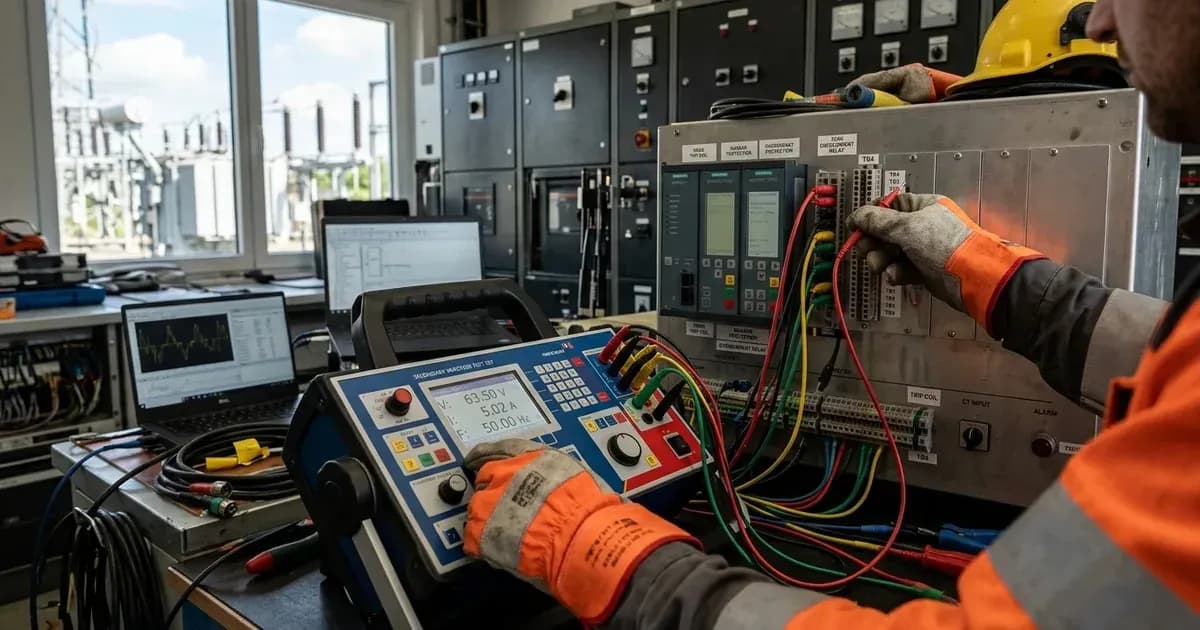
- Witness testing of primary substations: This involves specialised procedures for 11kV/33kV substations, including CT polarity checks and protection relay secondary injection, which require DNO presence and approval.
- Energisation certificates: The final energisation of a connection and the issuance of certificates are DNO responsibilities, confirming that all safety and technical requirements have been met.
- Changing DNO-mandated protection settings: Altering protection relay settings without DNO approval can breach your connection agreement and compromise network safety.
What the Published Sources Do Not Tell You
The provided sources offer a foundational understanding of DNO connection requirements and ENA standards. However, they do not detail the specific, granular procedures for "witness testing" or "commissioning" of primary 11kV/33kV substations.
Specifically, Statutory and engineering documentation does not cover:
- Detailed step-by-step witness testing procedures for primary substations, including specific tests for current transformers (CTs) or voltage transformers (VTs).
- The exact process for DNO approval of substation designs and equipment.
- Information on the specific types of protection relays and their settings beyond Loss of Mains (LoM) and Rate of Change of Frequency (RoCoF).
- The full list of DNOs in Great Britain and their specific connection policies, beyond the example of Electricity North West (ENWL).
- The typical costs associated with witness testing, commissioning, and connection fees.
- Standard timelines for DNO review, witness testing, and energisation.
- A comprehensive breakdown of roles and responsibilities for all parties (e.g., DNO, installer, generator owner) during these processes.
- The process for resolving disputes related to connection or testing.
- Specific requirements for different voltage levels (e.g., LV, HV, EHV) during testing and commissioning.
These details often vary by DNO and project scope, and are typically found in specific connection offers, DNO technical specifications, or industry guidance documents that are not publicly available or are subject to change. For project-specific details, direct consultation with the relevant DNO is essential.
Frequently asked questions
What is the legal basis for connecting generation to the electricity network in Great Britain?
An electricity distributor is legally obligated to connect premises to its distribution system when required by the owner, occupier, or an authorised supplier. This is for the purpose of conveying electricity to or from the premises.
What are the ENA G98 and G99 standards?
ENA G98 and G99 are standards that define the requirements for connecting generators in parallel with public low voltage networks in Great Britain. They superseded the previous ENA standard G59 on 17 May 2019.
What is Loss of Mains (LoM) protection?
Loss of Mains protection is a safety requirement for all generators connected to distribution networks in Great Britain. It is designed to detect if a generator is still connected to the supply network, preventing unsafe operation during grid outages.
What is the Rate of Change of Frequency (RoCoF) setting for LoM protection?
For Loss of Mains protection, the Rate of Change of Frequency (RoCoF) setting is 1Hz/s with a definite time delay of 500 milliseconds, as specified by Engineering Recommendation (EREC) G59.
What happens if a generator does not comply with Distribution Code requirements?
Generators that do not comply with Distribution Code requirements, such as updating Loss of Mains protection, may face an enforcement programme. This could ultimately result in the de-energisation of the generation assets.
References
- Legislation.gov.uk - Electricity Act 1989 — accessed 26 August 2026
- Legislation.gov.uk - Electricity Act 1989 Exceptions — accessed 26 August 2026
- ENA - Type Test Register — accessed 26 August 2026
- Electricity North West - Updating LoM Protection — accessed 26 August 2026
- Electricity North West - Flexible Connections — accessed 26 August 2026
Related guides
More from what to buy — and how not to get cheated.