UK PAS 63100 Commercial Battery Outbuilding Installation Guide
Updated 15 September 2026 · By SolarNevs Research Desk, Dealer surveys + verified sources · 4 sources · Method ↗
Key Takeaways
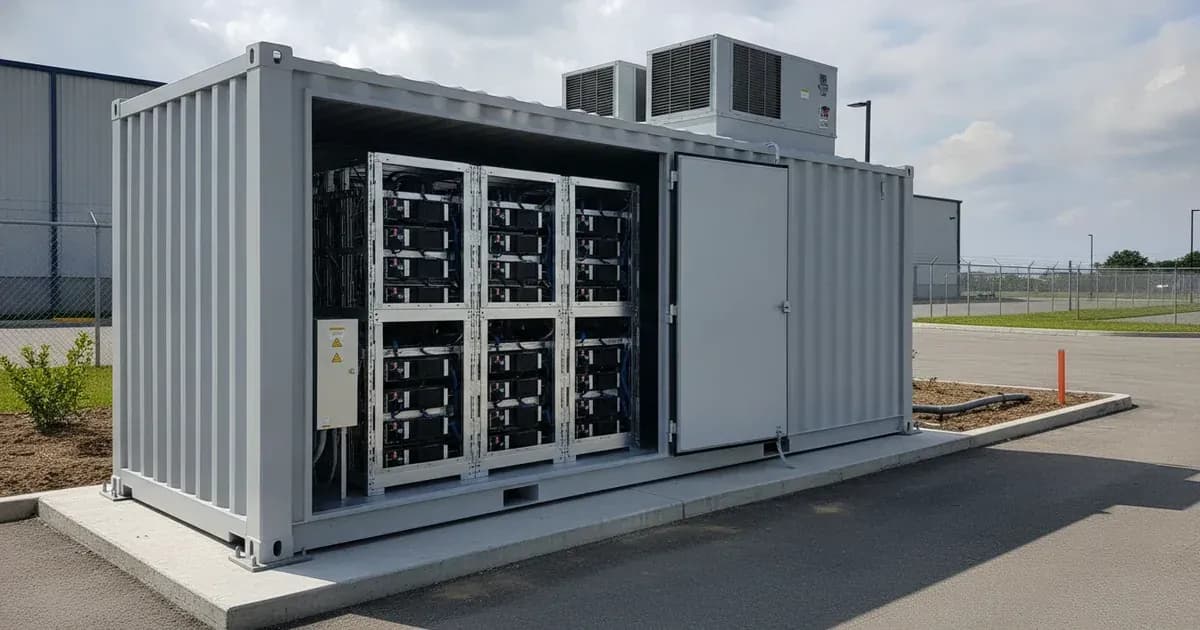
- Housing commercial Battery Energy Storage Systems (BESS) in dedicated external outbuildings eliminates catastrophic fire and off-gas risks to main commercial buildings.
- Outbuilding structures must feature certified fire-rated compartmentation and blast relief venting under PAS 63100 recommendations.
- Fire resistance benchmarks align with statutory standards detailed in Approved Document B Volume 1 for Dwellings.
- Commercial operators are required to implement general fire precautions to guarantee worker safety and premises security.
- Associated EV charging hubs benefit from permitted development rights with a 1.6-metre upstand height limitation.
- Public EV infrastructure co-located with battery storage is governed by statutory maintenance and payment reliability rules.
Outbuilding Design and Fire Compartmentation
Housing large stationary battery banks externally protects commercial business continuity:
- Boundary Setbacks: Outbuildings must maintain at least 3 to 5 metres clearance from property lines, main commercial walls, and flammable fuel storage.
- Fire-Rated Enclosures: Walls and ceilings must provide minimum 60 to 120-minute fire resistance providing robust fire resistance using reinforced concrete blockwork or composite mineral wool panels.
- Deflagration Venting: Roof structures must feature pressure-relief hatches designed to vent safely upward in the event of battery gas ignition.
Design Parameter | Engineering Benchmark | Safety & Risk Mitigation Objective |
|---|---|---|
Structural Separation | 3 to 5 metres setback | Isolates thermal hazards from primary walls and fuel stores |
Fire Compartmentation | 60 to 120 minutes resistance | Reinforced concrete / mineral wool prevents flame spread |
Explosion / Pressure Relief | Upward-facing roof relief hatches | Safely dissipates overpressure from battery off-gas ignition |
Fire Safety Framework: Statutory Precautionary Duties
Operating commercial energy storage requires strict adherence to fire safety legislation:
- Building Regulations: Meets technical guidance under Approved Document B (fire safety) volume 1 Dwellings, 2019 edition incorporating 2020, 2022 and 2025 amendments.
- Worker Safety: Under the 2005 Fire Safety Order, operators must take such general fire precautions as will ensure, so far as is reasonably practicable, the safety of any of his employees; and.
- Premises Integrity: Mandates measures to take such general fire precautions as may reasonably be required in the circumstances of the case to ensure that the premises are safe.
Permitted Development for Co-Located EV Charging
Commercial battery outbuildings frequently support fast-charging infrastructure:
- Wall Recharging Outlets: Covers The installation, alteration or replacement, within an area lawfully used for off-street parking, of an electrical outlet mounted on a wall for recharging electric vehicles.
- Highway Proximity: Devices must not face onto and be within 2 metres of a highway.
- Upstand Provisions: Authorizes The installation, alteration or replacement, within an area lawfully used for off-street parking, of an upstand with an electrical outlet mounted on it for recharging electric vehicles.
- Upstand Height Restriction: Mandates that upstands must not exceed 1.6 metres in height from the level of the surface used for the parking of vehicles;.
- Space Allocation Limit: Restricts development so it does not result in more than 1 upstand being provided for each parking space.
- Decommissioning Mandate: Enforces conditions that the development is removed as soon as reasonably practicable; when no longer required.
Automated and Electric Vehicles Act 2018 Governance
Commercial EV hubs co-located with battery storage operate under statutory service rules:
- Statutory Scope: Enforces that Regulations may impose requirements on operators of public charging or refuelling points in connection with.
- Open Access: Regulates the method of payment or other way by which access to the use of public charging or refuelling points may be obtained;.
- System Reliability: Governs the performance, maintenance and availability of public charging or refuelling points;.
Frequently asked questions
Why are commercial battery storage units installed in dedicated outbuildings?
Dedicated outbuildings isolate thermal runaway hazards, off-gas toxic smoke, and fire risks from primary commercial buildings and escape routes.
What building regulations govern fire separation for battery structures?
Fire separation and compartmentation rules align with Approved Document B (fire safety) volume 1 Dwellings and Volume 2 for non-dwellings.
What general fire precautions must commercial battery operators maintain?
Dutyholders must take such general fire precautions as will ensure employee safety and keep the premises safe.
What height limit applies to electrical upstands co-located with battery outbuildings?
Under Class E of the 2015 GPDO, electrical upstands in off-street parking areas must not exceed 1.6 metres in height.
What duty applies to redundant EV charging equipment?
Under statutory conditions, the development must be removed as soon as reasonably practicable when no longer needed.
References
- Building Regulations Approved Document B Volume 1 Dwellings — accessed 28 August 2026
- Regulatory Reform (Fire Safety) Order 2005 Article 8 Fire Precautions — accessed 28 August 2026
- Town and Country Planning (General Permitted Development) Order 2015 Part 2 — accessed 28 August 2026
- Automated and Electric Vehicles Act 2018 Section 10 — accessed 28 August 2026
Related guides
More from what to buy — and how not to get cheated.