Minnesota Rule 7835: Distributed Generation Interconnection Guide
Updated 19 September 2026 · By SolarNevs Research Desk, Dealer surveys + verified sources · 4 sources · Method ↗
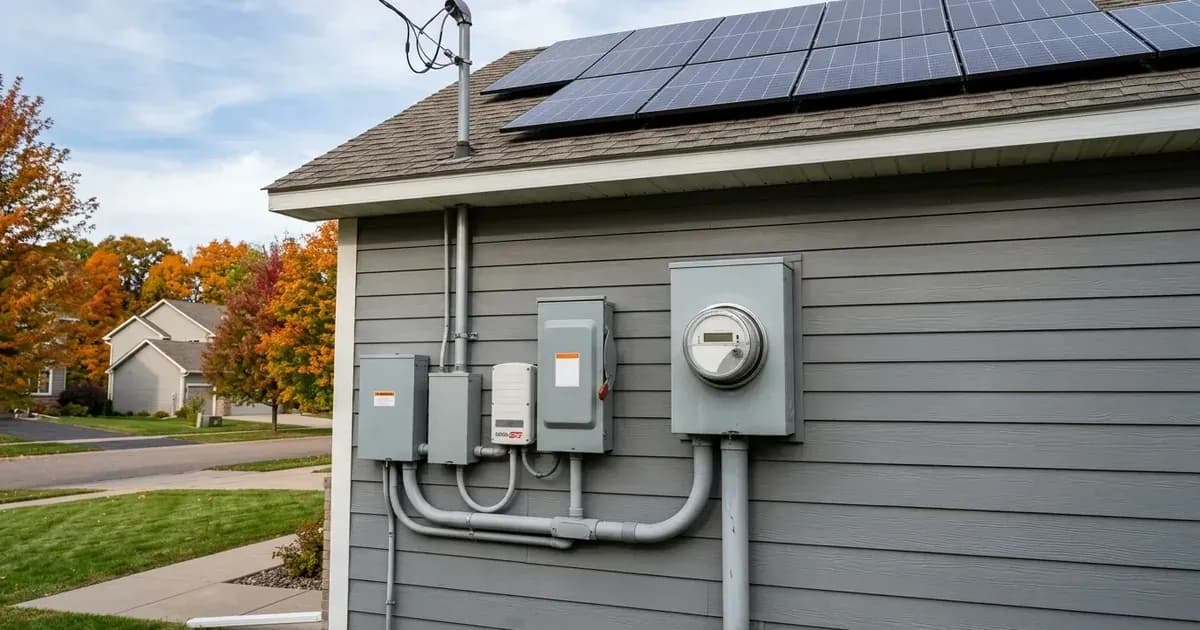
Minnesota Rule 7835 and its associated statutes provide the regulatory framework for distributed generation interconnection within the state. This guide outlines the key provisions that impact solar and other small power production facilities, focusing on utility obligations, capacity limits, and billing mechanisms. The overarching intent of these regulations is to encourage cogeneration and small power production while protecting ratepayers and the public.
Utility Obligations and Tariff Filings
Utilities in Minnesota have specific responsibilities regarding distributed generation. Each utility must file a cogeneration and small power production tariff with the commission for review and approval. This filing is required "Within 60 days after the effective date of this chapter, on January 1, 1985, and every 12 months thereafter". If, after the January 1, 2015, filing, "schedule C is the only change in the cogeneration and small power production tariff to be filed in a subsequent year", the utility may simply notify the commission of no other changes.
A core obligation is that "The utility must purchase energy and capacity from any qualifying facility which offers to sell energy to the utility and agrees to the conditions in this chapter." Furthermore, "Utilities shall be required to interconnect with a qualifying facility that offers to provide available energy or capacity and that satisfies the requirements of this section."
Defining Distributed Generation
Under Minnesota Statute 216B.164 Subd. 2a (h), "Distributed generation" means a facility that:
- Has a capacity of ten megawatts or less.
- Is interconnected with a utility's distribution system, over which the commission has jurisdiction.
- Generates electricity from natural gas, renewable fuel, or a similarly clean fuel, and may include waste heat, cogeneration, or fuel cell technology.
Net Metering and Capacity Limits
Minnesota law establishes different rules for billing and compensation based on the capacity of the qualifying facility:
- Facilities less than 40-kilowatt capacity: For these systems, "the customer shall be billed for the net energy supplied by the utility according to the applicable rate schedule for sales to that class of customer." Such facilities "may elect that the compensation for net input by the qualifying facility into the utility system shall be at the average retail utility energy rate."
- Facilities less than 1,000-kilowatt capacity: Similar to smaller systems, "the customer shall be billed for the net energy supplied by the utility according to the applicable rate schedule for sales to that class of customer."
- Facilities 40-kilowatt capacity or more (cooperative/municipal utility) or 1,000-kilowatt capacity or more (public utility): These facilities may elect to be governed by specific provisions, under which "The utility to which the qualifying facility is interconnected shall purchase all energy and capacity made available by the qualifying facility."
Standby Charges
To encourage distributed generation, "A public utility may not impose a standby charge on a net metered or qualifying facility: (1) of 100 kilowatts or less capacity". For facilities "of more than 100 kilowatts capacity, except in accordance with an order of the commission establishing the allowable costs to be recovered through standby charges."
Meter Aggregation and System Limits
For customers with multiple meters, "a public utility must aggregate for billing purposes a customer's designated meter with one or more aggregated meters if a customer requests that it do so."
The commission also has the authority to manage the overall impact of distributed generation. "The commission may limit the cumulative generation of net metered facilities under subdivisions 3 and 3a." A public utility can request such a limit "upon a showing that such generation has reached four percent of the public utility's annual retail electricity sales."
Utilities may also limit the total generation capacity of individual distributed generation systems for facilities of 40-kilowatt capacity or more:
- For solar photovoltaic and other distributed generation, this limit is "120 percent of the customer's on-site annual electric energy consumption" in kilowatt-hours alternating current.
- For wind generation systems, the limit is "120 percent of the customer's on-site maximum electric demand" in kilowatt alternating current.
Dispute Resolution and Rulemaking
In the event of disagreements, "In the event of disputes between a public utility and a qualifying facility, either party may request a determination of the issue by the commission."
The commission is also tasked with rulemaking: "The commission shall promulgate rules to implement the provisions of this section." This includes establishing "a uniform statewide form of contract for use between utilities and a net metered or qualifying facility having less than 1,000-kilowatt capacity if interconnected to a public utility or less than 40-kilowatt capacity if interconnected to a cooperative electric association or municipal utility."
For municipal electric utilities, "the term "commission" means the governing body of each municipal electric utility that adopts and has in effect rules implementing this section which are consistent with the rules adopted by the Minnesota Public Utilities Commission under subdivision 6." Similarly, for cooperative associations, "the term "commission" means the board of directors of a cooperative association that (1) elects, by resolution, to assume the authority delegated to the Public Utilities Commission over cooperative electric associations under this section, and (2) adopts and has in effect rules implementing this section."
Customer Data Access
To facilitate interconnection, "A utility must provide a customer's electricity usage data to the customer within ten days of the date the utility receives a request from the customer that is accompanied by evidence that the energy usage data is relevant to the interconnection of a qualifying facility on behalf of the customer."
Information Gaps
Specific details on disconnect switch requirements and IEEE 1547 compliance are not explicitly detailed within the provided sections of Rule 7835. Similarly, detailed utility safety rules beyond general interconnection requirements are not present in the provided rule sections. Information regarding net metering figures or claims from the https://mn.gov/puc/energy/distributed-energy-resources/net-metering/ URL could not be verified due to a CAPTCHA.
Frequently asked questions
What is the primary purpose of Minnesota Rule 7835?
Minnesota Rule 7835 and its associated statutes are intended to give the maximum possible encouragement to cogeneration and small power production consistent with protection of the ratepayers and the public. It outlines the framework for utilities to file tariffs and purchase energy from qualifying facilities.
What capacity limits apply to net metering under Minnesota Statute 216B.164?
For a qualifying facility having less than 40-kilowatt capacity, the customer is billed for net energy supplied by the utility. For facilities less than 1,000-kilowatt capacity, the same net billing applies. Additionally, facilities less than 40-kilowatt capacity may elect compensation at the average retail utility energy rate for net input.
Can utilities impose standby charges on distributed generation systems in Minnesota?
A public utility may not impose a standby charge on a net metered or qualifying facility of 100 kilowatts or less capacity. For facilities of more than 100 kilowatts capacity, standby charges are allowed only in accordance with a commission order establishing allowable cost recovery.
Are utilities required to purchase energy from qualifying facilities?
Yes, the utility must purchase energy and capacity from any qualifying facility which offers to sell energy to the utility and agrees to the conditions in this chapter. This also applies to qualifying facilities having 40-kilowatt capacity or more, or 1,000-kilowatt capacity or more if interconnected to a public utility.
How can customers resolve disputes with utilities regarding interconnection?
In the event of disputes between a public utility and a qualifying facility, either party may request a determination of the issue by the commission.
References
- Minnesota Rule 7835.0300 — accessed 26 August 2026
- Minnesota Rule 7835.0400 — accessed 26 August 2026
- Minnesota Rule 7835.1900 — accessed 26 August 2026
- Minnesota Statute 216B.164 — accessed 26 August 2026
Related guides
More from schemes, subsidies & financing.