Wisconsin PSC 119 Distributed Generation Interconnection Guide: Categories, Fees, and Timelines
Updated 18 September 2026 · By SolarNevs Research Desk, Dealer surveys + verified sources · 23 sources · Method ↗
Key Takeaways
- PSC 119 covers distributed generation of 15 MW or less, in four categories set by export capacity, not nameplate.
- Category 1 (20 kW or less) pays a $150 or $300 review fee and gets a completeness answer within 10 working days.
- Minimum liability insurance runs from $300,000 (Category 1) to $2,000,000 (Category 3).
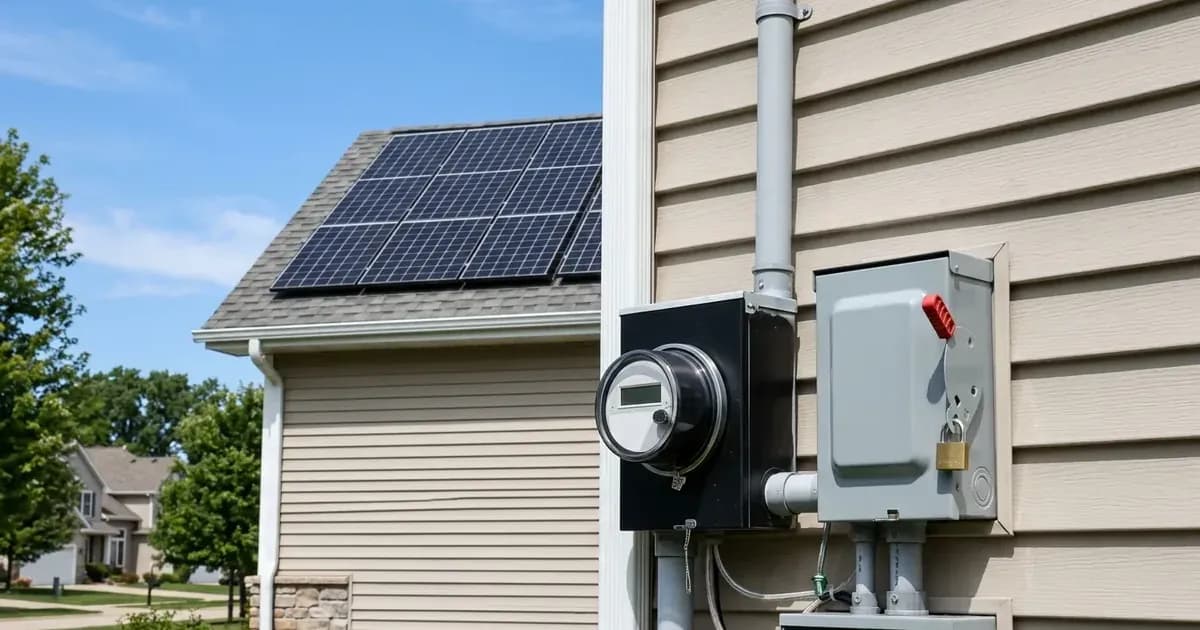
- The rule lets a utility require an external disconnect; We Energies wants it within 10 feet and line of sight of the meter.
- No disconnection is allowed while a PSC 119.40 dispute is pending.
The four PSC 119 categories at a glance
Parameter | Category 1 | Category 2 | Category 3 | Category 4 |
|---|---|---|---|---|
Export capacity (PSC 119.02) | 20 kW or less | >20 kW to 200 kW | >200 kW to 1 MW | >1 MW to 15 MW |
Application review fee (Table 119.08-1) | $150 (1-8 kW) or $300 (9-20 kW) | $300 + $10/kW | $2,000 + $2/kW | $4,000 + $0.50/kW |
Commissioning fee (Form 6031) | $150 | $250 | $1,000 | $2,500 |
Engineering review (PSC 119.04) | 10 working days | 15 working days | 20 working days | 40 working days |
Distribution system study (PSC 119.04) | 10 working days | 15 working days | 20 working days | 60 working days |
Final approval notice (PSC 119.04) | 10 working days | 10 working days | 20 working days | 20 working days |
Agreement signing after approval (119.04(4)(k)) | 5 working days | 10 working days | 10 working days | 10 working days |
Minimum liability insurance (Table 119.05-1) | $300,000 | $1,000,000 | $2,000,000 | Negotiated |
Material modification notice (PSC 119.06) | 20 working days | 40 working days | 60 working days | 60 working days |
PSC 119.01 says the chapter "applies to all DG facilities with a capacity of 15 MW or less" seeking interconnection to "an electric public utility's distribution system." We checked the text on 6 September 2026 through the Cornell LII mirror.
Export capacity decides your category
PSC 119.02(17m) defines export capacity as "the amount of power that can be transferred from the DG facility to the distribution system," so the category thresholds in the table are export limits. Alliant restates the consequence: a resource "no larger than 20 kW with a non-exporting energy storage system no larger than 20 kW shall be considered a Category 1 system." The rule applies only to "parallel operation," meaning connection to the energized grid "for longer than 100 milliseconds."
Form 6031 and the utility point of contact
PSC 119.03 makes each utility designate "one point of contact for all customer inquiries related to DG facilities" that supplies the standard forms. Form 6031, effective May 1, 2024, is the statewide application for systems up to 15 MW AC and goes to the utility, not the Commission. It needs spec sheets, a one-line diagram showing the "interconnection disconnect switch (if required), point of interconnection, meter(s), protection equipment," a site plan, proof of insurance and proof of equipment certification. The agreements are Form 6029 for "20 kW or less" and Form 6030 for "20 kW to 15 MW."
The statutory review clocks
Under PSC 119.04, "Within 10 working days of receiving a new or revised application and application fee, the public utility shall notify the applicant whether the application is complete." Review must finish within 10 working days of that finding, and if engineering review is needed "the notification shall state a nonbinding estimate of that review." Later clocks scale by category as the table shows. A PSC 119.13 pre-application request is checked "for completeness within 5 business days of receipt," the report is due "Within 15 business days" after that, and PSC 119.08 caps its fee at "up to $300."
Fees, insurance and refunds
Engineering review and study fees are cost based with no dollar figure in the rule, and "Public utilities shall refund to the applicant any fees paid in excess of costs incurred by the utility." Category 2 to 4 applicants "shall name the public utility as an additional insured party," or may "prove financial responsibility by another means mutually agreeable" to both sides.
Equipment, disconnect and testing rules
PSC 119.025 adopts IEEE 1547-2018 and IEEE 1547.1-2020 by reference, and PSC 119.20(6) requires that "All inverter-based DG facilities shall be UL 1741 published September 28, 2021 listed" and meet IEEE 1547-2018. Category 1 and 2 systems "shall be operated at a power factor greater than 0.9," telemetry may be required only for Categories 3 and 4, and storage must be UL 9540 listed.
The disconnect is permissive: "The public utility may require" a switch "that opens, with a visual break, all ungrounded poles of the interconnection circuit," lockable open and labeled "Interconnection Disconnect Switch." Under PSC 119.26, UL 1741 certified equipment skips utility design review, though an engineering review of grid compatibility can still follow. Before final approval, PSC 119.30 lets the utility "perform an unintentional islanding test or observe the automatic shutdown," which must trip within two seconds.
How We Energies and Alliant apply the rule
We Energies splits its process at 300 kW and confirms the "within 10 working days" completeness notice. Its manual requires that disconnects "shall be externally mounted and shall provide a visible open between its contacts"; breakers and air-conditioner pull-out disconnects are not accepted, and the switch "should be within 10' from metering equipment and within line of sight," mounted 30-72 inches above grade. Telemetry should be assumed "for any system 300kW or larger" at customer cost, and "hand-drawn one-lines will not be accepted." Its CGS NM rate applies below 300 kW, and a "Solar Disconnect Waiver for Energy Storage Systems" took effect June 1, 2025.
Alliant (Wisconsin Power and Light) uses the PowerClerk portal, answers completeness in 10 working days, then issues an Interconnection Approval Memorandum. Its pre-application report costs $300 plus an NDA. Billing splits at 20 kW: PgS-3 net metering up to 20 kW, PgS-1 overproduction credit above. Its DER requirements, effective December 1, 2025, defer disconnect specifics to "Electric Service Rulebook Chapter 511." Tariff details are in our We Energies and Alliant net metering guide.
Disconnection, modifications and disputes
PSC 119.09 lets a utility refuse or disconnect only for five reasons: no approved application or agreement, mutual termination, non-compliance, a system emergency, or maintenance on reasonable notice. For material modifications under PSC 119.06, "If the public utility fails to respond in the time specified in Table 119.06-1, the completed application is deemed approved." PSC 119.40 disputes go to the utility, then informal PSC staff review (the utility answers staff within 10 business days), then optional formal Commission review requested within 30 days; meanwhile the facility "may not be disconnected from the distribution system because of any disputed matter."
What you can check yourself, and what you cannot
You can confirm your category from the export capacity on your inverter spec sheet, price the fees from the table, and count the working-day clocks from the date your utility acknowledges Form 6031. You cannot self-certify UL 1741 or IEEE 1547 compliance, witness your own islanding test, or wire the disconnect; those sit with listed equipment, the utility and a licensed electrician.
What the published sources do not tell you
- Every rule quotation comes from the Cornell LII mirror because docs.legis.wisconsin.gov refused connections; its currency against the official post-May 2024 text was not verified.
- PSC 119.04 states no "deemed approved" consequence for a missed initial-application deadline; only PSC 119.06 has that language, leaving the 119.40 dispute route as the stated recourse.
- PSC 119.02 defines neither "business day" nor "working day," yet the chapter uses both, and no "fast track" tier exists by that name.
- PSC 119.20(3) gives no disconnect waiver criteria, distance rule or Category 1 exemption; Alliant's Chapter 511 and the terms of We Energies' storage waiver were not fetched.
- PSC 119 has no net-metering rule; per-kWh credits, typical cost-based study fees, real time to permission-to-operate, queue statistics, PSC 119.25, 119.27 and 119.32, Form 6031's DC-to-AC conversion factor and local permitting are all outside the fetched sources.
Related Regulatory Guides
Compare neighboring Midwest procedures in our Minnesota Rule 7835 interconnection guide and Iowa 199 IAC 45.8 Level 1 guide. Before filing Form 6031, size your export capacity with our solar sizing tool.
Frequently asked questions
What size limit defines Category 1 under Wisconsin PSC 119?
PSC 119.02(4) defines Category 1 as a DG facility with an export capacity of 20 kW or less, measured as the power that can flow to the distribution system rather than nameplate. Alliant's technical requirements restate that a resource no larger than 20 kW paired with a non-exporting battery no larger than 20 kW is still Category 1 (September 2026).
What does a Wisconsin PSC 119 interconnection application cost?
Table 119.08-1 sets the application review fee at $150 for 1-8 kW or $300 for 9-20 kW in Category 1, $300 + $10/kW for Category 2, $2,000 + $2/kW for Category 3 and $4,000 + $0.50/kW for Category 4. Form 6031 adds commissioning fees of $150, $250, $1,000 and $2,500, and the utility must refund anything above its actual cost (September 2026).
How long does a Wisconsin utility have to review a PSC 119 application?
Under PSC 119.04 the utility has 10 working days after receiving the application and fee to say whether it is complete, then 10 working days to finish application review. Engineering review takes 10, 15, 20 or 40 working days for Categories 1 to 4, and the final approval notice takes 10 working days for Categories 1-2 or 20 for Categories 3-4 (September 2026).
Does Wisconsin PSC 119 require an external disconnect switch for solar?
PSC 119.20(3) says the utility may require a visual-break disconnect switch that is accessible, lockable open and labeled Interconnection Disconnect Switch, but it does not mandate one. We Energies' manual requires an externally mounted, visible-open, lockable disconnect within 10 feet and line of sight of the meter, and rejects breakers and AC pull-out disconnects (September 2026).
What insurance does PSC 119 require for a distributed generation system?
Table PSC 119.05-1 sets minimum liability insurance at $300,000 for Category 1, $1,000,000 for Category 2, $2,000,000 for Category 3 and a negotiated amount for Category 4. Categories 2-4 must name the utility as additional insured, or prove financial responsibility by another means the utility agrees to (September 2026).
References
- PSC 119 chapter index (Cornell LII mirror) — accessed 6 September 2026
- PSC 119.01 Scope (LII) — accessed 6 September 2026
- PSC 119.02 Definitions (LII) — accessed 6 September 2026
- PSC 119.025 Adoption of standards by reference (LII) — accessed 6 September 2026
- PSC 119.03 Designated point of contact (LII) — accessed 6 September 2026
- PSC 119.04 Application process (LII) — accessed 6 September 2026
- PSC 119.05 Insurance and indemnification (LII) — accessed 6 September 2026
- PSC 119.06 Modifications to the DG facility (LII) — accessed 6 September 2026
- PSC 119.08 Fees and distribution system costs (LII) — accessed 6 September 2026
- PSC 119.09 Disconnection (LII) — accessed 6 September 2026
- PSC 119.10 One-line schematic diagram (LII) — accessed 6 September 2026
- PSC 119.13 Pre-application report (LII) — accessed 6 September 2026
- PSC 119.20 General design requirements (LII) — accessed 6 September 2026
- PSC 119.26 Certified paralleling equipment (LII) — accessed 6 September 2026
- PSC 119.30 Unintentional islanding test (LII) — accessed 6 September 2026
- PSC 119.40 Dispute procedures (LII) — accessed 6 September 2026
- PSC of Wisconsin - Customer-Owned Electrical Generation page — accessed 6 September 2026
- PSC Form 6031 Wisconsin Standard Distributed Generation Application (PDF, eff. 5/1/2024) — accessed 6 September 2026
- We Energies - Systems 300kW or less — accessed 6 September 2026
- We Energies - Customer-Owned Generation Resources — accessed 6 September 2026
- We Energies - Customer-Owned Generation Manual (PDF dated 04/13/2026) — accessed 6 September 2026
- Alliant Energy - Customer Interconnection for Wisconsin Customers — accessed 6 September 2026
- Alliant Energy - DER Technical Interconnection Requirements (PDF, eff. Dec 1, 2025) — accessed 6 September 2026
Related guides
More from schemes, subsidies & financing.