Virginia Net Metering: Rules for Dominion Energy and Appalachian Power Customers
Updated 19 September 2026 · By SolarNevs Research Desk, Dealer surveys + verified sources · 1 source · Method ↗
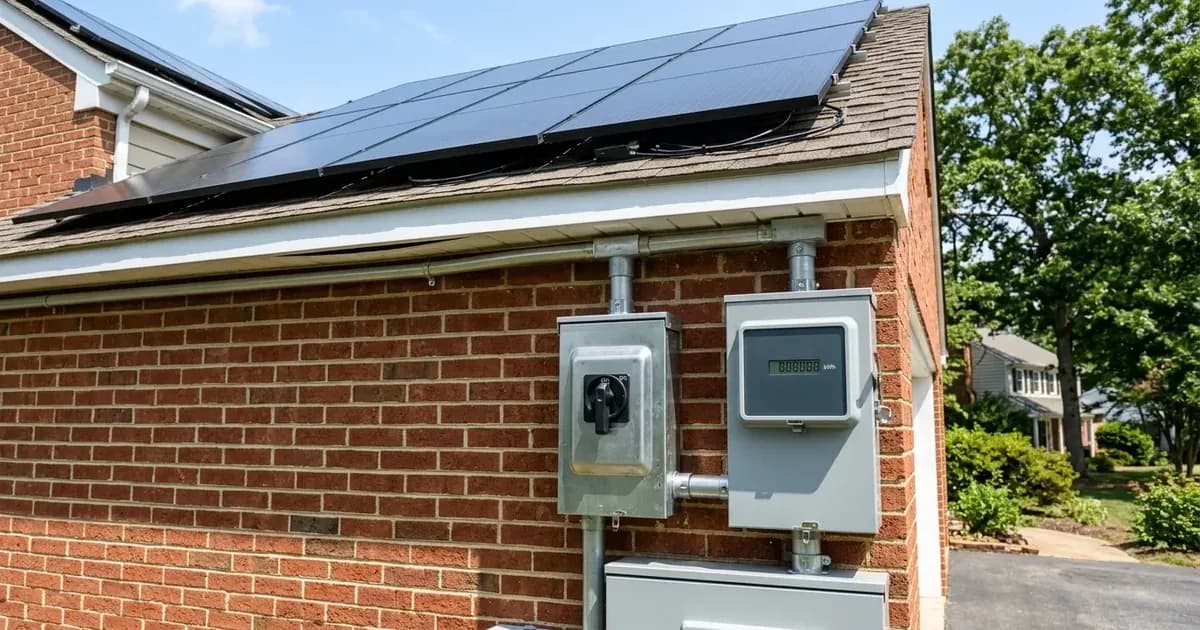
Net metering in Virginia allows customers who generate their own electricity, typically with solar panels, to receive credit for excess power they send back to the grid. The Virginia State Corporation Commission (SCC) establishes the regulations governing these provisions for electric utilities, including Dominion Energy and Appalachian Power. These rules are primarily outlined in Virginia Code § 56-594.
Eligibility and System Capacity Limits
To participate in net metering, your generating facility must meet specific capacity limits based on your customer type:
- Residential Customers: Your system's capacity must not exceed 25 kilowatts.
- Nonresidential Customers: Your system's capacity must not exceed three megawatts.
- Agricultural Customers: Your system's aggregate generation capacity must not exceed 500 kilowatts.
In addition to capacity limits, there are consumption caps for systems installed after July 1, 2020:
- Phase II Utility Service Territory: The system capacity cannot exceed 150 percent of your expected annual energy consumption. This is based on the previous 12 months of billing history or an annualized calculation if 12 months are not available.
- Phase I Utility Service Territory: The system capacity cannot exceed 100 percent of your expected annual energy consumption, calculated similarly.
The state also maintains an aggregate net metering cap, which is 6 percent of each electric distribution company's adjusted Virginia peak-load forecast for the previous year. Five percent of this is available to all customers, and one percent is reserved for low-income utility customers.
Interconnection Process and Standards
Before installing an electrical generating facility, you must notify your electric service provider and receive approval to interconnect.
- Review Periods: Electric distribution companies have specific timelines to review interconnection requirements:
- Residential Facilities: 30 days from the date of notification.
- Nonresidential Facilities: 60 days from the date of notification.
Your electrical generating system must comply with all applicable safety and performance standards. These include those established by the National Electrical Code (NEC), the Institute of Electrical and Electronics Engineers (IEEE), and accredited testing laboratories such as Underwriters Laboratories (UL).
Metering and Costs
Bi-directional metering equipment is required for net metering. This equipment must be capable of measuring the flow of electricity in two directions: power drawn from the grid and power sent back to the grid.
As an eligible customer-generator, you are responsible for all reasonable costs of equipment required for the interconnection to your supplier's electric distribution system. However, you are not required to provide proof of liability insurance or purchase additional liability insurance as a condition of interconnection.
Compensation for Excess Generation
If your system generates more electricity than you consume over a 12-month net metering period, you can be compensated for this excess electricity. This requires you to enter into a power purchase agreement with your supplier.
The power purchase agreement will obligate your supplier to purchase this excess electricity at a rate provided for in a net metering standard contract or tariff approved by the Commission. Parties may agree to a higher rate.
You, as the customer-generator, own any renewable energy certificates (RECs) associated with your electrical generating facility. At the time of entering a power purchase agreement, you have a one-time option to sell these RECs to your supplier.
Standby Charges
Rules regarding standby charges vary:
- Phase II Utility Residential Customers: If you are a residential eligible customer-generator in the service territory of a Phase II Utility and own an electrical generating facility with an aggregate nameplate capacity exceeding 20 kilowatts of alternating current, you are required to pay a monthly standby charge to your supplier.
- Other Investor-Owned Utilities: For customers of all other investor-owned utilities, standby charges are prohibited for any residential or agricultural eligible customer-generator on and after July 1, 2020.
Demand Response and Energy Efficiency
Eligible customer-generators may participate in demand response, energy efficiency, or peak reduction programs from dispatch of onsite battery service. This is permitted provided that the compensation received is for a distinct service not already compensated by net metering credits for electricity exported to the electric distribution system or by any other utility program or tariff.
Important Considerations
This guide outlines the statutory framework for net metering in Virginia. Specific tariffs for Dominion Energy and Appalachian Power are not detailed within Virginia Code § 56-594. The exact "avoided cost" rate for excess generation compensation and the specific methodology for standby charges for Phase II Utility residential customers over 20 kW AC are determined by the Commission. The definitions of "Phase I Utility" and "Phase II Utility" are also not provided in this section of the code. For precise details on these aspects, you should consult the specific regulations established by the Virginia State Corporation Commission and your utility's current tariffs.
Frequently asked questions
What are the solar capacity limits for net metering in Virginia?
For residential customers, the capacity of your generating facility cannot exceed 25 kilowatts. Nonresidential customers have a limit of 3 megawatts, while agricultural customers are capped at 500 kilowatts.
How long does it take for electric distribution companies to review interconnection requests in Virginia?
The electric distribution company has 30 days to review interconnection requirements for residential facilities. For nonresidential facilities, the review period is 60 days from the date of notification.
Am I required to have liability insurance for my solar system to interconnect in Virginia?
No, you are not required to provide proof of liability insurance or purchase additional liability insurance as a condition of interconnection in Virginia.
How is excess solar electricity compensated under Virginia's net metering rules?
You will be compensated for excess electricity if you enter into a power purchase agreement with your supplier. This agreement obligates the supplier to purchase excess electricity at a Commission-approved net metering standard contract or tariff rate, unless a higher rate is mutually agreed upon.
Are there standby charges for solar customers in Virginia?
Residential eligible customer-generators in the service territory of a Phase II Utility with an electrical generating facility exceeding 20 kilowatts of alternating current must pay a monthly standby charge. However, for customers of all other investor-owned utilities, standby charges are prohibited for any residential or agricultural eligible customer-generator on and after July 1, 2020.
References
- Virginia Code § 56-594 — accessed 26 August 2026
Related guides
More from schemes, subsidies & financing.