Shams Dubai Net Metering Guide: How DEWA Credits Your Solar Power (August 2026)
Updated 17 September 2026 · By SolarNevs Research Desk, Dealer surveys + verified sources · 4 sources · Method ↗
Also available in العربية
Key Takeaways
- Shams Dubai lets Dubai premises generate solar power on site; the electricity is used on site and any surplus is exported to DEWA's network.
- Surplus exports are handled through a Net Metering scheme: the energy is credited against future consumption — DEWA's FAQ states the producer shall not be paid any money for the excess electricity.
- Installed capacity is capped by Section 2.2 of the Shams Dubai Connection Conditions, as a share of your premises' Total Connected Load.
- DEWA states no tax or other incentives are currently offered for commercial and industrial solar, and exports never earn cash — the financial case is bill offset, which is why right-sizing the system matters more than maximising it.
What is Shams Dubai and who runs it?
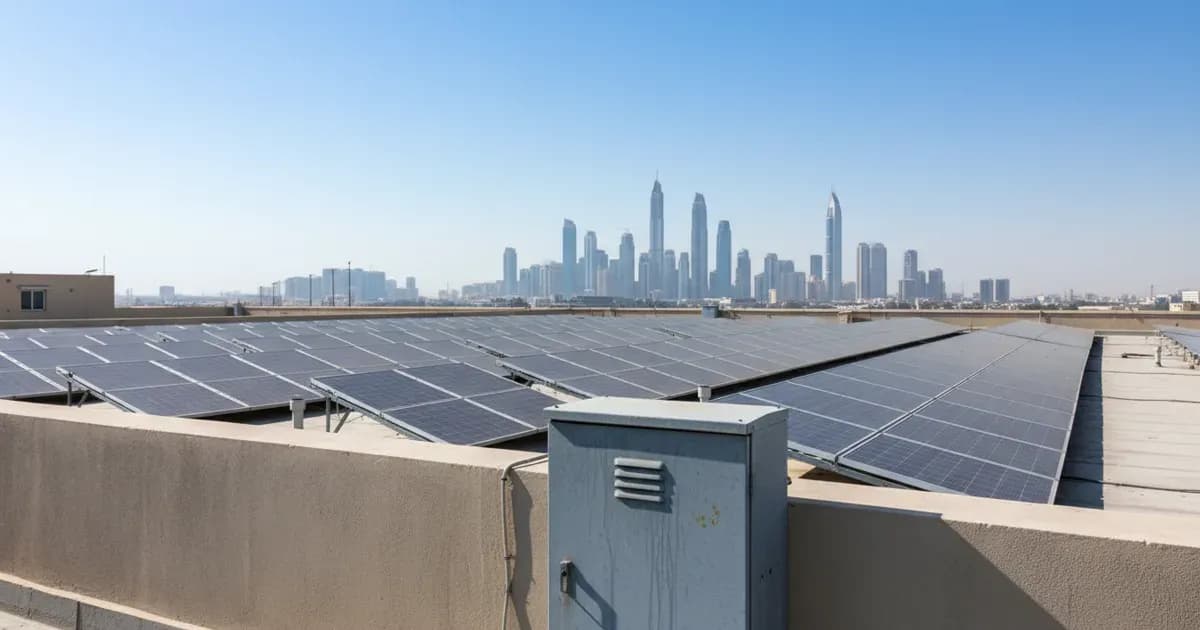
Shams Dubai is the Dubai Electricity and Water Authority's rooftop solar programme — DEWA describes it as its first smart initiative under the Distributed Renewable Resources Generation (DRRG) programme, implementing Dubai Executive Council Resolution No. 46 of 2014. The concept is simple: a home or business installs photovoltaic panels, the electricity is used on site, and the surplus is exported to DEWA's network.
It is a connection framework, not a subsidy scheme. DEWA sets the technical rules (eligible equipment, enrolled contractors, connection conditions) and operates the metering; it does not sell you the system or fund it.
How does net metering work under Shams Dubai?
When your panels produce more than your premises is consuming at that moment, the surplus flows out to the grid through your connection. DEWA's FAQ describes the mechanism precisely: surplus energy "will be exported to DEWA distribution network through a Net Metering scheme, this surplus energy will be credited and used to off-set future consumption of electricity."
In plain terms, the grid works like a ledger:
Situation | What happens |
|---|---|
Panels produce less than you use | The shortfall is drawn from the grid and billed normally |
Panels produce more than you use | The surplus is exported and recorded as a credit |
Later, at night or in winter | Your grid consumption is offset against banked credits |
Rules as of August 2026, per DEWA's Shams Dubai FAQ.
Will DEWA pay you cash for surplus electricity?
No — and this is the single most important thing to understand before sizing a system. DEWA's FAQ is explicit: "the producer shall not be paid any money for the excess electricity." Credits offset future bills; they are never converted into a payout.
This shapes the economics. In markets with cash feed-in tariffs, oversizing a system can be an investment strategy. Under Shams Dubai it is not: generation beyond what your own consumption can eventually absorb earns credits you may never fully use. The programme rewards systems sized to your actual consumption profile, not the biggest array your roof can hold.
How much solar capacity can you install?
There is a formal cap. DEWA's connection process page states: "The capacity installed cannot exceed the applicable share of the Total Connected Load as per the Shams Dubai Connection Conditions, Section 2.2 'Limits to capacity of Renewable Generators'."
Total Connected Load is a property of your specific DEWA connection, so the practical ceiling differs from one villa, warehouse, or office to the next. The detailed limits live in the Connection Conditions document itself — your DEWA-enrolled consultant or contractor works out the applicable share for your premises as part of the application. If a salesperson quotes you a system size before anyone has looked at your connection details, treat the number as provisional.
What rules apply to larger systems?
Two thresholds from DEWA's connection process page are worth knowing even if you are a residential or SME customer, because they explain why commercial quotes are structured the way they are:
- Above 100 kW: the installation must pass a successful plant performance test before it is connected.
- Above 400 kW: the cost of dedicated grid-integration equipment may be added to the standard connection fee.
A typical villa system sits far below both lines, so neither the performance test nor the additional fee applies. For an SME considering a large warehouse roof, however, crossing 100 kW adds a formal test gate to the schedule, and crossing 400 kW can change the connection cost — both worth raising with your contractor at the design stage.
Are there tax breaks or other incentives?
Do not count on any. DEWA's FAQ states plainly that "no tax or other incentives are currently being offered" for commercial and industrial solar, and — as covered above — no producer of any kind is paid cash for exports. We found no DEWA page offering a residential rebate or tax break either.
That is not necessarily bad news; it just means the arithmetic is honest and simple. The return on a Shams Dubai system is the electricity you no longer buy, plus banked credits smoothing out the months when production and consumption do not line up. Any quote that dangles a "government incentive" as part of the payback calculation deserves scrutiny.
How do you join the programme?
You cannot apply to DEWA directly. Applications for connecting solar to the network can only be made through consultants and contractors enrolled with DEWA. The connection process itself runs in three stages — permits and the connection application, then inspection and connection, then generation — across six steps, all coordinated by your enrolled contractor.
Practically, that makes contractor selection the real first step of joining Shams Dubai: the contractor prepares the application, uses equipment from DEWA's eligible list, and manages the process through to the point where your meter starts recording exports.
Where can you read the full rules?
The binding detail — including the Section 2.2 capacity limits — lives in the DRRG Connection Conditions and related documents, which DEWA publishes under the Shams Dubai Publications and Resources section of dewa.gov.ae. If you want the primary source rather than any summary (including this one), that is the document set to download and read before signing a contract.
For anything the published pages do not answer for your specific premises — metering configuration for your tariff, the exact capacity share for your connection — the reliable route is to put the question to your enrolled contractor or to DEWA directly rather than to rely on third-party claims.
Frequently asked questions
Does DEWA pay cash for surplus solar electricity?
No. Under the Shams Dubai Net Metering scheme, surplus energy exported to DEWA's network is credited and used to offset future electricity consumption. DEWA's own FAQ states the producer shall not be paid any money for the excess electricity.
How much solar capacity can I install under Shams Dubai?
Installed capacity cannot exceed the applicable share of your premises' Total Connected Load, as set out in Section 2.2 of the Shams Dubai Connection Conditions. Your DEWA-enrolled contractor calculates the limit for your specific connection.
Are there tax breaks for going solar in Dubai?
DEWA's FAQ states that no tax or other incentives are currently being offered for commercial and industrial solar, and no cash is paid for exports by any producer. The financial case rests on offsetting your own consumption and banking credits for surplus.
Can I apply to Shams Dubai myself?
No. Applications can only be made through consultants and contractors enrolled with DEWA, so choosing an enrolled contractor is the first practical step.
References
- DEWA – Shams Dubai — accessed 4 August 2026
- DEWA – Shams Dubai FAQ — accessed 4 August 2026
- DEWA – Shams Dubai Connection Process — accessed 4 August 2026
- DEWA – Publications and Resources — accessed 4 August 2026
Related guides
More from schemes, subsidies & financing.