SunPower Solar Panels Review Australia: Maxeon 40-Year Warranty
Updated 19 September 2026 · By SolarNevs Research Desk, Dealer surveys + verified sources · 2 sources · Method ↗
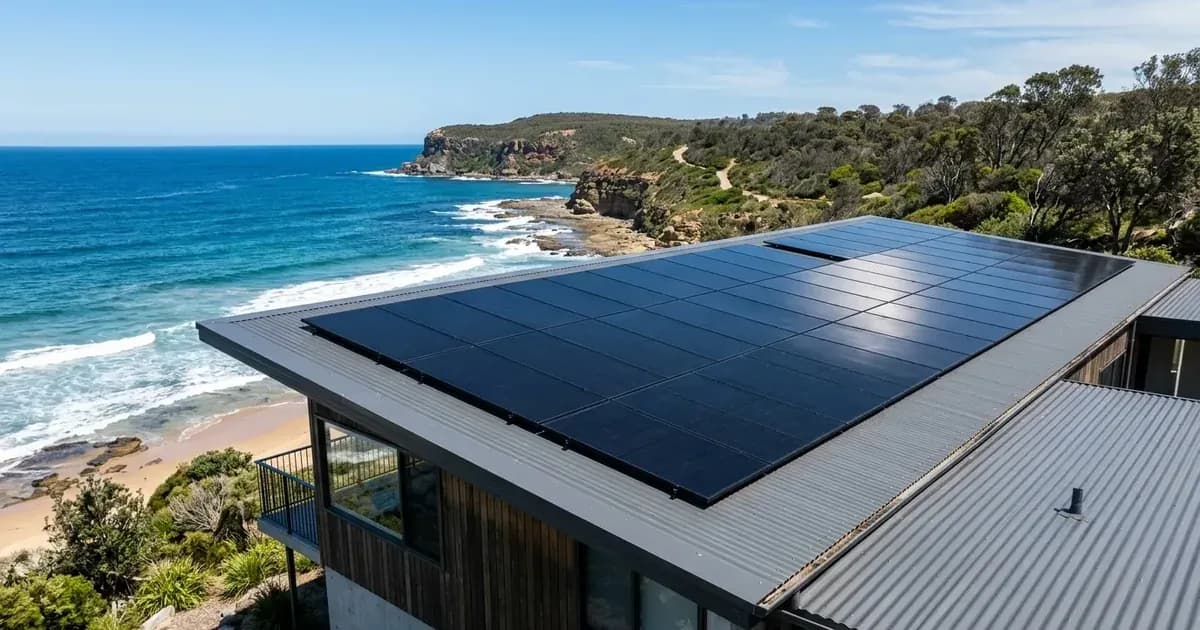
SunPower (marketed globally via Maxeon Solar Technologies) occupies the pinnacle of premium residential solar technology. Originating in Silicon Valley in 1985, SunPower built its reputation on proprietary Interdigitated Back Contact (IBC) cell architecture, delivering conversion efficiencies and warranty durations that set the benchmark for the global photovoltaic industry.
In Australia, SunPower represents the choice for homeowners seeking maximum energy density on restricted roof spaces, long-term durability in coastal saline environments, and the industry's only 40-year warranty package.
Brand Heritage & Tier 1 Ranking
SunPower holds Bloomberg Tier 1 status. In large-scale renewable infrastructure, Bloomberg New Energy Finance (BNEF) Tier 1 classification denotes bankability—verifying that major financial institutions provide non-recourse capital for developments deploying the manufacturer's equipment.
In Australia, SunPower maintains an established corporate and technical operations office based in Sydney. Having an active domestic presence guarantees that warranty claims, product replacement logistics, and consumer protections under Australian Consumer Law remain fully accessible.
Interdigitated Back Contact (IBC) Cell Technology
The technical foundation of SunPower's flagship Maxeon range is its patented Interdigitated Back Contact (IBC) design. Standard solar cells place delicate metal gridlines on the front face, which shade light and crack under thermal stress.
Maxeon cells eliminate front-side metal contacts entirely. Built upon a solid copper foundation, the cell absorbs sunlight across 100% of its front surface area. The thick copper backing provides immense mechanical strength, preventing the micro-cracks and solder-joint corrosion that degrade conventional modules over decades of thermal expansion and contraction.
Product Lineup: Maxeon vs Performance Series
SunPower's Australian catalog features two distinct hardware tiers:
1. SunPower Maxeon Series
The Maxeon family is SunPower's flagship offering. Notably, the first 400Wp residential solar panel the SunPower Maxeon 3 established a global milestone for residential power density. Built with Monocrystalline Maxeon Gen III IBC cells, it operates at a remarkably high rated voltage of 65.8 V, reducing current-related thermal losses and optimizing multi-panel string performance.
2. SunPower Performance Series
The Performance Series (e.g. Performance 6) provides a more cost-accessible option. Utilizing shingled Monocrystalline PERC cell strips overlapping like roof tiles, Performance panels eliminate traditional copper ribbon busbars, offering superior shade tolerance and reliability compared to standard full-cell modules.
Specifications Comparison Table
The following technical data highlights the electrical and structural characteristics across SunPower's module lineup:
Parameter | SunPower Maxeon 3 | SunPower Performance 6 |
|---|---|---|
Cell Technology | Monocrystalline Maxeon Gen III | Monocrystalline PERC |
Cell Count | 104 Cells | 104 Cells |
Power Output | 400Wp | 410Wp |
Rated Voltage | 65.8 V | 29.9V |
Panel Efficiency | 22.6% | 20.9% |
Annual Power Degradation | 0.25% | 0.45% |
Module Dimensions | 1690 x 1046 x 40mm (1.77m²) | 1808 x 1086 x 30mm (1.96m²) |
Module Weight | 19kg | 21kg |
Operational Temperature Range | -40°C to 85°C | -40°C to 85°C |
40-Year Warranty & Degradation Benchmarks
SunPower offers an unprecedented warranty framework that redefines long-term solar asset security:
- Product Warranty: SunPower provides a 40 years product warranty on its Maxeon range (upon registration), compared to 25 years on the Performance series. This covers all repair, replacement, and shipping costs associated with manufacturing faults.
- Performance Warranty: The performance warranty extends to 40 years on Maxeon modules, backed by an ultra-low annual degradation rate of just 0.25%. Over four decades of operation, a Maxeon array is warranted to retain at least 88.25% of its initial rated power output. In comparison, Performance series panels carry a 25 years performance warranty with 0.45% annual degradation.
AC Modules & Enphase Integration
For homeowners with multi-faceted or partially shaded roof planes, Sunpower’s Maxeon and Performance series panels series are called AC modules when they are combined with inbuilt Enphase micro-inverters.
Factory-assembling an Enphase microinverter directly to the back of the SunPower panel eliminates high-voltage DC rooftop wiring, provides individual panel-level maximum power point tracking (MPPT), and ensures that shading on one panel does not compromise the output of adjacent modules.
Pricing & Installation Costs in Australia
SunPower modules command a premium price position in the Australian solar market, reflecting their solid-copper cell architecture, high conversion efficiency, and four-decade warranty backing.
Based on Solar Choice market indexing across Australian capital cities, average fully installed turnkey costs for residential systems utilizing SunPower panels (inclusive of premium inverter or microinverters, mounting rails, and installation net of federal STC discounts) are:
- 6kW System: Average fully installed cost of $7,907
- 8kW System: Average fully installed cost of $10,195
- 10kW System: Average fully installed cost of $12,574
While initial out-of-pocket investment is higher than standard Tier-1 Chinese alternatives, SunPower's 40-year lifespan and 22.6% efficiency maximize total lifetime kilowatt-hours generated, offering excellent return on investment for long-term property owners.
Rebate Eligibility & Standards Compliance
To qualify for upfront federal financial incentives under the Clean Energy Regulator's Small-scale Renewable Energy Scheme (SRES), residential installations must satisfy statutory standards:
- System Capacity: Installations must have a capacity less than 100 kW and have a total annual electricity output less than 250 MWh to generate Small-scale Technology Certificates (STCs).
- Accreditation: Installers must list its panels and inverter on the Clean Energy Council list of approved products, verifying all equipment complies with Australian and New Zealand standards.
- Serial Verification: To help protect you from purchasing non-genuine solar panels, the Solar Panel Validation Initiative gives you an easy way to check and confirm that solar panels installed on your roof are genuine units validated against manufacturer records.
- STC Market Value: STCs trade on open markets typically between $33 and $38 per certificate, providing an immediate point-of-sale deduction off the gross system invoice.
To compare SunPower with alternative premium European and heterojunction technologies, explore our REC solar panels review Australia and our guide on how to compare solar quotes in Australia.
Frequently asked questions
What warranty coverage does SunPower offer in Australia?
SunPower provides an industry-exclusive 40 years product warranty and 40 years performance warranty on its Maxeon line, backed by a 0.25% annual degradation guarantee.
How much does a SunPower solar system cost in Australia?
Based on Solar Choice market indexing, average fully installed turnkey costs net of STCs are $7,907 for a 6kW system, $10,195 for an 8kW system, and $12,574 for a 10kW system.
What is an Enphase AC module?
SunPower Maxeon and Performance panels combined with inbuilt Enphase micro-inverters are called AC modules, providing panel-level optimization and eliminating high-voltage DC rooftop wiring.
What makes SunPower Maxeon IBC cells different from standard solar cells?
Maxeon IBC cells feature a solid copper foundation with zero front-contact metal gridlines, preventing thermal micro-cracking and achieving conversion efficiencies up to 22.6%.
References
- Solar Choice - SunPower Solar Panels Independent Review — accessed 28 August 2026
- Clean Energy Regulator - Rooftop Solar SRES Rules — accessed 28 August 2026
Related guides
More from what to buy — and how not to get cheated.