Maxpower MP-10000 10.24 kWh Lithium Battery
Rs 442,500 verified 2 Aug 2026 — prices in Pakistan move weekly
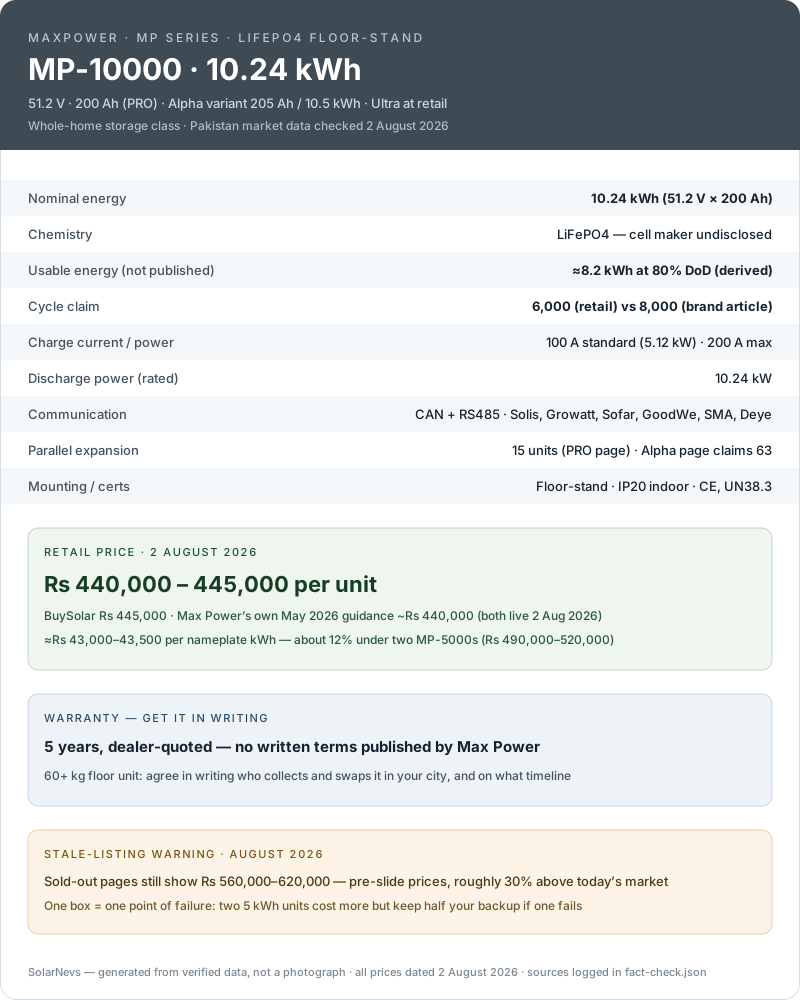
Specifications
| nominalEnergy | 10.24 kWh (51.2V x 200Ah); Alpha variant 10.5 kWh (205Ah) |
|---|---|
| chemistry | LiFePO4 (per Max Power; cell maker undisclosed) |
| usableEnergy | not published — ~8.2 kWh at the 80% DoD retailers quote (derived) |
| cycleClaim | 6,000-cycle guarantee (retail listings); 8,000 claimed in Max Power's May 2026 article |
| chargeCurrent | 100A standard (5.12 kW), 200A max (PRO page); Alpha 100A / 6.14 kW |
| dischargePower | 10.24 kW (PRO page) |
| comms | CAN + RS485; named compatible with Solis, Growatt, Sofar, GoodWe, SMA, Deye |
| parallel | 15 units (PRO) / 63 units (Alpha page claim) |
| mounting | floor-stand (PRO); IP20 indoor |
| Warranty | 5 years, dealer-quoted (BuySolar adds "lifetime free service"); no written warranty terms published on maxpower.com.pk — get the warranty card and claim procedure in writing before paying. |
The Maxpower MP-10000 is a 10.24 kWh (51.2V, 200Ah) LiFePO4 floor-stand battery — the whole-home storage unit in Maxell Power's lineup. As of 2 August 2026 it sells for Rs 440,000-445,000, which at roughly Rs 43,000 per nameplate kWh makes it about 12% cheaper per kWh than the brand's own MP-5000.
It targets homes running a 6-8 kW hybrid inverter that want an AC to survive load-shedding, not just fans and lights. The current official line is the MP-10000 PRO (200Ah) with an Alpha variant (205Ah, 10.5 kWh) alongside; legacy "Ultra" stock is still what most retailers list.
Specifications
Spec | Value |
|---|---|
Nominal energy | 10.24 kWh (51.2V × 200Ah); Alpha variant 10.5 kWh (205Ah) |
Chemistry | LiFePO4 (cell manufacturer undisclosed) |
Usable energy | Not published — ≈8.2 kWh at 80% DoD (derived, not a spec) |
Cycle life | 6,000-cycle guarantee (retail); 8,000 claimed in Max Power's May 2026 article |
Charge current / power | 100A standard (5.12 kW), 200A max (PRO page); Alpha lists 100A / 6.14 kW |
Discharge power | 10.24 kW (PRO page) |
Operating range | 40-58.4V · charge 0-55°C, discharge -30-60°C |
Communication | CAN + RS485 |
Named inverter compatibility | Solis, Growatt, Sofar, GoodWe, SMA, Deye |
Parallel expansion | 15 units (PRO page); Alpha page claims up to 63 |
Mounting / protection | Floor-stand · IP20 (indoor) · CE, UN38.3 |
Warranty | 5 years (dealer-quoted; not published on official site) |
Honest assessment
Pros. Per-kWh economics are the headline: Rs 43,000/kWh nameplate versus ~Rs 49,000 for the MP-5000 and Rs 55,000-60,000 for Pylontech — buying capacity in one big box is simply cheaper. The 10.24 kW rated discharge and 100-200A charge window mean it can absorb a large solar array's midday surplus and still carry an evening AC load, where a single 5 kWh unit would throttle. CAN and RS485 are published with a named six-brand compatibility list, and the PRO page carries CE and UN38.3 marks.
Cons. Same provenance hole as the whole range: no named cell maker, no published DoD or usable-energy figure, and the 6,000-vs-8,000 cycle contradiction between Max Power's product pages and its own article. The spec sheet itself is inconsistent between variants — PRO says 15 parallel units, the Alpha page says 63; PRO 200Ah/10.24 kWh, Alpha 205Ah/10.5 kWh — signs of datasheets written loosely rather than engineered documentation. At ~Rs 442,000 this is also a single point of failure; two 5 kWh units from any brand give redundancy this box cannot. And the price evidence is thinner than the MP-5000's: one live retailer plus the company's own guidance, with other listings stale or unreachable.
Who should buy. Homes with an 8+ kW hybrid and real overnight loads (an inverter AC, a freezer, a water pump) that want maximum stored kWh per rupee and have indoor floor space near the inverter. Buyers who value redundancy or documented cells over price should split the budget across two Pylontech US5000s instead — roughly Rs 384,000-432,000 for 9.6 kWh on Solar Citizen's May 2026 figures.
Pakistan reality check
Heat and placement. 10 kWh of LiFePO4 in one IP20 cabinet needs a ventilated indoor spot that stays as far under 40°C as your house allows — not the roof-side store room that hits 50°C in June. The charge window closes at 55°C cell temperature; on the hottest days a hot room means slower charging exactly when solar is most abundant. LiFePO4 remains the only sensible lithium chemistry for this climate — see why LiFePO4 beats other lithium here.
The BMS handshake. Same rule as every lithium battery in Pakistan: it must run on CAN or RS485 with the inverter, never on dumb voltage control. The named list (Solis, Growatt, Sofar, GoodWe, SMA, Deye) covers the common documented imports; if your inverter is a local badge, find out what it actually is before assuming compatibility — our BMS guide explains why this kills batteries.
Wiring is not optional at this size. 200A-class DC current demands properly sized cable, torqued lugs and a real DC breaker between battery and inverter. Most "lithium battery problems" reported at this capacity are installation problems — budget for the electrician, not just the box.
Warranty claim reality. Five years through the selling dealer, backed by Maxell Power in Lahore; no published service-centre network. For a 60+ kg floor unit, ask specifically: who collects it in your city if it fails, who provides backup while it is away, and how long a swap takes. Get it on the invoice. The warranty reality table shows how brands compare on paper versus practice.
Price context vs rivals (August 2026)
~10 kWh of storage | Price (Aug 2026) | Rs per nameplate kWh |
|---|---|---|
Maxpower MP-10000 (one unit) | Rs 440,000-445,000 | Rs 43,000-43,500 |
2 × Maxpower MP-5000 | Rs 490,000-520,000 | Rs 47,900-50,800 |
2 × Dyness DL5.0C | Rs 498,000-520,000 | Rs 48,600-50,800 |
2 × Pylontech UF5000 | Rs 560,000-620,000 | Rs 54,700-60,500 |
Pair prices are arithmetic (two times the verified single-unit price, from SolarPanelRates' 14 July 2026 list checked 2 August 2026), not quoted bundle deals — dealers sometimes discount pairs. The MP-10000's pitch is pure rupees-per-kWh; what the rivals sell for the premium is cell provenance and per-module redundancy. For sizing the right total, start from your load: how many kWh do you actually need.
Smaller sibling: MP-5000 5.12 kWh · brand overview: Maxpower hub.
Frequently asked questions
What does the Maxpower MP-10000 cost in Pakistan today?
Rs 440,000-445,000 as of 2 August 2026 — Rs 445,000 at BuySolar, ~Rs 440,000 in Max Power's own price guidance. A sold-out Zaksun listing still shows Rs 620,000 and RS Solar's unreachable page reportedly Rs 560,000; both predate the 2025-26 lithium price slide.
Is one MP-10000 better than two MP-5000s?
On 2 August 2026 prices, yes on cost — Rs 440,000-445,000 versus Rs 490,000-520,000 for two MP-5000s — and it needs one comms connection instead of a parallel setup. Two smaller units win on redundancy (one fails, half your backup survives) and on wall-mounting flexibility; the MP-10000 PRO is a floor-stand unit.
How much real backup does 10.24 kWh give?
At the 80% depth of discharge its cycle rating assumes, roughly 8.2 kWh usable — a typical Pakistani home's full evening-to-morning load including one inverter AC for part of the night. Discharge power is rated at 10.24 kW, comfortably above what a single-phase 6-8 kW hybrid will draw.
Which inverters pair with the MP-10000?
Max Power's MP-10000 PRO page lists CAN and RS485 and names Solis, Growatt, Sofar, GoodWe, SMA and Deye. As always in Pakistan, confirm your exact inverter model and firmware speaks the battery's protocol and get the cable in the deal — voltage-mode operation is where lithium packs go to die.
How many cycles is the MP-10000 rated for?
Retail listings state a 6,000-cycle guarantee; Max Power's own May 2026 article claims 8,000 cycles for the Alpha models. The enforceable commitment is the 5-year warranty. At one cycle per day, even 6,000 cycles is 16+ years — far beyond the warranty — so treat cycle counts as marketing, not a promise.
References
- Max Power official — MP-10000 PRO specs — accessed 2 Aug 2026
- Max Power official — MP-10000 Alpha specs — accessed 2 Aug 2026
- Max Power official — MP-series price article (21 May 2026) — accessed 2 Aug 2026
- BuySolar — MP-10000 Ultra Rs 445 — accessed 2 Aug 2026
- Zaksun — stale sold-out Rs 620 — accessed 2 Aug 2026
- Solar Citizen — Pylontech price Pakistan (May 2026) — accessed 2 Aug 2026
- SolarPanelRates — lithium price list (updated 14 Jul 2026) — accessed 2 Aug 2026