MS Jaguar Miso (60V graphene electric scooter)
Rs 158,000 verified 2 Aug 2026 — prices in Pakistan move weekly
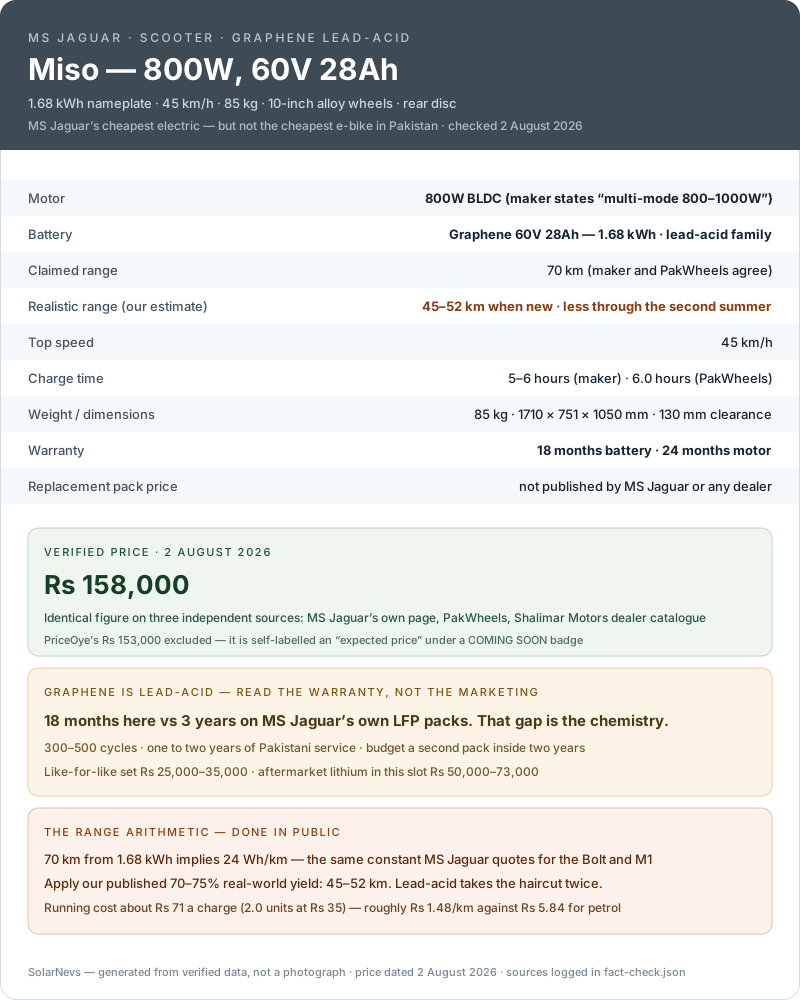
Specifications
| motor | 800W BLDC on PakWheels; MS Jaguar's own page says 'Multi-Mode 800-1000W' - a range, not a rating |
|---|---|
| battery | Graphene 60V 28Ah = 1.68 kWh nameplate. Graphene is a lead-acid derivative, not a lithium chemistry |
| claimedRangeKm | 70 (both MS Jaguar and PakWheels) |
| realisticRangeKm | 45-52 when new, applying our published 70-75% real-yield discount; less again as the pack ages |
| claimedTopSpeedKmh | 45 |
| chargeTimeHours | 5-6 (MS Jaguar); 6.0 (PakWheels) |
| weightKg | 85 |
| dimensionsMm | 1710 x 751 x 1050; ground clearance 130 |
| wheels | 10 in alloy |
| brakes | Rear disc braking system (MS Jaguar); PakWheels does not state a brake type |
| batteryWarranty | 18 months |
| motorWarranty | 24 months |
| colours | Blush Pink, Cream White, Deep Black |
| features | Cruise control, reverse gear, NFC card access, parking mode, anti-theft alarm, sports mode, USB charging port, digital meter, LED lighting |
| Warranty | 18 months on the battery and 24 months on the motor, stated identically on MS Jaguar's own Miso page and on PakWheels - one of the few numbers in this brand's paperwork that two independent sources agree on. No kilometre cap, no claim procedure and no replacement-pack price is published anywhere, and MS Jaguar has no warranty-policy page we could open on 2 August 2026. Eighteen months is also the honest signal about the chemistry: it is what a manufacturer offers on a lead-acid family pack. Get the term, the start date and the named service workshop written on the invoice. |
The MS Jaguar Miso is the cheapest electric vehicle MS Jaguar sells: a 10-inch-wheel retro scooter with an 800W hub motor and a graphene 60V 28Ah pack, listed at Rs 158,000 on 2 August 2026 by the manufacturer, by PakWheels and by the Shalimar Motors dealer catalogue - three independent sources printing the identical figure on the same day, which almost nothing else in this market manages.
What you are buying at that price is a lead-acid scooter with a lead-acid life. "Graphene" is a plate additive, not a chemistry change, and MS Jaguar's own warranty schedule says so: 18 months on this pack against 3 years on the LFP option in its Bolt and M1, and 5 claimed on the E-70. The rest of this page is about what that means for range, for running cost, and for the bill that arrives in year two.
Specifications
Spec | Value |
|---|---|
Motor | 800W BLDC (PakWheels); MS Jaguar states "Multi-Mode 800-1000W" |
Battery | Graphene 60V 28Ah = 1.68 kWh nameplate - lead-acid family |
Claimed range | 70 km (MS Jaguar and PakWheels agree) |
Realistic range | 45-52 km when new - see the arithmetic below |
Claimed top speed | 45 km/h |
Charge time | 5-6 hours (MS Jaguar); 6.0 hours (PakWheels) |
Weight | 85 kg |
Dimensions | 1710 x 751 x 1050 mm; ground clearance 130 mm |
Wheels | 10 in alloy |
Brakes | Rear disc (MS Jaguar); PakWheels states no brake type |
Battery warranty | 18 months |
Motor warranty | 24 months |
Colours | Blush Pink, Cream White, Deep Black |
Features | Cruise control, reverse gear, NFC card access, parking mode, anti-theft alarm, sports mode, USB port, digital meter, LED lighting |
Replacement pack price | not published by anyone |
The two spec sheets agree with each other, which is worth saying out loud on a brand where they usually do not - PakWheels prints 60.0 kWh in the battery field of the E-70 page and 2000.0 kWh on the E-125's. The Miso's 1.68 kWh is arithmetically correct for 60V x 28Ah, and it is the number everything below is built on.
Honest assessment
Pros. Rs 158,000 buys a new scooter from a manufacturer with a plant, a parent group and a dealer network, rather than a grey import with no service path - and it buys it at a price three separate sellers agree on, so there is nothing to haggle against and nothing to be surprised by. The feature list is genuinely generous for the money: cruise control, reverse gear, NFC card access, parking mode and a rear disc are things Rs 150,000 scooters in this market routinely omit. Ten-inch wheels and 85 kg make it easy to manage for a small rider, which is the market MS Jaguar names for it. And unlike most of this brand's paperwork, the Miso's two published spec sheets do not contradict each other.
Cons. The battery is the whole argument, and it is a lead-acid battery. Eighteen months of warranty on a pack that our replacement guide puts at 300-500 cycles means you are budgeting for a second pack inside two years and a third inside four, at Rs 25,000-35,000 a set for like-for-like or Rs 50,000-73,000 to go lithium - and nobody, MS Jaguar included, publishes that price. The 70 km range claim does not survive the discount our own range methodology applies to every brochure. The 45 km/h top speed is genuinely limiting: this is a within-neighbourhood scooter, not a bike for the Ring Road or a Karachi arterial with a pillion. Charging takes 5-6 hours, so there is no top-up-at-lunch usage pattern. And the motor specification is quoted as a range ("800-1000W") on the manufacturer's own page, which is a rating a manufacturer should be able to state as one number.
Who should buy. A short-distance urban rider - school run, market, 15-20 km a day inside one town - who wants a new vehicle with a dealer behind it for the smallest possible outlay, and who has read the paragraph about the battery and accepted it. That rider genuinely wins here: at 20 km a day the pack is barely stressed, the 45 km/h ceiling never binds, and the Rs 1.48-per-kilometre running cost against Rs 5.84 for petrol is real money. Anyone commuting 40 km a day, carrying a pillion regularly, or planning to keep the scooter five years should either pay up for an LFP bike or buy elsewhere - on this pack, a 40 km daily commute is a full discharge every single day, which is precisely the duty cycle lead-acid is worst at.
Pakistan reality check
The range arithmetic, done in public. MS Jaguar claims 70 km from 1.68 kWh. That implies 24 Wh per kilometre. Its own Bolt (1.92 kWh, 80 km claimed) and M1 (2.30 kWh, 90 km) imply 24 and 25.6 Wh/km - so the whole graphene range is quoted off one constant, which is what a calculation looks like rather than a test. Now apply our published real-world yield of 70-75%: 45-52 km. That is before the second haircut. A lead-acid family pack does not deliver its nameplate energy at real riding currents the way LiFePO4 does, and every 10C above 25C roughly halves its service life - Pakistani summers pass 45C. Expect the number to be at the bottom of that band in June and to keep falling through the second year. The one owner report we could find on this brand, on PakWheels' E-125 page, describes 75 km per charge against a 170 km claim - a 44% yield on a different model, but not an encouraging data point.
Eighteen months is the honest number on the page. It is easy to read a short warranty as a defect. Read it instead as the only piece of information on this listing that MS Jaguar has a financial reason to be accurate about. The company offers 3 years on the LFP packs in its Bolt and M1 and claims 5 on its E-70. It offers 18 months here. That gap is the chemistry difference, priced by the party that pays for the claims. Which also means: if a dealer tells you the Miso's graphene pack "lasts like lithium", the manufacturer's own warranty schedule contradicts him, and you should ask him to write his version on the invoice.
Ask for the replacement price before you buy the bike. This is the single most useful thing you can do in the showroom, and the reason it works is that the honest answer is uncomfortable. A like-for-like graphene set is roughly Rs 25,000-35,000 - about a fifth of the scooter - and an aftermarket lithium upgrade in the 60V 28-30Ah slot runs Rs 50,000-73,000 per our replacement guide. Over three years and 36,000 km, the Miso costs about Rs 158,000 for the bike, about Rs 52,000 of electricity and Rs 50,000-70,000 of battery sets: Rs 260,000-280,000 all-in. MS Jaguar's own 70cc petrol bike at Rs 107,900 burns about Rs 210,000 of petrol over the same distance at Rs 336.03 a litre, landing near Rs 318,000 before oil and chain work. The electric wins - by less than the "Rs 1,000 a month" advertising suggests, and only if the battery sets come in at the low end.
Heat and where you park it. Lead-acid family packs lose service life fastest when they sit hot and sit discharged. Charge indoors, park under cover, and do not leave the scooter at 10% overnight in July. Nothing on the listing tells you this, and it is worth more to the pack than any of the smart features.
Get the chemistry named on the invoice. MS Jaguar sells the Bolt and M1 in both graphene and LFP versions at prices that differ by Rs 42,000-71,000, and the model name is identical either way. The Miso is graphene only today - but on a brand structured like this, "MS Jaguar scooter" on a receipt is not a specification. Write "graphene 60V 28Ah, 18-month battery warranty from [date]" on the invoice and have the dealer sign it.
Price context vs rivals (August 2026)
Same portal, same day - PakWheels' electric-bike listing, 2 August 2026, everything within Rs 50,000 of the Miso:
Scooter | Battery, as the source prints it | Price (2 Aug 2026) |
|---|---|---|
Evee Flipper | Lead Acid | Rs 97,000 |
Benling Mini Scooter | "Lithium Ion" in the spec field, "48V 23Ah graphene" in the text on the same page - see below | Rs 120,000 |
Jolta JE-70D | Dry Gel, 60V 20Ah (a lead-acid type) | Rs 149,900 |
Evee Nisa | Graphene | Rs 155,000 |
MS Jaguar Miso | Graphene 60V 28Ah (lead-acid family) | Rs 158,000 |
Revoo A11 | Graphene | Rs 167,000 |
Evee Gen-Z | Graphene | Rs 177,900 |
Revoo A12 | Graphene | Rs 187,000 |
Yadea GT30 | Graphene | Rs 194,000 |
Evee S1 | Graphene | Rs 206,000 |
The Miso is not the budget end of this market - it is the middle of it. The Evee Flipper at Rs 97,000 and the Benling Mini at Rs 120,000 sit Rs 38,000-61,000 below it, and the Jolta JE-70D undercuts it by Rs 8,100. What the extra money buys against those is the feature set, the disc brake, the dealer network and a published 18-month battery term where some rivals publish nothing - the Yadea GT30's battery-warranty field on PakWheels reads simply "-".
What it does not buy is a different chemistry. Note that the middle column above is what the listing prints, not our paraphrase: eight of these ten are graphene or another lead-acid type, so the replacement-pack maths applies to them exactly as it applies to the Miso. Graphene is not the lithium a showroom may imply it is, on any of these bikes.
The one apparent exception is the Benling Mini, and it is not one you can lean on. PakWheels' battery-type field for it reads "Lithium Ion" while the descriptive text on the same page describes a 48V 23Ah graphene battery. We cannot resolve that from here, and we are not going to pick the flattering reading of a page that contradicts itself. If the Benling is the bike you are weighing against the Miso, make the dealer write the cell chemistry on the invoice - the same instruction we give for MS Jaguar's own Bolt, and for the same reason.
If the battery bill is what worries you - and on this evidence it should be - the decision is not between these ten scooters. It is whether to spend Rs 158,000 here or Rs 226,000-245,000 on MS Jaguar's own Bolt with the LFP pack, which triples the warranty to three years and roughly triples the cycle life for a Rs 68,000-87,000 premium. Across three years and two graphene sets, that premium is close to a wash - and you end the period with a battery that still has most of its life left. Full lineup and today's prices are on the MS Jaguar hub page.
Frequently asked questions
What does the MS Jaguar Miso cost in Pakistan today?
Rs 158,000 as of 2 August 2026, and unusually for this market three independent sources print exactly that figure on the same day - MS Jaguar's own product page, PakWheels' Miso page, and the Shalimar Motors dealer catalogue. PriceOye shows Rs 153,000 but labels it an expected price under a COMING SOON badge, so we do not treat it as a live listing.
Is the Miso's battery lithium?
No. It is a graphene 60V 28Ah pack, and graphene here means a lead-acid battery with a modified plate additive - the lead-acid family, not lithium. The 18-month battery warranty is the tell - MS Jaguar itself offers 3 years on the LFP option in its Bolt and M1 scooters and claims 5 on the E-70. If you want lithium from this brand, the Miso is not the model.
What is the real range of the MS Jaguar Miso?
Plan for 45-52 km when new, not the 70 km claimed. That is the claim discounted by the 70-75% real-world yield our own range methodology guide publishes, and it is before the lead-acid haircut - a graphene pack delivers less of its nameplate at real riding currents than lithium does. Expect that figure to fall again through the second summer as the pack ages.
What does it cost to charge and run?
About Rs 71 for a full charge - 1.68 kWh plus roughly 20% charging losses is about 2.0 units, at the Rs 35 residential tariff our home charging guide uses. Over a realistic 45-52 km that is about Rs 1.48 per kilometre, against about Rs 5.84 per kilometre for a 70cc petrol bike at the Rs 336.03 per litre OGRA price for 1-3 August 2026.
How much is a replacement battery for the Miso?
MS Jaguar does not publish one, and neither does any dealer we could open. Using our replacement-cost guide's voltage-and-capacity table, the Miso's 60V 28Ah slot falls between Rs 50,000 (60V 20Ah) and Rs 73,000 (60V 30Ah) for an aftermarket lithium pack, or Rs 25,000-35,000 for a like-for-like lead-acid set. On an 18-month warranty you should assume you are buying one of those roughly every 15-24 months and ask the dealer to quote it in writing before you buy the bike.
Is the Miso the cheapest electric bike in Pakistan?
No. It is the cheapest electric MS Jaguar, but on PakWheels' own electric-bike listing on 2 August 2026 the Evee Flipper was Rs 97,000, the Benling Mini Scooter Rs 120,000 and the Jolta JE-70D Rs 149,900. MS Jaguar's Rs 107,900 and Rs 115,900 models on the same brand page are petrol 70cc and 100cc bikes, not electrics - a confusion worth avoiding before you walk into a showroom.
References
- MS Jaguar official - Miso product page (price, graphene 60V 28Ah, 70 km, 45 km/h, 18/24-month warranty, rear disc) — accessed 2 Aug 2026
- PakWheels - MS Jaguar Miso price and specifications (800W, 1.68 kWh graphene, 70 km, 6 h charge, 85 kg, 10 in alloy) — accessed 2 Aug 2026
- Shalimar Motors - MS Jaguar EV dealer catalogue (Miso Rs 158,000) — accessed 2 Aug 2026
- PakWheels - MS Jaguar brand page (petrol 70cc Rs 107,900 and 100cc Rs 115,900 alongside the electrics) — accessed 2 Aug 2026
- MS Jaguar official - Bolt product page (graphene 60V 32Ah vs LFP 60V 30Ah, 18-month vs 3-year warranty) — accessed 2 Aug 2026
- MS Jaguar official - M1 product page (graphene 72V 32Ah vs LFP 60V 30Ah) — accessed 2 Aug 2026
- PakWheels - MS Jaguar Bolt specifications (1.92 kWh graphene, 80 km claimed) — accessed 2 Aug 2026
- PriceOye - MS Jaguar Miso page, self-labelled 'expected price' Rs 153,000 under a COMING SOON badge — accessed 2 Aug 2026
- PakWheels - all new electric bikes in Pakistan, same-day rival prices — accessed 2 Aug 2026
- PakWheels - Evee Flipper (battery type field reads 'Lead Acid'; Rs 97,000) — accessed 2 Aug 2026
- PakWheels - Benling Mini Scooter (battery type field reads 'Lithium Ion' while the page text describes a 48V 23Ah graphene pack; Rs 120,000) — accessed 2 Aug 2026
- PakWheels - Jolta Electric JE-70D (battery type 'Dry Gel', 60V 20Ah; Rs 149,900) — accessed 2 Aug 2026
- PakWheels - Evee Nisa (Graphene; Rs 155,000) — accessed 2 Aug 2026
- PakWheels - Revoo A11 (Graphene; Rs 167,000) — accessed 2 Aug 2026
- PakWheels - Evee Gen-Z (Graphene; Rs 177,900) — accessed 2 Aug 2026
- PakWheels - Yadea GT30 (Graphene; battery warranty field reads '-'; Rs 194,000) — accessed 2 Aug 2026
- PakWheels - Evee S1 (Graphene; Rs 206,000) — accessed 2 Aug 2026
- ARY News - petrol fixed at Rs 336.03 per litre, effective to 3 August 2026 — accessed 2 Aug 2026