Why Your Solar Inverter Trips During Load Shedding in Pakistan
Updated 2 August 2026 · By SolarNevs Research Desk, Dealer surveys + verified sources · 20 sources · Method ↗
Why Your Solar Inverter Trips During Load Shedding in Pakistan
{/* visual_plan: stat_block */}
Key Takeaways
- Hybrid inverters transfer from grid to battery in under 10 milliseconds, and a Backup Delay setting can change that timing on some models (verified July 2026).
- Deye's engineering guidance is to keep generator charging plus house consumption at roughly 70-80 percent of the generator's rated power so the engine does not stall (verified July 2026).
- On Deye hybrids the generator input, smart load output and micro-inverter input share one physical port, so only one function can be enabled at a time (verified July 2026).
- The fault codes to read are Deye F35 (no AC grid) and F41 (AC line over voltage), and Growatt "No AC Connection" and Error 304 (grid frequency out of range), verified July 2026.
- CNC Electric's guide (updated April 2026) reports restoration surges of 280-300V for a few seconds when supply returns after load shedding, which is when many trips occur.
What is happening at the moment the grid drops?
When the feeder goes dead, a hybrid inverter has to detect the loss, open its grid relay, and start supporting the house from battery. Documented changeover for hybrid inverters is generally under 10 milliseconds, fast enough that a desktop computer does not reboot.
The speed is the problem, not the solution. Every device that was running a moment ago is still running, and a few of them were mid-cycle. Compressors in air-conditioners and refrigerators, water pumps, and older ceiling-fan capacitors all present a starting or re-establishing current far above their running current. The inverter, which a second earlier was comfortably supplying 3kW backed by an infinite grid, is suddenly asked for a multiple of that from a battery with a hard current limit.
The result is an overload trip within a second or two of the outage beginning. Owners experience it as "the inverter fails when I need it", which feels like a defect and is usually a sizing or configuration issue.
The mirror-image event happens on restoration. CNC Electric's April 2026 guide reports that when power returns after hours of load shedding, the initial surge can spike to 280-300V for a few seconds, and calls this the number one killer of AC compressors and fridge motors in Pakistan. Your inverter sees that spike as a grid fault, which is what it is, and refuses to synchronise, or drops out immediately after connecting.
So the two failure moments are the drop and the return, and they have different causes. Diagnose them separately.
Is it overload, and how do you prove it?
Read the log and read the numbers, in that order.
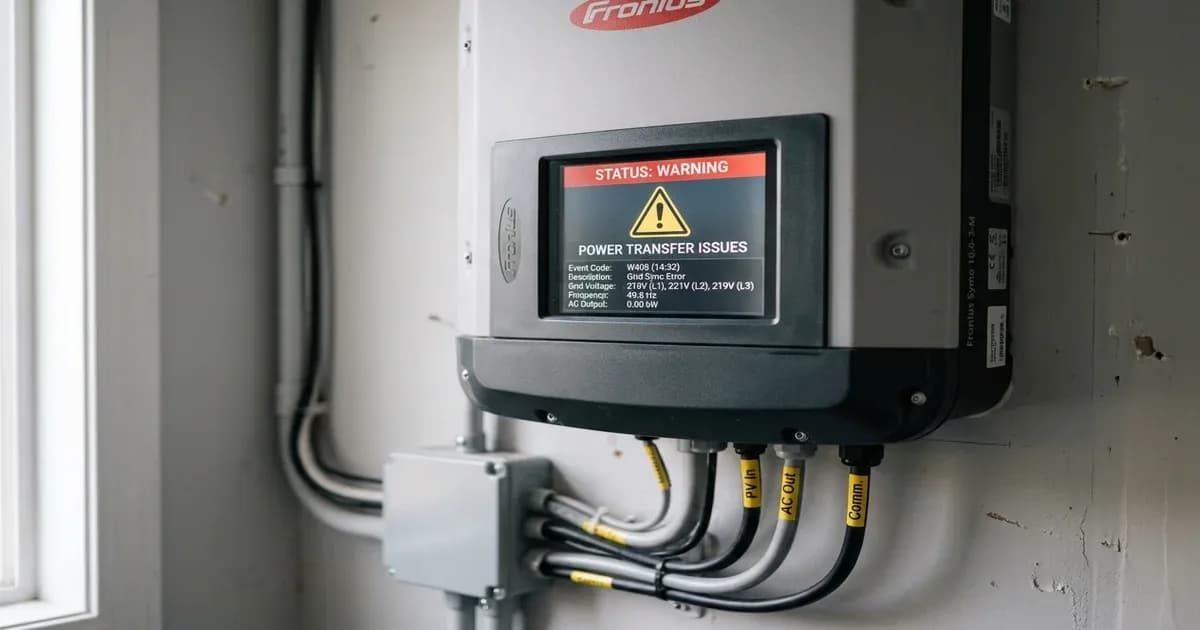
The fault codes distinguish the cases cleanly. Deye F35 means no AC grid detected and is normal during load shedding; it is a status, not a fault. Deye F41 means AC line over voltage and points at the restoration spike. Deye F34 and F18 are AC overcurrent faults and point squarely at load. Growatt's "No AC Connection" is the normal outage state, while Error 304 is grid frequency out of range, which is what you get when the source is a struggling generator rather than the grid.
Then do the arithmetic honestly. Add up what is running at the moment load shedding typically starts in your area. In Pakistan, LESCO-type rotations commonly run one hour off and one hour on, or two hours off in peak summer, and high-loss feeders get longer durations. If your shedding block starts at 2pm, the load at 2pm includes every air-conditioner in the house.
Then compare that number, plus a realistic starting allowance for the largest motor, against the inverter's continuous rating rather than its peak rating. Dealers quote peak. Peak is a few seconds. The number that matters is continuous.
The honest conclusion is often uncomfortable, because a 5kW hybrid is not a whole-house Pakistani summer solution. It is an essential-loads solution. That is a sizing conversation, not a repair.
{/* visual_plan: comparison */}
How should the essential-load side be wired?
The single most effective fix for load-shedding trips costs almost nothing and no dealer suggests it, because it means selling you less inverter.
Split the distribution board. Put the loads that genuinely must ride through an outage, including lights, fans, routers, one or two fridges, and the essential sockets, on the inverter's backup output. Leave the discretionary heavy loads, particularly the ducted or multiple air-conditioners and the water heater, on a non-backed circuit that simply goes dark during shedding.
This does three things at once. It removes the inrush stack at the moment of transfer. It stops your battery being emptied in twenty minutes by a load it was never sized for. And it makes the whole system's behaviour predictable, which is worth more than any single setting.
Where a hybrid inverter supports a smart load output, that same port can be used to shed a specific circuit automatically when the battery falls below a threshold. On Deye hybrids, note the constraint that the generator input, the smart load output and the micro-inverter input all use the same physical port, and only one function may be selected. You cannot have a generator input and a smart load output on the same unit.
How do you make a generator and a hybrid inverter live together?
This is where most Pakistani installations go wrong, because the generator was there first and the inverter was added around it.
Never parallel two sources. A changeover switch exists precisely to make it impossible for the grid and the generator to be connected at the same time. Pakistani changeover breakers start from around Rs 2,950 (2026) and are standard practice where any alternate supply exists. If your installation lets both sources reach the same busbar, stop using it until that is corrected. This is a safety issue, not a performance issue.
Feed the generator into the generator input, not the grid input, on models that have one. When a hybrid inverter has any AC source on its input it becomes a follower, matching that source's phase, frequency and voltage. Feeding a small generator into a grid input can make the inverter attempt to export into the generator, which the generator cannot absorb.
Size the charging. Deye's engineering guidance is direct, stating that you should set the generator charge current so that charging plus household consumption together stay at roughly 70-80 percent of the generator's nominal power, to prevent it from stalling. A 5kVA generator asked to run the house and dump 60A into a battery bank will bog, its frequency will sag, and the inverter will reject it.
Expect frequency and waveform problems from small sets. A cheap non-inverter generator under varying load wanders in frequency. The inverter's frequency window is a protection, not an inconvenience, and Growatt Error 304 exists precisely for this. If your inverter accepts the grid all day but refuses the generator, suspect the generator, not the inverter.
Get the neutral-earth arrangement right. Many portable generators ship with a floating neutral, expecting the bond to exist elsewhere in the installation. Get this wrong and you get nuisance earth-leakage tripping, or worse, no fault path at all. This is a job for a competent electrician with a meter, not a setting in an app.
{/* visual_plan: step_flow */}
Which UPS-mode and transfer settings matter?
Four settings do most of the work. Everything else is noise.
Battery discharge floor. If the inverter cuts to grid or shuts down when the battery hits its low limit, and your shedding block is longer than your battery can cover at your load, the "trip" is simply the battery running out. Check the state of charge at the moment of the event before you change anything else.
Backup or transfer delay. Documented hybrid changeover is under 10 milliseconds, but the Backup Delay parameter alters that on some models. A slightly longer delay can help where a noisy grid produces repeated micro-dropouts and the inverter is chattering between sources. Change it in one step and observe for a week.
Charge current from AC. A hybrid that immediately slams maximum charge current into the battery the instant grid returns is adding a large load to a feeder that has just been re-energised, on top of every neighbour's compressor restarting. Reducing AC charge current smooths restoration and reduces the chance of the inverter tripping straight back off.
Grid protection settings. Leave them alone. Deye's own configuration guidance says not to touch the F(W), V(W) or V(Q) curves without specific instruction because they are imposed by the network operator. If a technician's proposed fix for load-shedding trips is to widen your grid voltage or frequency windows, you are being sold silence, not a repair.
One last piece of context that changes the economics. Under the NEPRA Prosumer Regulations 2026, notified as SRO 251(I)/2026 on 9 February 2026, new connections no longer receive net metering; export is credited around Rs 11 per unit (February 2026) against import that can reach Rs 50-65 per unit (February 2026). That makes battery ride-through, not export, the thing worth engineering for. Yet only about 4 percent of Pakistani solar homes have batteries at all (2025), which is the real reason so many systems collapse the moment the feeder opens.
Frequently Asked Questions
Why does my inverter trip the moment load shedding starts?
Usually inrush. Everything that was running on grid restarts simultaneously on battery within about 10 milliseconds, and motor starting current can be several times running current, which trips the overload protection.
Can I run a hybrid inverter from a generator?
Yes if the model has a generator input, but keep generator charging plus house load to roughly 70-80 percent of the generator's rated output so the engine does not stall.
Is a changeover switch still needed with a hybrid inverter?
A hybrid inverter with an internal transfer relay does the switching itself. A separate changeover is used where a generator or a second source must be selected, and it must never parallel two sources.
References
- Wattuneed, Deye hybrid inverter configuration guide 2026
- Deye inverter fault code list F01-F64
- Deye fault codes 5kW-8kW reference
- Growatt inverter error codes, Pakistan context
- CNC Electric, changeover breaker complete guide, Pakistan
- CNC Electric, changeover switch prices, Pakistan 2026
- CNC Electric, voltage regulator vs voltage protector, Pakistan
- VIOX, hybrid inverter ATS wiring, 2-wire start and neutral bonding
- LESCO load shedding schedule and feeder-level rotations
- ProPakistani, IESCO announces temporary load shedding schedule
- [NEPRA Prosumer Regulations 2026, SRO 251(I)/2026](https://www.nepra.org.pk/Legislation/3-Reg/3.35%20NEPRA%20%20Prosumer%20Regulations%202026/NEPRA%20Prosumer%20Regulations%20(SRO%20251(I)2026)%2009-02-26.PDF)
- RV Electricity, generator bonding plug and floating neutral explained
Frequently asked questions
Why does my inverter trip the moment load shedding starts?
Usually inrush. Everything that was running on grid restarts simultaneously on battery within about 10 milliseconds, and motor starting current can be several times running current, which trips the overload protection.
Can I run a hybrid inverter from a generator?
Yes if the model has a generator input, but keep generator charging plus house load to roughly 70-80 percent of the generator's rated output so the engine does not stall.
Is a changeover switch still needed with a hybrid inverter?
A hybrid inverter with an internal transfer relay does the switching itself. A separate changeover is used where a generator or a second source must be selected, and it must never parallel two sources.
References
- WattUneed — accessed 26 July 2026
- DIY Solar Power Forum — accessed 26 July 2026
- BSL Battery — accessed 26 July 2026
- Sunriver — accessed 26 July 2026
- Viox — accessed 26 July 2026
- Inverter Error Codes — accessed 26 July 2026
- Solar Deals — accessed 26 July 2026
- Scribd — accessed 26 July 2026
- Solar Inverters PK — accessed 26 July 2026
- CNC Electric Pakistan — accessed 26 July 2026
- Check Bills Online — accessed 26 July 2026
- ProPakistani — accessed 26 July 2026
- CNC Electric Pakistan — accessed 26 July 2026
- CNC Electric Pakistan — accessed 26 July 2026
- DIY Solar Power Forum — accessed 26 July 2026
- RV Electricity — accessed 26 July 2026
- Mike Holt Forum — accessed 26 July 2026
- DIY Solar Power Forum — accessed 26 July 2026
- NEPRA — accessed 26 July 2026
- IESCO — accessed 26 July 2026
Related guides
More from inverter errors & fixes.