Monocrystalline vs Polycrystalline Solar Panels in Pakistan 2026
Updated 2 August 2026 · By SolarNevs Research Desk, Dealer surveys + verified sources · 4 sources · Method ↗
Monocrystalline vs Polycrystalline Solar Panels in Pakistan 2026
{/* visual_plan: stat_block */}
Key Takeaways
- Monocrystalline N-type TOPCon panels dominate 99% of new solar installations in Pakistan for 2026.
- Polycrystalline technology has been phased out by major manufacturers due to low cell conversion efficiency (15% to 17%).
- Monocrystalline panels retail between Rs 39 and Rs 46 per watt (July 2026), offering higher daily energy generation per square meter.
- Residual polycrystalline clearance stock sells for Rs 30 to Rs 34 per watt (July 2026), but lacks 30-year manufacturer warranty backing.
- Tax-verified monocrystalline imports carrying 10% GST under the Finance Act 2025 qualify for NEPRA net billing approvals.
What is the difference between monocrystalline and polycrystalline solar panels?
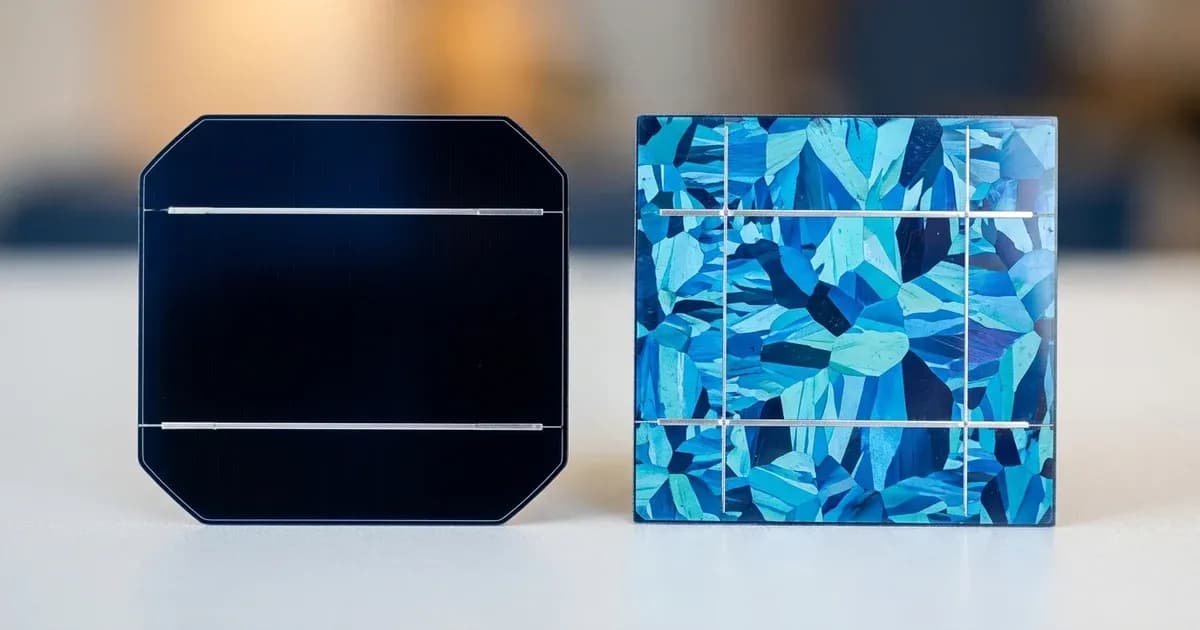
Monocrystalline and polycrystalline solar panels differ in silicon wafer structure, manufacturing processes, and energy conversion performance. Monocrystalline cells are manufactured from a single continuous silicon crystal structure, creating uniform black wafers with truncated corners.
Polycrystalline cells are produced by melting multiple silicon fragments together in a mold. This multi-crystal structure creates a speckled blue appearance. However, boundaries between individual silicon crystals impede electron flow, limiting polycrystalline panel efficiency to 15% to 17%, compared to 22.0% to 23.0% for modern monocrystalline N-type TOPCon modules.
Feature / Specification | Monocrystalline (N-Type TOPCon) | Polycrystalline (Legacy) |
|---|---|---|
Silicon Structure | Single continuous crystal | Multiple melted silicon crystals |
Panel Color | Uniform dark black | Speckled blue marble |
Cell Efficiency | 22.0% to 23.0% | 15.0% to 17.0% |
Price per Watt | Rs 39 to Rs 46 (July 2026) | Rs 30 to Rs 34 (July 2026) |
Temperature Coefficient | -0.30% per degree C | -0.40% per degree C |
Roof Space Requirement | Low (585W per 2.5 sq meter) | High (330W per 2.0 sq meter) |
Commercial Availability | Standard inventory across all dealers | Discontinued liquidation stock |
Why did polycrystalline solar panels become obsolete in Pakistan?
Polycrystalline solar panels dominated the Pakistani market from 2012 to 2018 due to lower manufacturing costs. However, rapid advances in monocrystalline wafer production in China narrowed the manufacturing cost gap, eliminating polycrystalline's financial advantage.
Three key operational factors led to the decline of polycrystalline panels in Pakistan.
First, roof space constraints favor high-efficiency modules. A standard 10kW system using 585W monocrystalline panels requires only 17 modules, occupying approximately 42 square meters of roof area. Achieving 10kW with older 330W polycrystalline panels required 30 modules, occupying over 60 square meters of space.
Second, high summer heat penalizes polycrystalline performance. Polycrystalline cells carry a poor temperature coefficient of -0.40% per degree Celsius. On a summer afternoon in Punjab or Sindh when cell temperatures reach 65 degrees Celsius, polycrystalline output drops by 16%, whereas monocrystalline N-type output drops by only 12%.
Third, major Tier-1 manufacturers like Jinko, LONGi, Canadian Solar, and JA Solar ceased polycrystalline production lines, shifting 100% of factory capacity to monocrystalline N-type TOPCon lamination.
What is the price comparison between monocrystalline and polycrystalline panels?
Monocrystalline Tier-1 N-type panels retail between Rs 39 and Rs 46 per watt (July 2026) in major markets like Lahore and Karachi. A standard high-output 585W monocrystalline module costs Rs 25,418 (July 2026) for Jinko Tiger Neo and Rs 26,796 (July 2026) for LONGi Hi-MO X7.
Residual polycrystalline stock is sold by liquidation vendors at Rs 30 to Rs 34 per watt (July 2026) for 330W or 340W modules (Rs 9,900 to Rs 11,560 (July 2026) per panel). While the lower per-watt rate appeals to budget buyers, these panels are often old stock manufactured before 2020.
Under the Finance Act 2025, official imports incur a 10% GST. Buying tax-documented monocrystalline panels ensures valid importer warranty support. In addition, DISCO utilities require verified serial numbers for net billing registration under NEPRA regulations, which discontinued poly stock cannot provide.
Should you ever buy polycrystalline panels for your system?
Buying polycrystalline panels in 2026 is recommended only for small standalone 12V or 24V DC systems where initial capital expenditure is the primary concern. Applications like rural DC fans, small water pumps, or temporary security lighting can use cheap poly panels effectively.
For grid-tied residential roofs, commercial buildings, and hybrid battery systems, monocrystalline N-type TOPCon panels are the essential standard. Monocrystalline modules yield higher daily kilowatt-hours, resist heat degradation, and provide 30-year performance guarantees.
Frequently Asked Questions
Are polycrystalline solar panels still sold in Pakistan?
Polycrystalline panels are virtually obsolete in 2026 and are sold only as residual clearance stock at Rs 30 to Rs 34 per watt (July 2026) for small DC agricultural applications.
Why are monocrystalline solar panels better than polycrystalline panels?
Monocrystalline panels use single-crystal silicon wafers that achieve higher cell efficiency (22% to 23%), superior heat tolerance, and lower space requirements than multi-crystal poly panels.
What is the price per watt of monocrystalline panels in Pakistan?
Tier-1 monocrystalline N-type TOPCon panels cost between Rs 39 and Rs 46 per watt (July 2026) in local retail markets.
References
Frequently asked questions
Are polycrystalline solar panels still sold in Pakistan?
Polycrystalline panels are virtually obsolete in 2026 and are sold only as residual clearance stock at Rs 30 to Rs 34 per watt (July 2026) for small DC agricultural applications.
Why are monocrystalline solar panels better than polycrystalline panels?
Monocrystalline panels use single-crystal silicon wafers that achieve higher cell efficiency (22% to 23%), superior heat tolerance, and lower space requirements than multi-crystal poly panels.
What is the price per watt of monocrystalline panels in Pakistan?
Tier-1 monocrystalline N-type TOPCon panels cost between Rs 39 and Rs 46 per watt (July 2026) in local retail markets.
References
- Solar Citizen — accessed 25 July 2026
- W11Stop — accessed 25 July 2026
- FBR — accessed 25 July 2026
- NEPRA — accessed 25 July 2026
Related guides
More from what to buy — and how not to get cheated.