Ireland Solar Grid Export Billing and Tax Rules Guide
Updated 18 September 2026 · By SolarNevs Research Desk, Dealer surveys + verified sources · 5 sources · Method ↗
Key Takeaways
- The Clean Export Guarantee (CEG) provides remuneration for microgeneration exports, with tariffs ranging from 16c/kWh to 25c/kWh as of June 2024.
- A smart meter is generally required for export payments, but deemed export calculations apply if you are not eligible for a smart meter.
- An income tax exemption of up to €400 annually applies to profits from domestic microgeneration for tax years 2024-2028 under Section 216D TCA 1997.
- ESB Networks collects half-hourly smart meter data, which is then shared with your electricity supplier for billing.
How is solar electricity export billed and taxed in Ireland?
In Ireland, exporting excess solar electricity from your home to the national grid involves specific billing mechanisms and tax rules. The Commission for Regulation of Utilities (CRU) oversees the Clean Export Guarantee (CEG) framework, which ensures you are remunerated for your microgeneration exports. Additionally, Revenue provides an income tax exemption for certain profits from domestic microgeneration.
Understanding Ireland's Clean Export Guarantee (CEG)
The Clean Export Guarantee (CEG) sets the framework for how you are paid for the electricity your solar panels export. These "Enduring Arrangements to Remunerate Customers for Microgeneration Exports" have been in operation since 2022. The CRU, as Ireland's independent economic regulator, establishes the regulatory environment, while individual electricity suppliers set their commercial export tariffs.
As of June 2024, export tariffs offered by suppliers typically range from 16c/kWh to 25c/kWh. The CRU has decided to "retain a regulated zero-floor price for the CEG export tariff," meaning there is no minimum price set by the regulator. Suppliers have flexibility in their tariff structures, offering "flat-rate tariffs and/or time-of-export tariffs and/or dynamic export price tariffs."
To qualify for export payments with a supplier like Bord Gáis Energy, you must have them as your energy supplier, possess an installed microgenerator, and have notified ESB Networks of your grid connection via an NC6 form or equivalent. A smart meter is also generally required for payment eligibility.
Export Remuneration and Tax Exemption Details
Microgeneration Export Tariff and Payment Overview
Parameter | Regulatory Requirement / Value | Notes |
|---|---|---|
CEG Implementation Date | In operation since 2022 | Interim arrangements |
Export Tariff Range (June 2024) | 16c/kWh to 25c/kWh | Set by individual suppliers |
Regulated Floor Price | Zero-floor price | Set by CRU |
Supplier Payment Frequency (Example: Bord Gáis Energy) | 4 times per year | As a credit to your electricity bill, after 3 months of export |
Supplier Payment Rate (Example: Bord Gáis Energy) | 18.5 cent per kWh | For excess electricity exported under their Microgen Export Plan |
ESB Networks Settlement Frequency (Transitional) | M+4 settlement | Expected by 1 January 2025 for ESBN to suppliers |
Microgeneration Income Tax Exemption
Ireland's tax authority, Revenue, provides an income tax exemption for profits from microgeneration. This is outlined in "Section 216D of the Taxes Consolidation Act (TCA) 1997."
Parameter | Regulatory Requirement / Value | Notes |
|---|---|---|
Legal Basis | Section 216D TCA 1997 | Exemption from income tax, USC, and PRSI |
Exemption Amount (2022-2023) | Up to €200 | For profits arising from microgeneration |
Exemption Amount (2024-2028) | Up to €400 | Extended by Finance Act 2025 to end of 2028 |
Qualifying Period | 1 January 2022 to 31 December 2028 | Scheme duration |
Qualifying Individual | Individual at sole or main residence, for own consumption | Does not need to own the property |
Electricity Bill Requirement | Individual must be named on the electricity bill | Multiple individuals on bill can each claim exemption |
Exemption Scope | Profits from domestic generation supplied to national grid | Does not cover self-consumption savings |
Tax Return for Exempt Profits | No requirement to declare profits up to the limit | For amounts up to €400 (2024-2028) or €200 (2022-2023) |
Excess Profits | Must be declared as income | Amounts above the exemption limit |
Deductible Expenses | Revenue-nature expenses incurred wholly and exclusively | Excludes capital expenditure like installation costs |
Capital Allowances | Not available | Profits do not arise from trade/profession |
Scheme Availability | Not available to companies or corporate entities | Applies only to qualifying individuals |
Smart Metering, Deemed Export, and Grid Connection
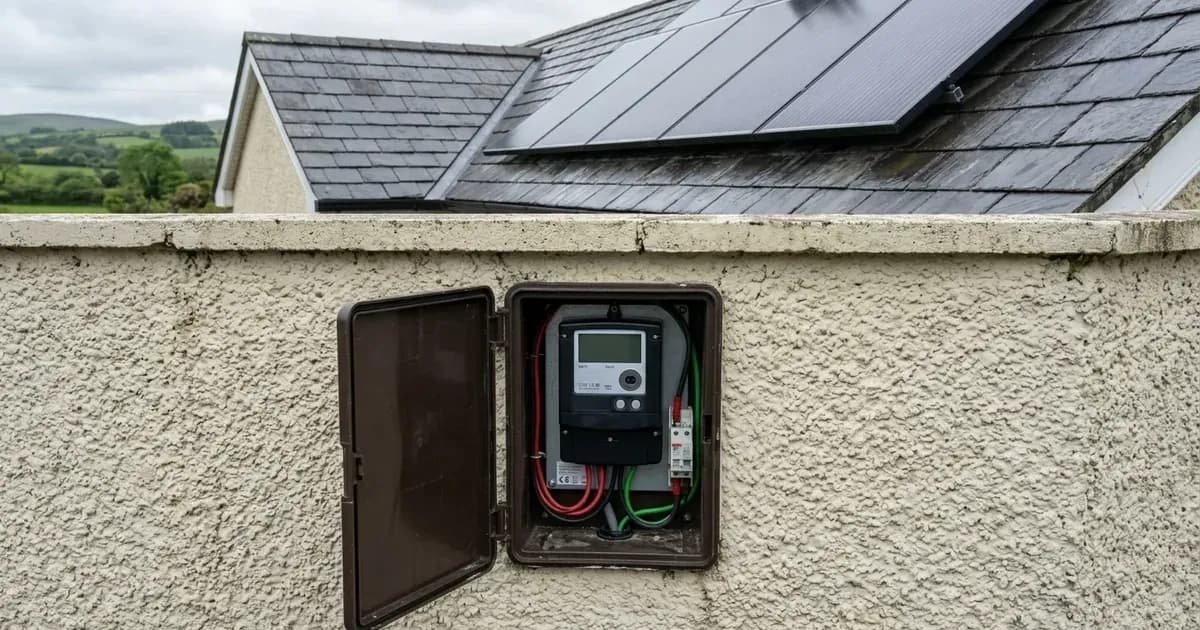
Smart meters play a central role in accurate export billing. ESB Networks has installed "Over 2 million smart meters" across Ireland. If you are eligible for a smart meter, you will need one installed to qualify for export payments. ESB Networks aims to install a smart meter "within four months of a valid NC6 form being processed."
Your smart meter collects data on your electricity use and export every 30 minutes. "Every day, ESB Networks will collect data from your smart meter" and share it with your chosen electricity supplier. You can view your half-hourly demand and export data by signing up to the ESB Networks customer portal, where you can download it as a spreadsheet.
For customers "not eligible under the National Smart Metering Program to have a smart meter installed," a "deemed export calculation" is used. This means your export amount is calculated using a pre-determined formula. The CRU has decided to "retain the existing formula and parameter values for the calculation of deemed export quantities."
Connecting your microgeneration system to the grid requires specific forms. Systems under 6kW (single phase) or 11kW (three phase) require an NC6 form. Larger systems, up to 50kW, require an NC7 form.
Navigating Disputes and Consumer Protections
The CRU has implemented measures to strengthen customer protections for exporting customers. These include requirements for suppliers regarding the frequency of payments, information provided on bills, and transparency of export tariff information. Suppliers are obligated to implement these measures from 1 January 2025.
If you are unhappy with the service from your supplier or ESB Networks regarding microgeneration, you should first make a formal complaint directly to the company. If you are not satisfied with their resolution, the CRU provides a free complaint resolution service.
The CRU also plans to introduce changes that will enable customers to contract with separate suppliers for imports and exports, which is expected to foster greater competition in the market.
What the published sources do not tell you
The provided documents do not specify the exact parameters (MEC, capacity factor, export factor) used in the deemed export calculation formula, only that the CRU decided to retain them. Details on "commercial export taxation" beyond individual microgeneration are not covered. The specific timeline for customers to contract with separate import and export suppliers is not yet determined, as the CRU is still working on the necessary market system and process changes. Specific terms and conditions for all supplier export plans are not detailed, as tariffs and conditions can vary between providers.
Frequently asked questions
What is the income tax exemption for microgeneration in Ireland?
Profits from domestic microgeneration supplied to the national grid are exempt from income tax, USC, and PRSI up to €400 annually for tax years 2024 to 2028. For 2022 and 2023, the exemption was €200.
Do I need a smart meter to get paid for exporting solar electricity in Ireland?
Yes, if you are eligible for a smart meter, you will need one installed to qualify for export payments. If you are not eligible, your export amount will be calculated using a deemed export formula.
How often will I receive payments for my exported solar electricity?
Payment frequency is set by individual electricity suppliers. For example, Bord Gáis Energy states payments are made four times per year as a credit to your electricity bill, once you have exported for at least three months.
What is the Clean Export Guarantee (CEG) in Ireland?
The Clean Export Guarantee (CEG) is the framework for remunerating customers for microgeneration exports in Ireland. It has been in operation since 2022, with export tariffs ranging from 16c/kWh to 25c/kWh as of June 2024.
What happens if my microgeneration export profits exceed the tax exemption limit?
Any amounts exceeding the exempt amount of €400 must be declared as income in your annual tax return. You may deduct revenue-nature expenses incurred wholly and exclusively in generating those profits.
References
- CRU Clean Export Guarantee - Enduring Arrangements — accessed 28 August 2026
- Bord Gáis Energy Microgen Export Plan — accessed 28 August 2026
- Revenue.ie Section 216D TCA 1997 Guidance — accessed 28 August 2026
- CRU Consumer Information - Microgeneration — accessed 28 August 2026
- CRU Consumer Information - Smart Meters — accessed 28 August 2026
Related guides
More from schemes, subsidies & financing.