Alaska Battery Troubleshooting: Charging and Low Backup Fixes
Updated 6 September 2026 · By SolarNevs Research Desk, Dealer surveys + verified sources · 6 sources · Method ↗
Key Takeaways
- Alaska A-series batteries are flat-plate graphite-enhanced lead-acid units; treat them as standard flooded deep-cycle batteries during diagnosis.
- A common cause of low backup is an inverter left on its default AGM profile (56.4 V on a 48 V bank) instead of the flooded absorption setting (58.4 V); note that setpoints are 25 °C reference figures that require temperature compensation in hot environments.
- Check electrolyte levels monthly and verify full charge using a hydrometer target of 1.245–1.275 (1.260 at 25 °C); always wear eye protection during hydrometer testing as it draws acid out, add distilled water only (never acid), and note that Alaska publishes no gravity spec of its own so the card in the box governs.
- Equalization or boost charging deliberately drives the cell into the hydrogen gassing region and needs a ventilated space away from sparks and flames; stop DIY work and contact an installer if specific gravity refuses to rise after equalization or if cell temperature approaches 46 °C–52 °C.
Why is my Alaska battery not charging or providing low backup?
An Alaska battery (such as the A-series A270) fails to charge or provides short backup primarily because the solar inverter delivers inadequate charging voltage, or because unmonitored electrolyte evaporation has exposed active plate areas. Alaska Batteries (produced by SMJ Industries in Islamabad) utilizes graphite-enhanced plate technology, but the core chemistry remains flooded lead-acid. Running on factory-default AGM inverter presets (56.4 V on 48 V banks) imposes a chronic voltage deficit compared to the flooded absorption requirement (58.4 V, referenced to 25 °C and requiring temperature compensation in hot ambient conditions), causing progressive plate sulfation.
Your first step is checking the battery-type setting on your inverter (Program 05 on Axpert-family units) to ensure Flooded chemistry is selected, followed by inspecting electrolyte levels across all cells while wearing eye protection goggles and adding distilled water only (never acid).
Step-by-step diagnosis for Alaska battery charging problems
Follow these sequential diagnostic steps to determine whether charging issues stem from inverter programming, wiring faults, or internal plate degradation:
- Verify Inverter Chemistry Selection:
- Action: Enter your inverter configuration menu (Program 05 on Voltronic Axpert and Inverex Axpert-family platforms; the battery-type setting on Growatt SPF units).
- Result: Confirm the screen displays "Flooded" (FLD) or "User-Defined" (USE) rather than "AGM" or "Lithium".
- Meaning: If configured for AGM, bulk absorption caps at 56.4 V (48 V bank). Flooded lead-acid cells demand 57.6 V–58.4 V (14.4 V–14.6 V per 12 V unit, referenced to 25 °C with temperature compensation in summer heat) to reverse daily sulfate buildup.
- Confirm Charging Voltages Across Terminals:
- Action: Measure DC voltage across battery terminals while solar charging is active.
- Result: Voltage should reach 14.4 V–14.7 V per 12 V unit during bulk absorption and settle at 13.5 V–13.8 V during float (both 25 °C reference values requiring temperature compensation in ambient heat).
- Meaning: If voltage remains stuck below 13.8 V, the charger is operating in float mode prematurely, leaving the battery chronically undercharged.
- Inspect Distilled Water Electrolyte Levels:
- Action: Wear eye protection goggles and chemical-resistant gloves, then unthread cell vent caps and inspect liquid levels inside each cell.
- Result: Electrolyte must completely submerge the plates in every cell.
- Meaning: Exposed active plates oxidize and lose capacity permanently. Top up using only distilled or demineralized water, never tap water and never acid.
- Measure Specific Gravity (SG) Across All Cells:
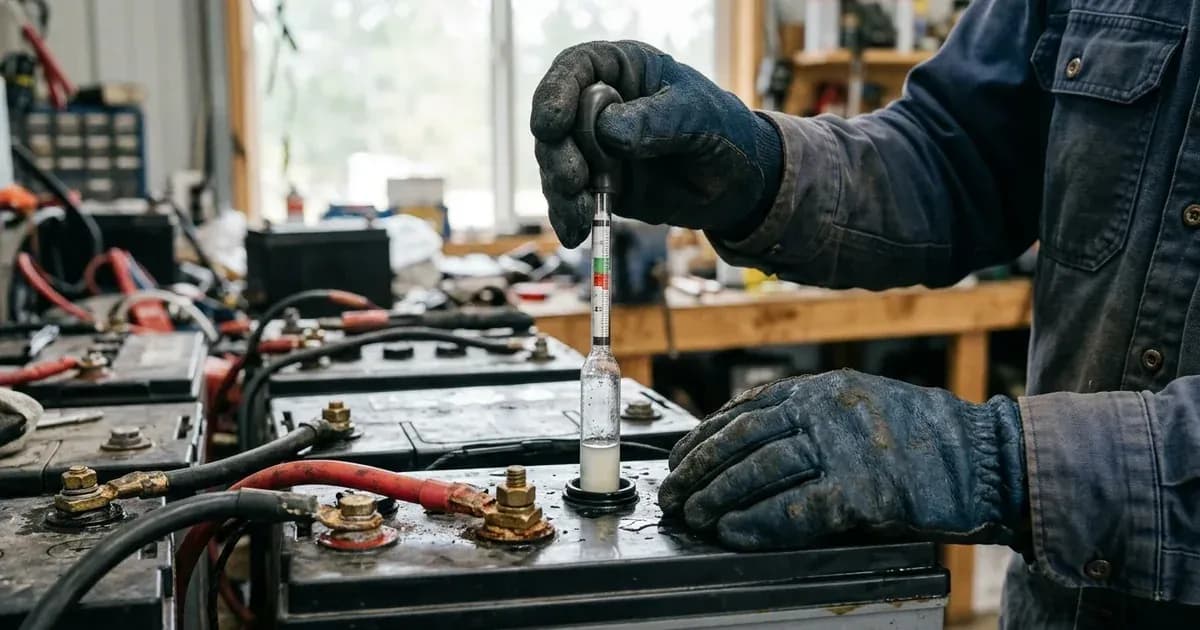
- Action: Always wear protective goggles and gloves because drawing electrolyte into a hydrometer pulls corrosive sulfuric acid out of the cell. Test each individual cell after a complete charging cycle.
- Result: Compare readings to standard flooded lead-acid benchmarks:
- 1.245–1.275 (1.260 at 25 °C): 100% state of charge (≥12.6 V rested OCV).
- 1.220: 75% state of charge (12.35 V rested OCV).
- 1.190: 50% state of charge (12.20 V rested OCV).
- 1.150: 25% state of charge (12.00 V rested OCV).
- 1.120: Fully discharged (11.80 V rested OCV).
- Meaning: If one cell reads more than 0.030 SG below adjacent cells, that cell is either stratified or failing. Perform a corrective equalization in a ventilated space away from sparks and flames (equalization deliberately drives the cell into the hydrogen gassing region); if the gravity still refuses to come up, the cell is dead.
- Examine Terminal Posts and Interconnect Cables:
- Action: Disconnect charging power and isolate the DC breaker first, and always use insulated tools because a dropped metal wrench across battery terminals will short hundreds of amps. Inspect terminal connections for looseness, heat discoloration, or white sulfate deposits.
- Meaning: Clean corroded posts with a wire brush and tighten hardware securely to specification (target 8–10 N·m on standard M8 bolts per Eastman class datasheet; loose terminals arc and overtightening cracks posts). Review our guide on solar battery installation mistakes and cable sizing.
- Decode Inverter Warning Alarms:
- Action: Observe inverter LCD fault numbers during charging or blackout transitions.
- Meaning: If your inverter sounds repetitive alarms, consult our troubleshooting guide on inverters beeping continuously.
Common Causes and Fixes for Alaska Batteries
Symptom detail | Likely cause | Fix |
|---|---|---|
Inverter charges all day but backup collapses within minutes | Chronic undercharge from default AGM settings or sulfated plates | Switch Program 05 to Flooded (58.4 V bulk on 48 V at 25 °C reference, requiring temperature compensation in ambient heat), then in a ventilated space away from sparks and flames run a boost charge at 14.1 V–14.4 V per 12 V unit (which deliberately drives the cell into the hydrogen gassing region) until specific gravity reaches about 1.260. |
Inverter shuts down early in the evening | Low-DC cutoff set higher than the bank needs, or faded capacity | Read the cutoff program (Program 29 on Axpert-family units, Programs 19/20/21 on Growatt SPF). The Axpert default is 21.0 V on a 24 V bank, about 10.5 V per 12 V unit; do not drop below roughly 10.8 V per 12 V under load just to buy runtime, because deep discharge is what kills flooded plates. If the setting is sane, wear eye protection and test specific gravity across all cells with a hydrometer (drawing electrolyte out carries corrosive acid hazard). |
Zero charge current displayed on inverter | Tripped DC battery breaker or blown inline fuse | Kill power first and isolate the DC breaker using insulated tools (because a spanner across a bank shorts hundreds of amps), reset DC breaker, and test fuse continuity with a multimeter. |
One cell reads 1.150 SG while others reach 1.260 | Acid stratification or a failing cell | Wear eye protection and top up water (using distilled water only, never acid). Then in a ventilated space away from sparks and flames, run a corrective equalization after a full charge at low current (5–10% of C20, knowing equalization deliberately drives the cell into the hydrogen gassing region), stopping once SG plateaus for 45–60 minutes. If SG fails to rise, replace the unit. |
Rapid water consumption and boiling odor | Wrong battery-type setting overcharging the bank, or float set above the 13.8 V–14.2 V standby band | Lower bulk voltage to 14.4 V–14.6 V per 12 V unit (referenced to 25 °C with temperature compensation in summer heat) and verify float drop to 13.5 V–13.8 V. Always wear eye protection when inspecting boiling cells. |
Battery temperature climbs into the 46 °C–52 °C range during charge | Overcharging current or high ambient summer heat | Disconnect charging immediately to prevent thermal runaway. Ensure battery room has active cross-ventilation away from sparks or flames. |
New battery refuses charge within first few weeks | Manufacturing cell defect | Claim a warranty replacement through your retail dealer. Pakistani retailers list a 9-month warranty on Alaska batteries and Alaska publishes no official terms, so keep the dealer-stamped card and the invoice. |
Flooded Maintenance vs Battery Aging Realities
Alaska batteries are flooded lead-acid storage units without internal digital BMS microcontrollers:
Maintenance Best Practices
- Watering Cadence: Wear eye protection goggles and check electrolyte levels monthly (using float indicators where fitted). In Pakistani summer conditions, temperatures above roughly 35 °C accelerate water loss and self-discharge. Add distilled or demineralized water only when plates become exposed, and never add acid.
- Equalization Schedule: Perform an equalization charge every 60 to 180 days under heavy cyclic service, or whenever cell specific gravity spread exceeds 0.030. Equalization deliberately drives cells into the hydrogen gassing region, so only equalize in a well-ventilated space away from sparks and flames. Equalize only after a full charge and only with distilled water topped up first (wearing eye protection, adding water only and never acid), and stop immediately if cell temperature approaches 46 °C–52 °C (per Rolls engineering guidelines).
- Construction Reality and Sizing: Note that Alaska A-series models (such as the A270 180 Ah at ~33 kg) are lighter flat-plate units compared to industrial tall-tubular batteries (~55–64 kg for 185–230 Ah). Alaska publishes no cycle-life rating; the deep-cycle class baseline is 1,200 to 1,500 cycles at 50% DoD, and the lighter flat-plate construction should be expected to tolerate shallower cycling. Compare market pricing in our tubular battery price guide for Pakistan.
For general system charging faults, consult our parent diagnostic guide for solar battery not charging.
Safety: Working with Flooded Lead-Acid Batteries
Observe these mandatory safety standards when servicing lead-acid battery banks:
- Explosive Hydrogen Gas: Charging and equalization produce flammable hydrogen gas by deliberately driving cells into the gassing region. Never enclose batteries in airtight cabinets; ensure active cross-ventilation and keep open flames, sparks, and lighters away.
- Corrosive Sulfuric Acid: Electrolyte contains dilute sulfuric acid, and hydrometer testing draws acid out of the cell. Always wear eye protection goggles and chemical-resistant gloves. Always add distilled water only and never add acid. If acid splashes skin or eyes, flush immediately with plenty of running water and seek prompt medical attention.
- Terminal Connections and Arc Flash: Always isolate the DC breaker and kill power before servicing terminals, and use insulated tools; dropping a metal spanner across a battery bank shorts hundreds of amps and causes severe arc flashes.
- Charge Controller Requirement: Never connect solar panels directly to battery terminals without a charge controller; unregulated solar input overcharges the bank and drives heavy gassing, and Pakistani owner forums carry a community-reported case of a battery exploding after exactly this shortcut.
- Heavy Lifting Precautions: Alaska A270 monoblocs weigh roughly 32–35 kg, and 180 Ah–230 Ah deep-cycle units in general run from 33 kg up to 64 kg. Use two people and proper lifting technique during installation.
When to call a technician instead
Contact a certified solar installer under the following conditions:
- Unresolved Specific Gravity Variance: If a cell is still more than 0.030 below its neighbours after a corrective equalization (conducted with eye protection in a ventilated space away from sparks and flames, as equalization deliberately drives the cell into the hydrogen gassing region), its gravity is not coming back and the cell is dead.
- Physical Case Bulging or Acid Leaks: Container distortion or cracked terminal posts require immediate decommissioning. Always kill power and isolate with insulated tools before disconnecting damaged terminals, as accidental shorts release hundreds of amps.
- Warranty Processing: Pakistani retailers list a 9-month warranty on Alaska batteries; Alaska itself publishes no warranty terms, so the dealer-stamped card and the purchase invoice are all you have. Preserve both.
For professional escalation standards, consult our guide on when to call a solar technician.
Still showing the fault? Book a technician
If the steps above did not clear it, tell us the inverter or battery and the exact code. We pass it to a technician who covers your city; visit charges are quoted before they come.
How this pays for the site: the technician or verifier pays SolarNevs a fixed introduction fee. Nobody pays to be recommended, and you are free to use our free guides instead.
Frequently asked questions
What technology do Alaska batteries use for solar and UPS systems?
Alaska Batteries (manufactured by SMJ Industries in Islamabad) primarily produces flooded lead-acid batteries featuring graphite-enhanced plates. While marketed as dual-purpose solar/UPS units, the widely stocked A-series is flat-plate; the DC-series (DC1600 and DC2000) is listed as deep-cycle tubular by a single retailer, and Alaska publishes no specification pages of its own.
Why is my Alaska battery not holding charge or giving low backup?
Low backup is commonly caused by chronic undercharging when inverters remain on default AGM settings (56.4 V on a 48 V bank) instead of the flooded absorption setting (58.4 V, referenced to 25 °C and requiring temperature compensation in ambient summer heat), unmonitored electrolyte evaporation, or sulfation from prolonged deficit charging; Alaska batteries have no internal BMS or comms, so all system alarms originate from the inverter.
What specific gravity indicates a fully charged Alaska battery?
Alaska does not publish a proprietary specific gravity spec; standard flooded lead-acid target gravity is 1.245–1.275, with 1.260 at 25 °C on the Osaka tubular data sheet. Always wear eye protection when using a hydrometer because it draws corrosive acid out of the cell. A cell sitting near 1.190 (roughly 50% state of charge, 12.20 V rested OCV) after a full charge points to chronic undercharging or plate sulfation.
How long should an Alaska battery last in Pakistani conditions?
Alaska publishes no cycle-life or DoD rating, and its marketing claim of up to 30% longer life from graphite plates is unverified by third-party testing. The deep-cycle class baseline is 1,200 to 1,500 cycles at 50% Depth of Discharge; expect the lighter flat-plate A-series (e.g. A270 180 Ah at ~33 kg vs 55–64 kg for true tall tubulars) to tolerate shallower cycling than true tubular units.
Can I add tap water to my Alaska flooded battery?
No. Always wear eye protection when opening cells and top up electrolyte using pure distilled or demineralized water only, checking monthly. Tap water carries dissolved minerals that contaminate the electrolyte and shorten plate life, and acid must never be added as a top-up.
References
- ProPakistani Alaska Graphite Battery Series Launch — accessed 23 August 2026
- Batteries International Pakistan Alaska Launch News — accessed 23 August 2026
- Osaka Tubular Technical Data Sheet PDF — accessed 23 August 2026
- Eastman TT Conventional Battery Technical Datasheet — accessed 23 August 2026
- Rolls Battery Corrective Equalization Instructions — accessed 23 August 2026
- Alaska Batteries Official Website — accessed 23 August 2026
Related guides
More from inverter errors & fixes.