Solar Panel Price in Riyadh (August 2026)
Updated 17 September 2026 · By SolarNevs Research Desk, Dealer surveys + verified sources · 5 sources · Method ↗
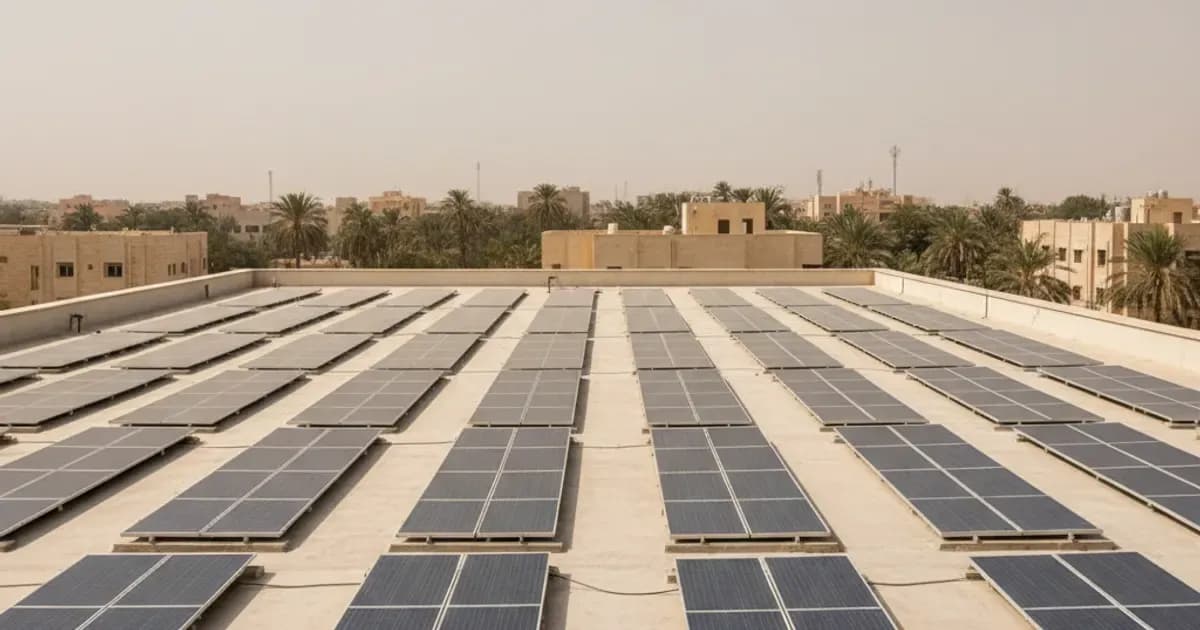
Key Takeaways
- Our own survey on 5 August 2026 recorded a 270W polycrystalline module at Riyadh-registered retailer dlel.sa at SAR 250 — SAR 0.93 per watt, the first per-watt rooftop-panel rate in SAR we have measured ourselves.
- Brand-name large-format modules cost more per watt, not less: published Longi 630W to 660W listings ran SAR 750 to SAR 950 (August 2026), about 1.19 to 1.44 SAR per watt.
- Installed rooftop prices in Riyadh are genuinely quote-only. No Riyadh installer we checked publishes a system price, and we will not invent one.
- Your tariff does not change because you live in Riyadh — the Saudi consumption tariff is national. What Riyadh changes is dust, heat and daytime cooling load.
What do solar panels actually cost in Riyadh today?
There are two honest numbers to work with, and they answer different questions.
The first is ours. On 5 August 2026 our Saudi price survey recorded a 270W 24V polycrystalline module at Dleel Al-Taqah (dlel.sa) — a Riyadh-registered specialty retailer that publishes a commercial registration and sells at real add-to-cart prices — for SAR 250. That is SAR 0.93 per watt, and it is the first per-watt rooftop-panel rate in Saudi riyals we have measured on our own rather than repeated from someone else. It sits in our Saudi solar panel price index with the date it was taken.
The second is the brand-name band. Published listings at Saudi specialty store solarcells.sa put in-stock Longi 630W to 660W modules at SAR 750 to SAR 950 (August 2026) — roughly 1.19 to 1.44 SAR per watt. That figure and the retailers behind it are covered in detail in our guide to the solar panel price in KSA.
What | Where | Price (SAR) | Per watt | Dated |
|---|---|---|---|---|
270W polycrystalline module | dlel.sa (Riyadh) | 250 | ~0.93 SAR/W | Our survey, 5 Aug 2026 |
Longi 630W | solarcells.sa | 750 | ~1.19 SAR/W | Published listing, Aug 2026 |
Longi 660W | solarcells.sa | 950 | ~1.44 SAR/W | Published listing, Aug 2026 |
Figures as of August 2026.
Why is the cheap panel also the cheap per-watt panel?
This is the part a price table alone will mislead you about, so it is worth slowing down on.
Normally, small panels cost more per watt than large ones — the glass, frame, junction box and shipping are close to fixed per module, so spreading them over 660 watts beats spreading them over 270. Our Riyadh survey row runs the other way. A 270W polycrystalline panel at SAR 0.93 per watt undercuts a 630W N-type module at SAR 1.19 per watt.
The explanation is technology and stock age, not a bargain. Polycrystalline 270W modules are a generation behind: lower efficiency per square metre, weaker high-temperature behaviour, and in most cases clearance or long-tail inventory rather than current production. On a Riyadh rooftop you would need roughly two and a half of them to match one 660W module, with two and a half times the mounting, clamps and cabling, and more roof consumed for the same output.
The rule this leads to is simple, and it applies to every price you will be quoted: compare per-watt rates only within the same class of panel. A per-watt figure with no module class attached is not a price, it is a talking point.
What does a full rooftop system cost in Riyadh?
We do not publish one, because nobody in Riyadh publishes one.
Every turnkey supplier we checked in the Saudi market — the large distributors and the Riyadh installation firms alike — operates on a request-a-quote basis. There is no public installed price per kilowatt for a Riyadh villa in the way there is for panels on a shelf. Saying otherwise would mean inventing a number, and that is the one thing this site will not do. Where the market is quote-only, we say it is quote-only.
What you can do is build the hardware half from published figures and treat the rest as the variable the quotes are actually competing on. Panels come from the rates above. The inverter side has a verified anchor: an 11kW three-phase 48V hybrid inverter at dlel.sa listed at SAR 3,471 (August 2026), with the wider band covered in our guide to solar inverter and battery prices in Saudi Arabia. Storage is priced separately in our Saudi battery survey. Mounting, DC and AC cabling, protection, the SEC grid application and labour are what an installer adds on top — and they are real costs, not padding.
Does living in Riyadh change your electricity tariff?
No, and this matters more than most Riyadh buyers expect.
The Saudi consumption tariff is set nationally, not by municipality. The residential rate is consistently reported across independent sources as 18 halalas per kWh up to 6,000 kWh in a month and 30 halalas above that, with a fixed meter charge and 15 percent VAT on top. An honesty note we owe you: the regulator's own tariff page was not reachable from our research session, so we present those slabs as well-corroborated secondary figures, not primary-verified ones — the same discipline explained on our method page.
There is one useful independent cross-check. GlobalPetrolPrices, collecting in December 2025, put the all-in Saudi household electricity price at SAR 0.200 per kWh including taxes and fees. An 18-halala base rate plus a fixed meter charge and 15 percent VAT lands very close to that, which is what corroboration looks like when it works: two sources built differently, arriving at the same place.
The practical consequence for a Riyadh household is that solar savings are driven by how much of your own generation you consume, not by your postcode.
What does Riyadh's climate actually do to an array?
Riyadh is inland desert, and that shapes a system in two ways that coastal Saudi cities do not share to the same degree.
The first is dust. Soiling — the film of dust that settles on glass between cleans — is the single most under-discussed loss on an inland Saudi roof, and it worsens quickly during dust events. We are not going to quote you a percentage: we did not measure Riyadh soiling losses ourselves and the published figures vary widely by site and cleaning interval. What we will say is that a Riyadh quote which contains no cleaning plan is an incomplete quote, and that access for cleaning is a design decision, not an afterthought.
The second is heat. Every panel loses output as its cell temperature rises, and Riyadh summers push module temperatures far above the 25°C at which nameplate wattage is measured. This is where the temperature coefficient on a datasheet stops being a specification and starts being money: a module with a shallower coefficient gives back more of its rating in July. It is also the strongest technical argument for paying the higher per-watt rate for a modern N-type module over legacy polycrystalline stock.
Riyadh's compensation is the resource itself. This is one of the sunniest capitals on earth, and the load profile — heavy daytime air conditioning — lines up almost perfectly with when a rooftop array generates.
Where can you actually see a price in Riyadh?
Three layers, in descending order of usefulness.
Specialty retailers are the primary layer. dlel.sa is Riyadh-registered, publishes its registration details, and sells panels, inverters, batteries and pumping systems at add-to-cart prices — which is precisely why our weekly Saudi survey tracks it. solarcells.sa is the comparable source for brand-name large-format modules.
Marketplaces are the cross-check layer. Amazon.sa and the large electronics chains publish public SAR prices, but their solar range skews to portable and small-format gear rather than rooftop hardware. Use them to sanity-check a level, not to source a system.
Distributors and installers are the quote layer, and there is no public price there at all. That is not evasiveness on their part — project supply genuinely is quoted — but it does mean your comparison has to be built from written quotes you collect yourself.
How should you check a Riyadh quote before signing it?
Start by making the quote itemisable. Ask for panel brand, model number and wattage; inverter make, model and rating; battery chemistry and capacity; and the labour and approvals lines separately. A single lump sum removes your ability to check anything.
Then price the hardware against the published layer. If the panel line implies far more than the 1.19 to 1.44 SAR per watt band (August 2026) for the class of module named, ask what accounts for the gap — there may be a good answer, but you are entitled to hear it. If the quote names no model at all, that is the answer.
Then check the installer, not just the numbers. Whether they can talk fluently about the SEC application and their standing on the official qualification platform is the cheapest due-diligence test available, and it is set out in our guide to Shamsi and qualified solar installers in Saudi Arabia. Finally, make sure the payback maths in front of you is built on net billing rather than net metering — Saudi Arabia credits exports well below the import tariff, and our guide to SEC net billing explains why that changes the answer.
Frequently asked questions
What is the solar panel price in Riyadh right now?
Our own price survey on 5 August 2026 recorded a 270W polycrystalline module at Riyadh-registered retailer dlel.sa for SAR 250, which is SAR 0.93 per watt. Brand-name large-format modules sit higher: published Longi 630W to 660W listings ran SAR 750 to SAR 950 (August 2026), roughly 1.19 to 1.44 SAR per watt.
Why is the cheaper panel also cheaper per watt?
Because it is older technology. The SAR 0.93 per watt figure is a 270W polycrystalline panel, not a Tier-1 large-format module. Per-watt rates are only comparable within the same class of panel, and small legacy poly stock is not interchangeable with a 630W N-type module.
How much does a full rooftop solar system cost in Riyadh?
We do not publish a Riyadh installed-system price, because no Riyadh installer we checked publishes one. Turnkey rooftop work in the Kingdom is quote-only, so the honest method is to collect three written itemised quotes and check the hardware lines against published retail.
Does living in Riyadh change my electricity tariff?
No. The Saudi consumption tariff is national, not municipal, so a Riyadh household pays the same published rate as one in Jeddah or Dammam. What changes by city is generation, soiling and cooling load, not the price of a kilowatt-hour.
References
- SolarNevs own price survey — Saudi index, 5 August 2026 (dlel.sa 270W poly at SAR 0.93/W; dlel.sa gel batteries) — accessed 5 August 2026
- Dleel Al-Taqah (dlel.sa) — Riyadh-registered solar retailer, public add-to-cart SAR prices — accessed 5 August 2026
- Solar Cells KSA — solar panels category (Longi 630-660W, SAR 750-950) — accessed 4 August 2026
- SEC (Saudi Energy) — small-scale solar PV service page, citing SERA Administrative Decision 2/47/41 — accessed 4 August 2026
- GlobalPetrolPrices — Saudi Arabia household electricity price SAR 0.200/kWh, December 2025 collection (all-in, taxes included) — accessed 5 August 2026
Related guides
More from solar & panel prices in pakistan.