UK Commercial Battery Wholesale Arbitrage and DUoS Avoidance Guide
Updated 6 September 2026 · By SolarNevs Research Desk, Dealer surveys + verified sources · 4 sources · Method ↗
Key Takeaways
- Commercial battery energy storage systems (BESS) deliver revenue via wholesale market price arbitrage and Distribution Use of System (DUoS) red-band peak avoidance.
- Generation and on-site distribution operate under statutory licensing exemptions established by the Electricity Act 1989.
- Systems with capacities up to 50 megawatts do not require formal Section 36 consents from the Secretary of State.
- Class A small generator exemptions allow unlicensed operation up to statutory output thresholds.
- Direct on-site private wire supply is permitted where a single consumer occupies premises on the same site as the generating asset.
- Public authority sites hosting flexibility assets must maintain Display Energy Certificates (DEC) under secondary energy regulations.
Wholesale Arbitrage and DUoS Shifting Mechanics
Industrial electricity consumers face severe triad or half-hourly distribution network tariffs during late afternoon red-band windows:
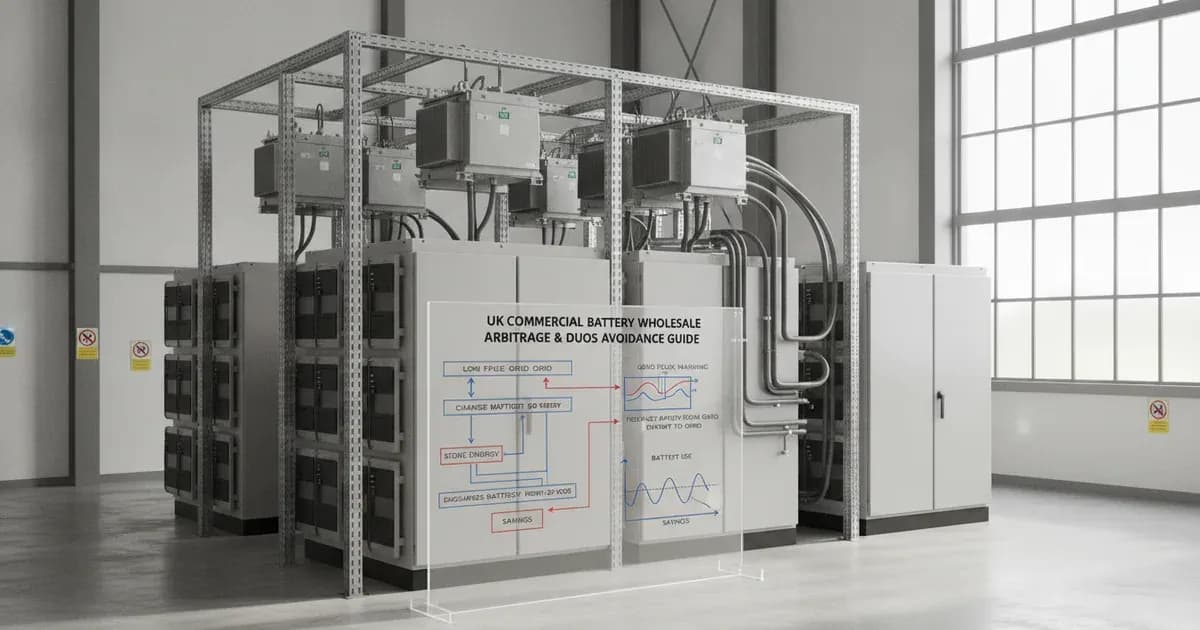
- Wholesale Arbitrage: Batteries charge during cheap overnight periods or negative pricing slots and discharge during peak market pricing.
- DUoS Avoidance: Shifting facility load entirely to on-site battery storage during weekday distribution peak charges eliminates red-band capacity fees.
Statutory Licensing and Electricity Act 1989
Operating commercial energy generation and storage assets requires strict compliance with national energy legislation:
- Generation Prohibition: Section 4 makes it an offence if a person generates electricity for the purpose of giving a supply to any premises or enabling a supply to be so given.
- Supply Prohibition: Prohibits anyone who supplies electricity to any premises.
- Offence Standard: Establishes that an operator shall be guilty of an offence unless he is authorised to do so by a licence or exemption.
- Supply Definition: Specifies that in relation to electricity, means supply through electric lines.
Section 36 Consents and Class A Exemptions
Commercial BESS developments benefit from established capacity thresholds:
- Secretary of State Consent: Under Section 36, a generating station shall not be constructed, extended or operated except in accordance with a consent granted by the Secretary of State.
- Fifty Megawatt Threshold: Consent is not required where capacity does not exceed the permitted capacity, that is to say, 50 megawatts.
- Class A Generator Relief: Exemption applies to Persons (other than licensed generators) who do not at any time provide more electrical power from any one generating station than statutory limits.
- Declared Capacity: Enforces limits of 50 megawatts in the case of a generating station with a declared net capacity of less than 100 megawatts.
- Private Wire Consumption: Recognizes supply to a single consumer who occupies premises which are on the same site as the premises where the generating station is situated and who consumes all the power provided to him from that generating station at those premises.
Public Sector Energy Monitoring and DEC Compliance
Where storage and solar are deployed across civic infrastructure, reporting obligations apply:
- Public Premises Duty: Governs buildings occupied by public authorities and frequently visited by the public.
- Prominent Display: Occupiers must display at all times a valid display energy certificate in a prominent place clearly visible to members of the public who visit the building.
- Benchmarking Ratings: Certificates must express the operational rating of the building in a way approved by the Secretary of State.
Frequently asked questions
How do commercial battery storage systems avoid DUoS charges?
Batteries discharge during peak red-band Distribution Use of System (DUoS) periods, reducing maximum demand charges and grid import costs.
What statutory exemption allows unlicensed operation of small commercial batteries?
Under Class A of the 2001 Class Exemptions Order, unlicensed operators may generate power from stations not exceeding 10MW or 50MW depending on net capacity.
Does commercial battery storage require Secretary of State consent under Section 36?
Consent is not required for generating stations where capacity does not exceed the permitted capacity of 50 megawatts.
What constitutes an electricity supply offence under the Electricity Act 1989?
Under Section 4, generating or supplying electricity to any premises is an offence unless authorised by a licence or statutory exemption.
How do public buildings verify operational energy efficiency?
Public authority buildings display a valid Display Energy Certificate expressing operational ratings approved by the Secretary of State.
References
- Electricity Act 1989 Section 4 Prohibition on Unlicensed Supply — accessed 28 August 2026
- Electricity Act 1989 Section 36 Consent for Generating Stations — accessed 28 August 2026
- Electricity Class Exemptions from the Requirement for a Licence Order 2001 — accessed 28 August 2026
- Energy Performance of Buildings Regulations 2012 Regulations 14 and 15 — accessed 28 August 2026
Related guides
More from what to buy — and how not to get cheated.