UK DNO G100 Export Limitation Schemes Compliance Guide
Updated 6 September 2026 · By SolarNevs Research Desk, Dealer surveys + verified sources · 3 sources · Method ↗
Key Takeaways
- Where an energy installation utilizes export limitation, installers must submit an Engineering Recommendation G99 application along with G100 scheme details before installing the device.
- The DNO will assess applications within 45 days for low voltage devices and within 65 days for high voltage installations.
- Under statutory ESQCR Regulation 22, parallel generation requires appropriate equipment to prevent danger or interference with the public distribution network.
- Installers must agree specific requirements with the operating distributor prior to energisation.
- Energy sources must be configured to disconnect automatically from parallel operation upon loss of mains power.
- Fast track applications can reduce turnaround times to 10 days or less for eligible type-tested integrated microgeneration and storage systems.
The Role of EREC G100 Export Limitation
As distributed generation expands across the UK, local distribution substations frequently experience reverse power flow and thermal constraints. Rather than paying extensive network reinforcement fees or facing severe export caps, commercial and residential developers deploy Export Limitation Schemes (ELS) conforming to Engineering Recommendation G100.
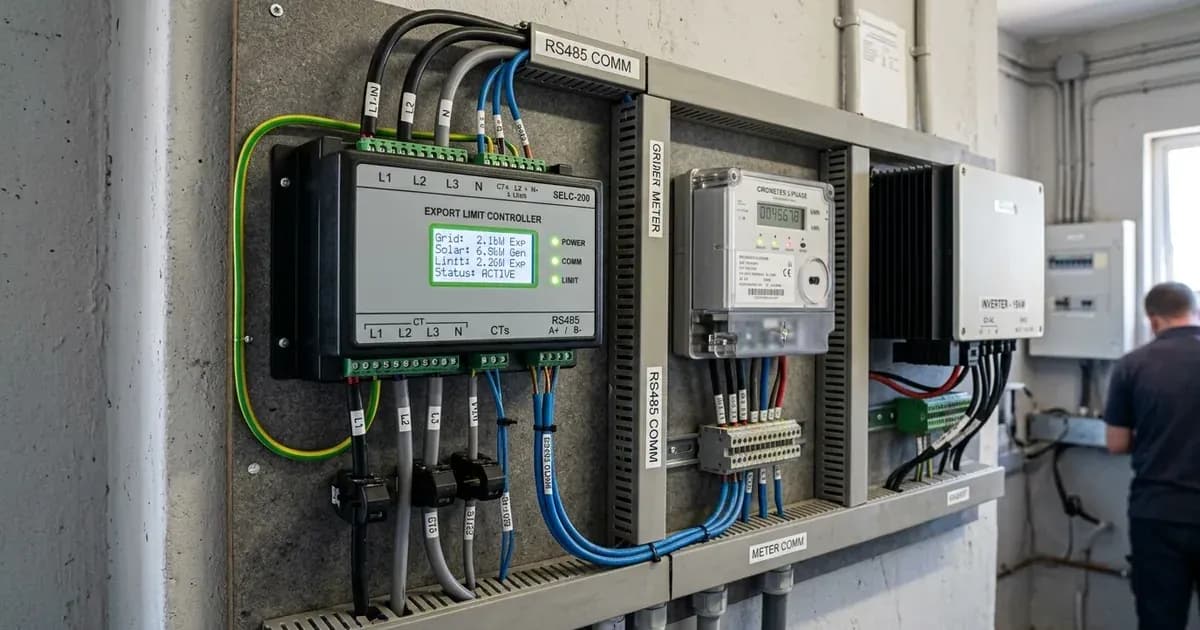
An export limitation scheme measures power at the grid boundary (point of common coupling) and dynamically curtails inverter output or diverts surplus solar into on-site battery storage when export approaches the network limit.
DNO Application Process: Integrating G99 and G100
National guidance issued by the Department for Energy Security and Net Zero sets explicit procedural steps for export-constrained sites:
- If an energy device is classified as apply to connect, installers must submit the relevant Engineering Recommendation G99 application form (or G100 if export is limited) to the DNO before installing the device to ensure safe and effective operation of the electricity network.
- The DNO will be in touch within 45 days for low voltage energy devices and 65 days for high voltage energy devices to approve installation or request necessary adjustments.
- It is the energy device owner's legal responsibility to ensure that the DNO has received notification and granted formal authorisation before work is carried out on site.
Where battery storage is integrated with generation under an apply to connect scheme, installers can utilise a fast track application process, submitting Form A1-2 to reduce connection assessment times to 10 days or less.
Statutory Safety Mandates Under ESQCR Regulation 22
Connecting parallel generation equipment to the electricity grid is governed by primary statutory legislation under the Electricity Safety, Quality and Continuity Regulations 2002:
Protection Against Network Interference
Regulation 22(1)(a) establishes that no person shall install or operate a source of energy in parallel with a distributor's network unless they have the necessary and appropriate equipment to prevent danger or interference with that network or with the supply to consumers so far as is reasonably practicable. In a G100 scheme, this equipment includes fail-safe controllers, calibrated current transformers, and dedicated communication channels.
Agreement with the Network Distributor
Regulation 22(1)(d) strictly requires that the installer agrees specific requirements with the distributor who owns or operates the network. Operating an export limiter without explicit DNO endorsement violates statutory safety rules.
Automatic Disconnection Architecture
Regulation 22(2)(b) mandates that the energy source is configured to disconnect itself electrically from the parallel connection when the distributor's equipment disconnects the supply of electricity to the installation. If the G100 controller detects an internal fault or loss of measurement signal, it must curtail generation to the safe fallback limit within fail-safe operating windows.
Switched Alternative Rules (Regulation 21)
Where backup generators or islanded microgrids operate as switched alternatives, Regulation 21 specifies that the installer must ensure the source of energy cannot operate in parallel with the distributor's network and complies with British Standard Requirements.
Frequently asked questions
What is an EREC G100 export limitation scheme?
G100 sets technical rules for customer export limitation schemes that restrict solar or battery export power to avoid exceeding grid connection agreements.
When must a G100 application be submitted to the DNO?
Installers must submit the G99 form along with G100 export limitation details before installing any device where export is actively restricted.
How long does a DNO take to evaluate a G100 export limitation application?
The DNO assessment window is 45 days for low voltage installations and 65 days for high voltage connections.
What happens if an export limiting system loses communication?
G100 mandates fail-safe operation, ensuring generation is throttled or disconnected within statutory safety limits to prevent network overloading.
Can G100 schemes be combined with fast track applications?
Yes, where fully type-tested integrated microgeneration and storage is used, fast track applications can reduce connection review times to 10 days or less.
References
- DESNZ Register Energy Devices in Homes or Small Businesses Guidance — accessed 28 August 2026
- Electricity Safety Quality and Continuity Regulations 2002 Regulation 22 — accessed 28 August 2026
- Electricity Safety Quality and Continuity Regulations 2002 Regulation 21 — accessed 28 August 2026
Related guides
More from what to buy — and how not to get cheated.