UK DESNZ Solar PV Deployment Statistics Report: National Capacity & Milestones
Updated 18 September 2026 · By SolarNevs Research Desk, Dealer surveys + verified sources · 2 sources · Method ↗
Key Takeaways
- Official DESNZ Energy Trends data confirms the United Kingdom has surpassed 2 million total solar installations across domestic, commercial, and utility sectors.
- Solar PV has accounted for most new renewable electricity capacity in recent quarters, expanding consistently across all four quarters of the year.
- Total renewable energy generation reached a landmark 53.1 per cent share of all UK electricity produced in Quarter 1 2026, up 7.4 percentage points annually.
- Small-scale domestic rooftop solar experienced record additions in 2025, bolstered by residential battery co-location and zero-rate VAT incentives.
What Are the Latest National Solar Milestones Recorded by DESNZ?
The Department for Energy Security and Net Zero (DESNZ) tracks the expansion of low-carbon electricity infrastructure through its quarterly Energy Trends releases and monthly solar photovoltaics deployment datasets. The June 2026 Energy Trends publication establishes that the UK renewable energy sector has achieved unprecedented scale, driven by strong growth in both utility-scale solar farms and domestic rooftop microgeneration.
Most notably, official deployment tracking confirms that there are now more than 2 million solar installations in the UK in total. This landmark achievement reflects two decades of sustained capital deployment, transitioning from early Feed-in Tariff (FIT) subsidies through corporate utility schemes and consumer-led residential rooftop adoption. Solar PV has accounted for most of the new capacity in this timeframe with new capacity being consistently added each quarter, demonstrating the technology's resilience and modular installation speed compared to long-lead infrastructure like offshore wind and nuclear power.
At the utility scale, new capacity over the last 12 months includes Cleve Hill, the largest solar farm in the UK which was installed in the summer of 2025. Located on the north Kent coast, Cleve Hill represents a major technological leap for British utility solar, combining high-density bifacial PV modules with large-scale co-located battery energy storage systems (BESS).
How Did Small-Scale and Domestic Rooftop Solar Perform?
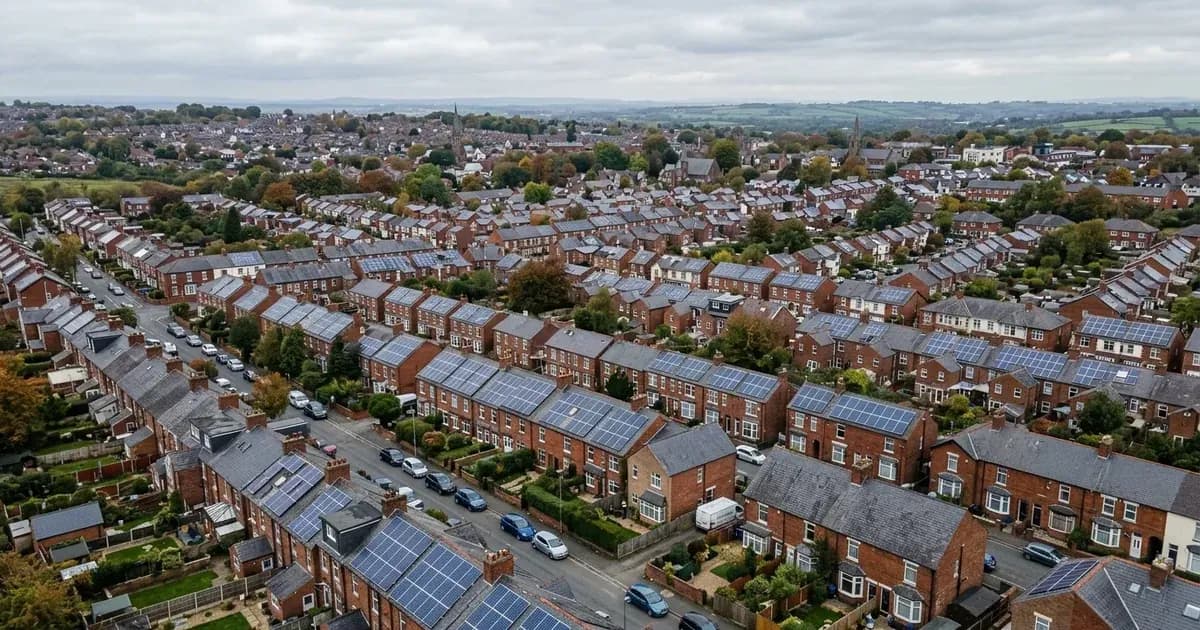
While utility-scale ground arrays delivered large single-asset capacity injections, decentralized small-scale generation represented the fastest-growing volume segment. DESNZ records that in addition, there was a record number of small-scale solar installations in 2025, largely on domestic rooftops.
Domestic adoption was accelerated by multiple structural factors:
- Fiscal Certainty: The extension of zero-rate VAT on domestic energy-saving materials provided immediate upfront cost reductions on equipment and installation labor.
- Grid Resilience: Elevated retail electricity tariffs under the Ofgem default price cap encouraged homeowners to lock in predictable energy costs.
- Battery Pairing: DESNZ explicitly highlights the rapid rise of batteries, such as batteries co-located with domestic rooftop solar panels. Combining rooftop solar with home battery storage enables residential systems to achieve high on-site self-consumption, capturing peak evening value and providing emergency power supply (EPS) resilience against distribution network interruptions.
Deployment Sector | Key Structural Characteristic | Statistical Record & Milestone | Policy & Financial Driver |
|---|---|---|---|
National Landmark | Cumulative UK Installations | Surpassed 2 million solar installations | Long-term MCS accreditation & FIT/SEG growth |
Utility Ground Mount | Major Project Deployment | Cleve Hill installed summer 2025 | Nationally Significant Infrastructure Project (NSIP) |
Small-Scale Rooftop | Residential Microgeneration Systems | Record installation numbers in 2025 | Zero VAT on solar PV and home battery retrofits |
First Quarter Generation | Seasonal Q1 Performance | Generation up 1.8% year-on-year | Record first-quarter output despite lower sun hours |
Clean Generation Share | National Energy Mix | 53.1% renewable generation in Q1 2026 | +7.4 percentage point gain over Q1 2025 |
How Did Solar PV Generation Perform Under Seasonal Variations?
Solar energy generation in the British Isles naturally exhibits marked seasonal fluctuation, with peak output concentrated between April and September. However, the first quarter of 2026 demonstrated the increasing technological efficiency and geographical distribution of modern arrays:
Despite a fall in average sun hours on last year, generation from solar PV increased by 1.8 per cent on last year, a record for the first quarter of the year. This counter-intuitive growth—achieving higher total output during a quarter characterized by lower solar irradiance—was driven directly by the massive volume of new capacity connected throughout 2024 and 2025. Modern N-type TOPCon and heterojunction (HJT) solar cells deliver superior low-light sensitivity and improved temperature coefficients, allowing newer installations to capture diffuse light effectively during overcast winter and early spring conditions.
Across the wider energy sector, renewable energy includes solar power, wind, wave, tidal, hydroelectricity, and bioenergy. In Quarter 1 2026, renewables’ share of total generation was 53.1 per cent. This represents an impressive increase of 7.4 percentage points on the first quarter of 2025, proving that clean power now provides the absolute majority of Great Britain's electrical consumption during active quarters.
How DESNZ Data Guides Domestic System Engineering
For prospective solar adopters and UK system designers, the national statistics published in Energy Trends Table ET 6.1 (quarterly capacity and generation) and Table ET 6.3 (monthly deployment) offer valuable real-world benchmarks:
- Overcoming Winter Curtailment: The record Q1 generation figures prove that orienting arrays for broader annual capture provides meaningful energy production even during low-sun periods.
- Co-located Storage Necessity: Because solar PV contributes consistently to clean generation peaks, grid export prices during sunny midday hours can experience wholesale price suppression. Integrating co-located home batteries allows domestic generators to avoid midday spill, storing electricity to displace grid consumption during evening peak tariff windows.
- Quality Certification: With small-scale installations hitting record volumes, adherence to MCS certification and competent person self-certification under Building Regulations remains mandatory to ensure compliance and maintain eligibility for export revenue under the Smart Export Guarantee.
Frequently asked questions
How many solar installations exist in the United Kingdom?
According to official DESNZ national statistics, the UK has surpassed the historic milestone of more than 2 million cumulative solar installations nationwide.
What share of UK electricity generation came from renewables in Q1 2026?
In Quarter 1 2026, renewables accounted for 53.1 per cent of total UK electricity generation, representing an increase of 7.4 percentage points year-on-year.
How did UK solar PV generation perform despite lower sun hours?
Despite a fall in average sun hours compared to the previous year, solar PV generation increased by 1.8 per cent, setting a record for the first quarter of the year.
What major utility-scale solar project contributed to recent UK capacity?
Cleve Hill, recognized as the largest solar farm in the UK, was installed in the summer of 2025, adding significant utility-scale capacity to the national grid.
References
- DESNZ Energy Trends June 2026 National Statistics Publication — accessed 29 August 2026
- DESNZ Solar Photovoltaics Deployment Monthly Statistics — accessed 29 August 2026
Related guides
More from reports & data stories.