Minnesota Xcel Energy Solar Net Metering and Interconnection Guide
Updated 19 September 2026 · By SolarNevs Research Desk, Dealer surveys + verified sources · 1 source · Method ↗
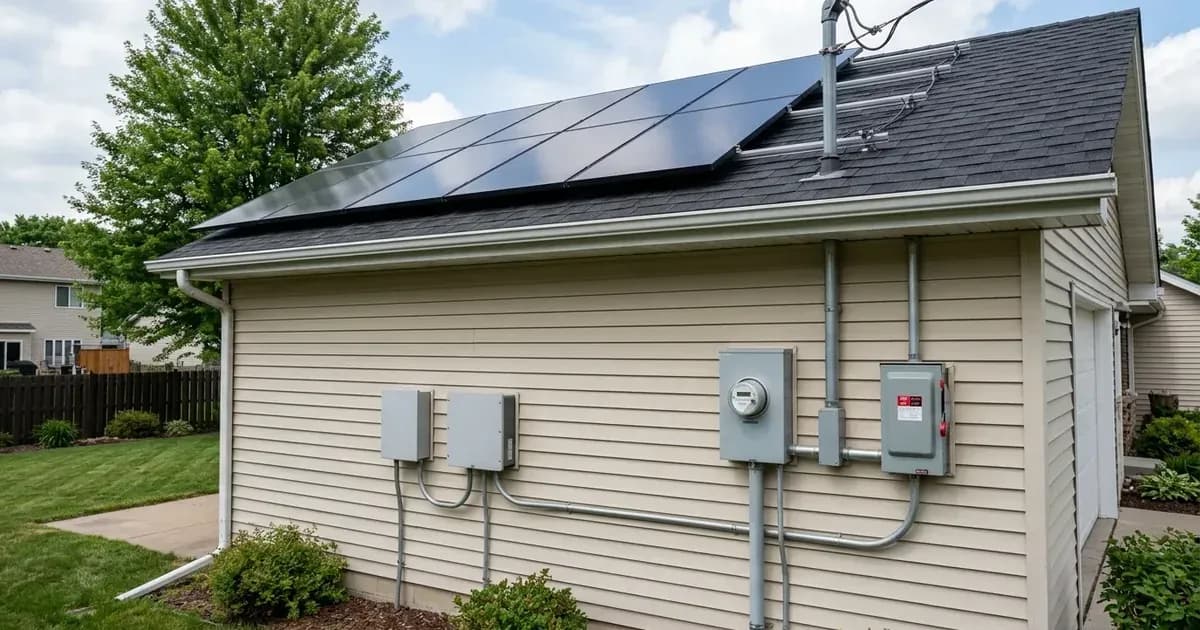
This guide outlines the statutory framework for solar net metering and interconnection in Minnesota, particularly as it applies to public utilities such as Xcel Energy. It details the capacity limits, compensation mechanisms, standby charge rules, and meter aggregation provisions established by Minnesota Statutes 216B.164.
Specific program names, current compensation rates, or application processes directly from Xcel Energy, or details on a distinct "Solar Rewards" program, are not available in the provided statutory text. This article focuses on the foundational legal requirements.
Solar Facility Capacity Limits
Facility Type / Rule Category | Capacity & Sizing Limits | Compensation & Tariff Mechanism |
|---|---|---|
Qualifying Facility (QF) | Less than 1,000 kW | Billed for net energy; net export credited at MPUC rate or average retail rate |
Net Metered Facility | 40 kW to less than 1,000 kW | kWh bill credits carried forward; annual net excess paid at applicable rate |
Solar PV Sizing Cap | Up to 120% of annual on-site consumption (AC) | Constrains total annual production to customer historical electricity usage |
Standby Charge Exemption | 100 kW or less capacity | Standby charges prohibited; systems > 100 kW require specific MPUC order |
Alternative Solar Tariff | Distributed solar PV (20-year contract) | Charges for all consumption; credits all generation at distributed solar value rate |
Minnesota statutes define various capacity limits for distributed generation facilities, which determine how they are treated under net metering rules:
- Qualifying Facilities (Public Utilities): If you are interconnecting with a public utility, your qualifying facility can have a capacity of less than 1,000-kilowatt.
- Net Metered Facilities (Public Utilities): For net metered facilities interconnected to a public utility, the capacity can be 40 kilowatts or greater but less than 1,000 kilowatts.
- Solar Photovoltaic and Other Distributed Generation: The total generation system annual energy production (kilowatt hours alternating current) is limited to 120 percent of the customer's on-site annual electric energy consumption.
- Wind Generation Systems: For wind systems, the total generation system capacity (kilowatt alternating current) is limited to 120 percent of the customer's on-site maximum electric demand.
Compensation for Excess Solar Generation
The method of compensation for electricity your solar system feeds back into the grid depends on your facility's type and size:
For Public Utilities (Less than 1,000-kilowatt)
If your qualifying facility has less than 1,000-kilowatt capacity and is interconnected to a public utility, you will be billed for the net energy supplied by the utility. Compensation for your net input into the utility system is at a per kilowatt-hour rate determined by the Minnesota Public Utilities Commission (MPUC) or the average retail utility energy rate.
For Public Utilities (40 kilowatts to Less than 1,000 kilowatts)
If your net metered facility is 40 kilowatts or greater but less than 1,000 kilowatts and interconnected to a public utility, you may elect to receive compensation for your net input into the utility system as a kilowatt-hour credit. This credit is applied to your energy bill and carried forward to subsequent energy bills. Any net input supplied by the customer that exceeds energy supplied by the utility during a calendar year must be compensated at the applicable rate.
Alternative Tariff for Distributed Solar Photovoltaic
Public utilities may apply for MPUC approval for an alternative tariff. This tariff compensates customers through a bill credit mechanism that reflects the value of distributed solar photovoltaic resources to the utility, its customers, and society. Under this tariff:
- You are charged for all electricity consumed at the applicable rate schedule.
- You are credited for all electricity generated by your solar photovoltaic device at the distributed solar value rate.
- Unused credits in any month are carried forward and credited against all charges.
- If you have a positive balance after the 12-month cycle ending on the last day in February, that balance will be eliminated, and the credit cycle will restart on March 1.
- Utilities must enter into a contract with a term of at least 20 years, unless a shorter term is mutually agreed upon.
- You will be paid the same rate per kilowatt-hour generated each year for the term of the contract.
Standby Charges
Minnesota statutes restrict when public utilities can impose standby charges on net metered or qualifying facilities:
- 100 kilowatts or less capacity: A public utility may not impose a standby charge on facilities of 100 kilowatts or less capacity.
- More than 100 kilowatts capacity: Standby charges may only be imposed in accordance with an order from the MPUC that establishes the allowable costs to be recovered through such charges.
Meter Aggregation
Minnesota law allows for the aggregation of multiple meters under specific conditions:
- Request and Eligibility: A public utility must aggregate a customer's designated meter with one or more aggregated meters if requested. To qualify, each aggregated meter must be owned by the customer, located on contiguous property, and the total of all aggregated meters must be subject to the size limitations specified in the statute.
- Implementation: A public utility must comply with a request to aggregate additional meters within 90 days.
- Rank Order: You must designate the rank order for the aggregated meters to which net metered credits are to be applied. You can amend this rank order at least 60 days prior to the beginning of the next annual billing period.
- Billing Application: Meter aggregation applies only to charges that use kilowatt-hours as the billing determinant. All other charges applicable to each meter account will be billed to you.
- Credit Application: The public utility will first apply kilowatt-hour credits to the charges for the designated meter, then to the aggregated meters in your specified rank order. If your net metered facility supplies more electricity than the energy usage recorded by your designated and aggregated meters during a monthly billing period, the utility will apply credits to your next monthly bill for the excess kilowatt-hours.
- Aggregation Fee: A public utility may charge a reasonable fee to cover the administrative costs incurred in implementing meter aggregation, subject to MPUC approval.
Customer Electricity Usage Data Access
Utilities are required to provide customers with their electricity usage data within ten days of a request. This request must be accompanied by evidence that the data is relevant to the interconnection of a qualifying facility. Electricity usage data includes:
- The total amount of electricity used by a customer monthly.
- Usage by time period if the customer operates under a tariff where costs vary by time of use.
- Usage data that is used to calculate a customer's demand charge.
Frequently asked questions
What are the capacity limits for solar facilities interconnected with public utilities in Minnesota?
For public utilities, a qualifying facility can have less than 1,000-kilowatt capacity. Solar photovoltaic systems are limited to 120 percent of the customer's on-site annual electric energy consumption (AC).
How are customers compensated for excess solar generation under net metering with public utilities in Minnesota?
Customers with qualifying facilities less than 1,000-kilowatt capacity are compensated for net input at a per kilowatt-hour rate determined by the commission or the average retail utility energy rate. For net metered facilities between 40 kilowatts and less than 1,000 kilowatts, compensation is a kilowatt-hour credit carried forward on the customer's energy bill.
Can public utilities in Minnesota impose standby charges on solar customers?
A public utility may not impose a standby charge on a net metered or qualifying facility of 100 kilowatts or less capacity. For facilities more than 100 kilowatts, standby charges are allowed only in accordance with a commission order.
What is the alternative tariff option for distributed solar photovoltaic resources in Minnesota?
Public utilities may offer an alternative tariff where customers are charged for all electricity consumed and credited for all electricity generated at a distributed solar value rate. Unused credits are carried forward, but any positive balance after a 12-month cycle ending February 28 is eliminated, with the cycle restarting March 1.
How does meter aggregation work for solar customers in Minnesota?
A public utility must aggregate a customer's designated meter with one or more aggregated meters upon request, provided they are owned by the customer, on contiguous property, and the total aggregated meters are within size limitations. Credits are applied first to the designated meter, then to aggregated meters in rank order.
References
- Minnesota Statutes 216B.164 — accessed 26 August 2026
Related guides
More from schemes, subsidies & financing.