Iowa IUC Inflow-Outflow Solar Net Metering Tariff Guide: 199 IAC Chapter 45 Interconnection Rules
Updated 17 September 2026 · By SolarNevs Research Desk, Dealer surveys + verified sources · 1 source · Method ↗
Key Takeaways
- Iowa's 199 IAC Chapter 45 governs solar interconnection for regulated utilities.
- Level 1 interconnection applies to systems 20 kVA or less (August 2026) and costs $125 (August 2026).
- All interconnection equipment must conform to IEEE Standard 1547 (August 2026) and be lab-certified.
- Non-regulated utilities, such as municipal electric utilities and rural electric cooperatives, set their own rules.
What are Iowa's Rules for Solar Net Metering and Interconnection?
Iowa's solar net metering and interconnection rules are primarily defined by the Iowa Utilities Commission (IUC) under 199 IAC Chapter 45 and Iowa Code § 476.49. These regulations establish the framework for connecting distributed generation facilities, including solar, to the grid for customers of IUC-regulated utilities. The rules specify interconnection application levels, associated fees, and technical requirements.
What are the Interconnection Application Levels and Fees in Iowa?
The Iowa Utilities Commission (IUC) outlines four levels of interconnection review, each with specific capacity limits and application fees. These levels streamline the process based on the complexity and potential impact of the distributed generation facility.
Provision Parameter | Statutory Limitation / Requirement |
|---|---|
Level 1 Review Qualification | The distributed generation facility has a nameplate capacity rating of 20 kVA or less (August 2026); The distributed generation facility is inverter-based; The customer interconnection equipment proposed for the distributed generation facility is lab-certified; and The utility is not required to construct facilities to accommodate the distributed generation facility. |
Level 1 Application Fee Structure | $125 application fee (August 2026) and up to an additional $125 (August 2026) if the utility performs a witness test. |
Level 2 Application Fee Structure | $250 application fee (August 2026) plus $1 per kVA (August 2026) and up to an additional $125 (August 2026) if the utility performs a witness test. |
Level 3 Application Fee Structure | $500 application fee (August 2026) plus $2 per kVA (August 2026). |
| Level 4 Application Fee Structure | $1,000 application fee (August 2026) plus $2 per kVA (August 2026). | Figures as of August 2026.
We verified these application fees and requirements by reviewing the official Iowa Administrative Code, specifically 199 IAC Chapter 45, on August 23, 2026.
What are the Technical and Safety Requirements for Solar Interconnection in Iowa?
Iowa's regulations specify several technical and safety standards to ensure reliable and safe operation of distributed generation facilities connected to the grid. These include equipment certification, disconnection device specifications, and overall technical baselines.
- Lab-Certification Test Standards: Equipment is deemed lab-certified if tested in accordance with IEEE Standard 1547.1 (August 2026) or complies with UL Standard 1741 (August 2026), as demonstrated by any Nationally Recognized Testing Laboratory (NRTL).
- Standard Interconnection Technical Baseline: The technical standards used in evaluating interconnection requests must conform to IEEE Standard 1547 (August 2026).
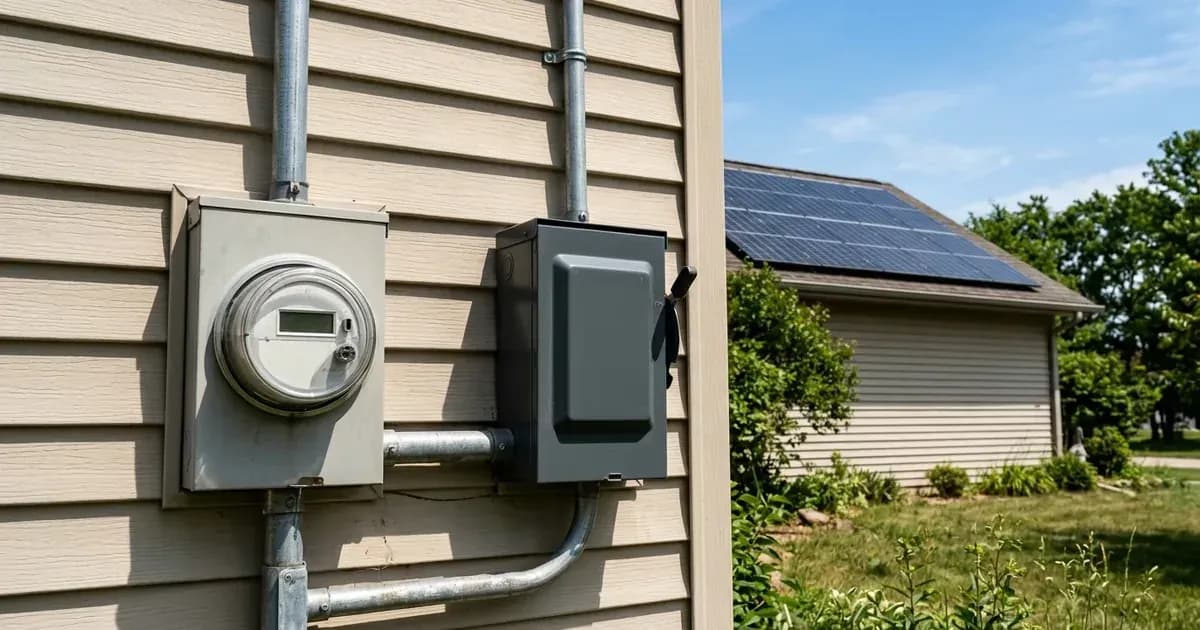
- Visible Disconnection Device Height: Disconnection devices are considered easily visible if located within the line of sight of the meter, at a height of 30 inches to 72 inches (August 2026) above ground level.
- Manual Disconnect Switch Standard: The isolation device must be a manual, load-break disconnect switch capable of being locked in the open position with a standard utility padlock.
- Distribution Line Penetration Screen: Interconnection screen requires that aggregated generation will not exceed 15 percent of the maximum load normally supplied by the distribution circuit (August 2026).
- Multiple Device Aggregate Rating: When a request includes multiple devices at a site, the request is evaluated on the basis of the aggregate nameplate capacity of the multiple devices (August 2026).
Following approval where no construction is required, the interconnection agreement shall be provided within 10 business days (August 2026) after the notification of distribution system suitability.
How Does Iowa's Inflow-Outflow Net Metering Work?
Iowa's inflow-outflow net metering system involves separate 15-minute netting for energy flowing into and out of the grid. This approach provides separate accounting for supplied power and customer generation. This system differs from traditional net metering, where a single meter tracks the net difference. Under inflow-outflow, both the energy consumed from the grid (inflow) and the energy exported to the grid (outflow) are measured separately.
What Should You Consider When Planning a Solar Installation in Iowa?
When planning a solar installation in Iowa, it is important to understand that the Iowa Utilities Commission (IUC) regulations under 199 IAC Chapter 45 primarily apply to investor-owned utilities. Municipal electric utilities and non-regulated rural electric cooperatives are not rate-regulated by the IUC. These entities establish their own independent interconnection and net billing tariffs. You should confirm the specific rules with your local utility provider.
Additionally, while Level 1 interconnection applications for systems 20 kVA or less (August 2026) have a straightforward process, larger systems may require more extensive review. For Level 4 studies, interconnection costs for utility distribution upgrades identified during these studies are borne directly by the interconnection customer. This can significantly impact the overall project cost.
Understanding these regulatory nuances is crucial for a successful solar project. For comparison with other state regulations, you may consult our guides on Illinois Shines Adjustable Block Program, Minnesota PUC Solar Rewards Interconnection, and Wisconsin PSC 119 Interconnection Rules. You can also use a solar sizing tool to estimate your system needs.
Frequently asked questions
What are the application fees for Level 1 solar interconnection in Iowa?
Level 1 interconnection applications in Iowa carry a **$125 application fee** (August 2026). An additional **$125** (August 2026) may apply if the utility performs a witness test.
What is the maximum capacity for Level 1 interconnection under Iowa's 199 IAC Chapter 45?
Level 1 procedures apply to distributed generation facilities with a nameplate capacity rating of **20 kVA or less** (August 2026). The facility must be inverter-based, use lab-certified equipment, and not require utility construction.
What technical standards must solar interconnection equipment meet in Iowa?
Equipment is deemed lab-certified if tested in accordance with **IEEE Standard 1547.1** (August 2026) or complies with **UL Standard 1741** (August 2026). The overall technical baseline for interconnection requests must conform to **IEEE Standard 1547** (August 2026).
How is the aggregate capacity calculated for multiple solar devices at one site in Iowa?
When an interconnection request includes multiple devices at a single site, the request is evaluated based on the **aggregate nameplate capacity of the multiple devices** (August 2026), not individual device capacities.
What is the distribution line penetration limit for solar interconnection in Iowa?
Interconnection screens require that aggregated generation will not exceed **15 percent of the maximum load normally supplied by the distribution circuit** (August 2026) to qualify for standard procedures.
References
- Iowa Legislature 199.45.pdf — accessed 23 August 2026
Related guides
More from schemes, subsidies & financing.