South Africa Eskom Homeflex and Ruraflex SSEG Solar Export Tariffs Guide
Updated 16 September 2026 · By SolarNevs Research Desk, Dealer surveys + verified sources · 7 sources · Method ↗
Key Takeaways
- Eskom requires households and rural customers with solar PV to be on Homeflex or Ruraflex tariffs for grid connection.
- All Small-Scale Embedded Generation (SSEG) systems below 100kVA must register with Eskom, even if they do not export electricity.
- A valid Certificate of Compliance (CoC) and an NRS 097-2-1 compliant inverter are mandatory for SSEG connection to the Eskom network.
- Eskom's published documents define various charges and requirements but do not specify current numerical tariff rates or export credit values.
Understanding Eskom's Homeflex and Ruraflex Tariffs for Solar Export
Eskom Holdings SOC Ltd is South Africa's primary electricity utility, managing customer applications, tariffs, and small-scale embedded generators (SSEG) through its Distribution division. If you have a solar-rooftop PV system and are connected to the Eskom grid, you are required to be on specific tariffs.
For residential customers with solar-rooftop PV, the Homeflex tariff is mandatory. Rural customers, including agricultural businesses and households in rural areas, are required to be on a Ruraflex tariff if they have solar PV. These tariffs are designed to accommodate customers who generate some of their own electricity and may export excess to the grid.
What is actually going on: Time-of-Use (TOU) and Network Charges
Eskom's tariff structures, such as Homeflex and Ruraflex, often incorporate Time-of-Use (TOU) periods. This means the cost of electricity consumed, and potentially the value of electricity exported, varies depending on the time of day and season. Eskom defines "High-demand season" as the TOU Period from 1 June to 31 August of each year, and "Low-demand season" as the TOU Period from 1 September to 31 May of each year.
When you connect an SSEG system to the Eskom network, you will encounter various charges and terms:
Term | Definition |
|---|---|
Active energy charge | The charge for each unit of energy consumed, typically charged as c/kWh. |
Administration charge | A daily fixed charge per point of supply to recover administration-related costs like meter reading, billing, and meter capital. It is based on the monthly utilised capacity or monthly maximum exported capacity. |
Ancillary Service charge | A charge that recovers the cost of providing ancillary services by the System Operator. |
Annual maximum export capacity | The higher of the notified maximum export capacity (MEC) or the actual maximum exported capacity, measured in kW, and registered during a rolling 12-month period. |
Distribution losses charge | A production-based (energy) charge to generators, based on approved loss factors, load factor, seasonal and TOU energy production, and the WEPS energy rate (excluding losses). |
Distribution network capacity charge | A fixed network charge (R/kVA or R/POD) to recover Distribution network costs, charged on the annual utilised capacity or maximum export capacity where maximum demand is measured, or the NMD where maximum demand is not measured. |
Distribution network demand charge | A variable network charge (R/kVA or c/kWh) to recover Distribution network costs, charged on the chargeable demand or the active energy. |
DUoS charge (generators) | Distribution Use-of-System charges payable by generators, comprising the network capacity charge based on maximum export capacity, the losses charge, the ancillary service charge, the service charge, and the administration charge. |
Maximum export capacity (MEC) | The maximum capacity at the point(s) of supply notified by the customer and accepted by Eskom for the transmission of electrical energy between a generator and the Transmission or Distribution System. |
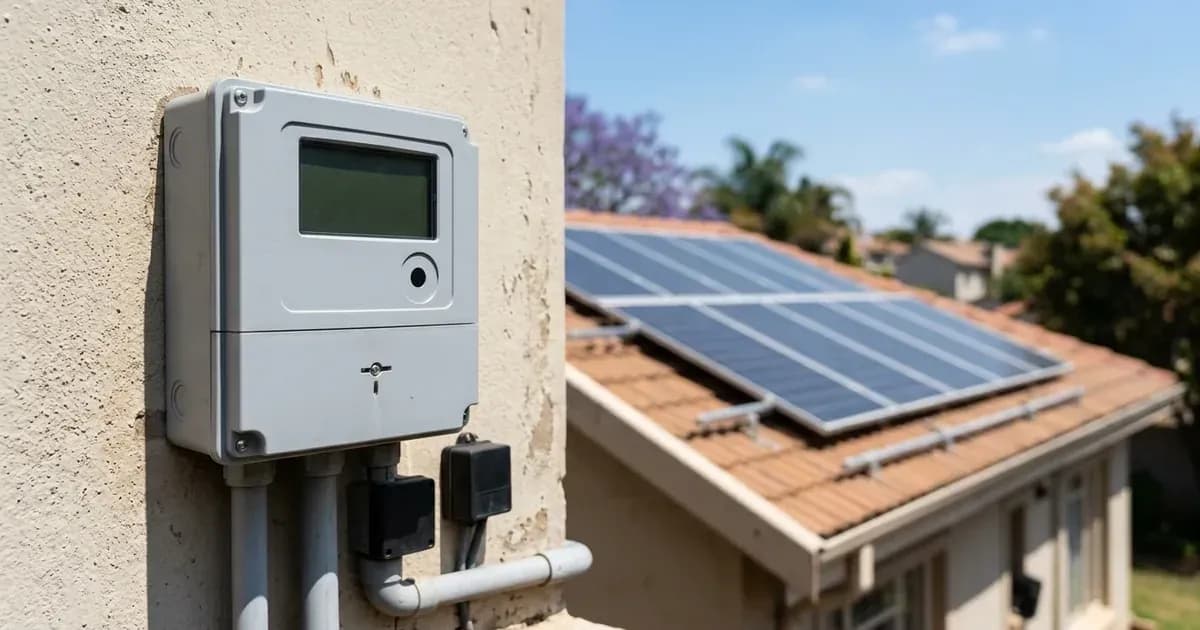
For systems that export electricity, Eskom requires the installation of 4Q TOU metering, which is a bi-directional smart meter. This meter records both energy consumed from the grid and energy exported to the grid, allowing for accurate billing based on Time-of-Use periods. Eskom states they schedule meter installation at no cost for systems up to 50kVA.
SSEG Requirements for Connection to the Eskom Network
Connecting a Small-Scale Embedded Generator (SSEG) to the Eskom network involves specific registration and technical requirements to ensure safety and grid stability.
SSEG Registration Requirements
Requirement | Details |
|---|---|
Mandatory Registration | All households and small businesses with systems below 100kVA must register with Eskom, even if they do not export electricity. |
NERSA Registration Threshold | Any SSEG installation above 100kW requires registration approval from NERSA. |
Registration Cost (up to 50kVA) | No registration or connection fees for systems up to 50kVA until 30 September 2026. |
Smart Meter Fees (up to 50kVA) | No smart meter fees for systems up to 50kVA. |
Exemption for Off-Grid Systems | Customers who are fully off-grid and not connected to Eskom’s network do not have to register, but must declare and provide proof of full independence from Eskom’s supply. |
Required Documents | A valid Certificate of Compliance (CoC) signed by registered persons, an NRS097-2-1 type test certificate for the inverter, and a basic Embedded Generation Installation (EGI) test report signed by DoL registered persons. |
Application Form | The "APPLICATION FOR THE CONNECTION OF A SMALL-SCALE EMBEDDED GENERATOR (SSEG) TO THE ESKOM NETWORK Revision: December 2025 V2" form must be completed. |
For more detailed information on the registration process, refer to our guide on SSEG Registration in South Africa.
SSEG Technical Requirements
Requirement | Details |
|---|---|
Inverter Compliance | Ensure that the inverter is NRS 097-2-1 compliant. |
Inverter Compliance Verification | Compliance with NRS 097-2-1 may be demonstrated through a Municipal Verification Route or an Independent Certification Route. |
Point of Control & Isolation | Provide a main switch (point of control) and a dedicated point of isolation for the embedded generator inside the customer installation in accordance with SANS 10142-1. |
Single Line Diagram | Provide a Single Line Diagram of the customer installation that clearly shows the point of control, the SSEG point of isolation, the generation connection point, and protection devices. |
Anti-Islanding Protection | Ensure that the SSEG installation includes anti-islanding and protection functions required by SANS 10142-1 to prevent energising a dead network. |
Reverse Power Flow Limiting | Reverse power flow limiting is part of the design and commissioned in accordance with the utility export agreement. |
EGI Compliance Test Report | Have the Embedded Generation Installation (EGI) Compliance Test Report completed and signed by a professionally registered competent person. |
Maximum Export Capacity (MEC) Definition | MEC is the total AC active power exported into the grid as measured at the point of utility connection, with the EG generating at full active power output and other load circuits measuring minimal or no-load consumption, limited to 75% for a dedicated supply and 25% for shared networks. |
You can find more information on inverter compliance in our guide to NRS 097 Approved Inverters in South Africa.
What you can change yourself, and what you cannot
As a solar system owner, your primary responsibility lies in ensuring your system operates safely and in compliance with Eskom's requirements. You can manage your energy consumption patterns to align with Time-of-Use periods, potentially reducing your electricity bill.
However, any changes to the grid-connection settings of your inverter, such as export limits or anti-islanding parameters, are not settings you can change yourself. These are critical for grid stability and safety. Altering them can breach your connection agreement and invalidate your Certificate of Compliance (CoC). Work on these settings, as well as the initial installation and any modifications to the electrical wiring, must be performed by a registered person. A valid Certificate of Compliance (CoC) must be issued for every SSEG installation by a Registered Person as defined in the Electrical Installation Regulations (EIR). For more on this, see our guide on Electrical CoC for Solar in South Africa.
It is a legal requirement for connecting your solar to the Grid. All SSEG above 100 kVA must be registered with NERSA, and SSEG up to 100 kVA must be registered with the electricity distributor. Registering your Small Scale Embedded Generation system like PV solar adds an extra layer of safety and ensures everything is installed and tested by accredited professionals. Unregistered systems pose risks such as back-feeding electricity into lines during faults, endangering electrical workers, damaging household appliances and Eskom equipment, and disturbing voltage or reducing power quality for your neighbourhood.
Even if you are fully off-grid, if an Eskom connection remains active and connected to the property, fixed network access charges will apply. This reflects the continued availability of the grid as a backup supply, irrespective of actual energy consumption. For switched (non-parallel) configurations, the alternative off-grid supply shall remain electrically isolated from the grid at all times.
What the published sources do not tell you
While Eskom provides comprehensive documentation on the requirements and definitions for SSEG connections and tariffs, the provided excerpts of their tariff schedules do not contain specific numerical values for several critical items:
- Eskom Homeflex and Ruraflex Time-of-Use (TOU) export tariff rates (c/kWh): The actual rates for energy exported to the grid during different TOU periods are not specified.
- Active energy export credits (c/kWh): The specific monetary value or calculation method for credits earned by feeding excess solar energy back to the grid is not detailed.
- Monthly network capacity charges (R/kVA or R/POD): The specific numerical values for these fixed network charges are absent.
- Billing credit offset rules: Detailed rules on how export credits are applied against consumption, carried over, or paid out are not present in the provided documents.
- Specific TOU periods and rates: While "High-demand season" and "Low-demand season" are defined, the exact time blocks (e.g., peak, standard, off-peak hours) and corresponding energy rates for these periods are not provided.
These numerical values are typically found in the full tariff schedules, which are often multi-page documents. The provided sources are excerpts that focus on definitions and requirements rather than the specific pricing.
Frequently asked questions
What are Eskom Homeflex and Ruraflex tariffs?
Homeflex is a residential tariff required for households with solar-rooftop PV connected to Eskom's network. Ruraflex is a rural tariff applicable to agricultural customers, businesses, and households in rural areas with solar PV.
Do I need to register my solar system with Eskom even if I don't export energy?
Yes, all households and small businesses with systems below 100kVA must register with Eskom, even if they do not export electricity. This is a legal requirement for grid-connected systems.
What technical standards must my solar inverter meet for Eskom connection?
Your solar inverter must be NRS 097-2-1 compliant. Compliance can be demonstrated through a Municipal Verification Route or an Independent Certification Route, as specified in Eskom's documentation.
Are there fees for registering an SSEG system with Eskom?
For systems up to 50kVA, there are no registration or connection fees until 30 September 2026. There are also no smart meter fees for systems up to 50kVA during this period.
What is Maximum Export Capacity (MEC)?
MEC, or Maximum Export Capacity, is the total AC active power that can be exported into the grid at the point of utility connection. It is defined in your application form and accepted by Eskom for energy transmission.
References
- Eskom Distribution Customer Application Tool — accessed 27 August 2026
- Eskom GEN-OFFSET Schedule Mar2024_Non_Local_Authority.pdf — accessed 27 August 2026
- Eskom Tariffs and Charges — accessed 27 August 2026
- Eskom Small-Scale Embedded Generators — accessed 27 August 2026
- Eskom Application Form for SSEG_2025V2_Dec.pdf — accessed 27 August 2026
- Eskom EMBEDDED-GENERATOR-INSTALLATION-EGI-REPORT-240-153339608-REV-1.pdf — accessed 27 August 2026
- Eskom Declaration-Form-Customer-Off-grid-Alternative-Supply.pdf — accessed 27 August 2026
Related guides
More from inverter errors & fixes.