5kW Solar System Australia: Cost, Panels, Output, and Payback
Updated 19 September 2026 · By SolarNevs Research Desk, Dealer surveys + verified sources · 3 sources · Method ↗
Key Takeaways
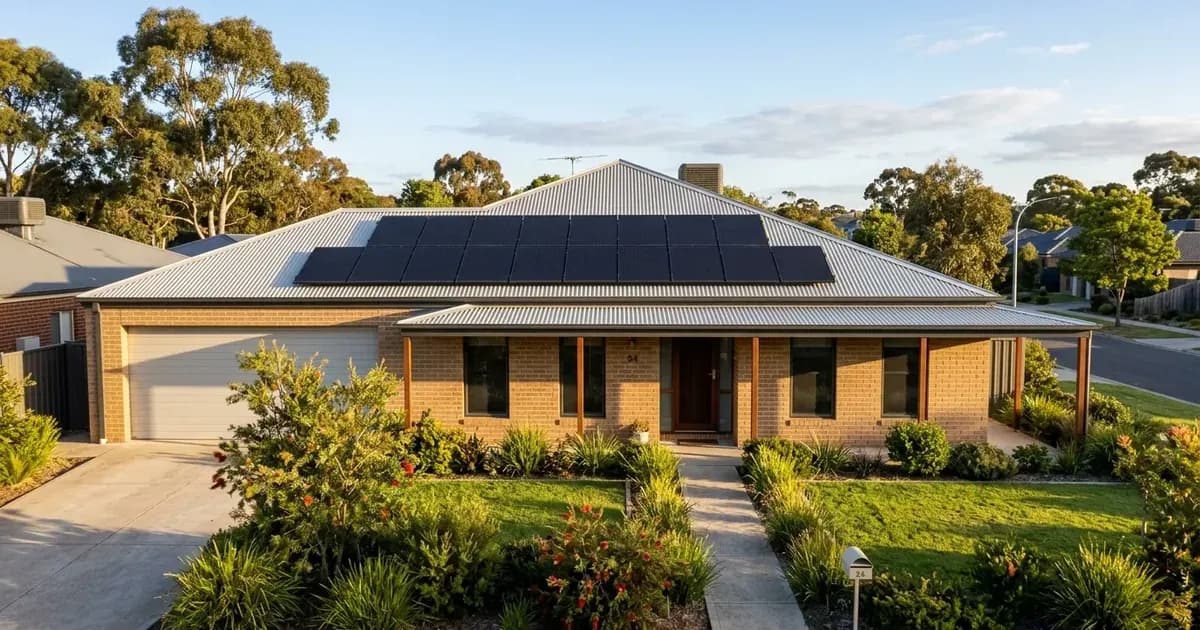
- A standard 5kW solar system in Australia requires between 15 and 20 panels and occupies roughly 25 to 35m2 of unshaded roof space.
- The national average installed price sits at approximately $1.13 per watt or $5,110 after factoring in federal STC discounts and GST.
- Daily energy generation varies by season and location, yielding approximately 15 kWh in mid-winter up to 26 kWh during peak summer in cities like Sydney.
- With a 40% self-consumption profile, system investment payback times range between 2.4 years in Perth and 5.4 years in Hobart.
Is a 5kW Solar System Still Worth Installing in Australia?
While larger arrays have become common across Australia, a 5kW solar system remains a practical and cost-effective sizing bracket for smaller homes, townhouses, duplexes, and properties with limited unshaded roof space. If your household consumes between 15 kWh and 20 kWh of electricity per day, a 5kW system provides substantial daytime bill reduction without demanding extensive roof real estate.
Under Australian connection guidelines, a 5kW system is typically paired with either a 4kW inverter or a matching 5kW single-phase string inverter. Because Australian network service providers pre-approve inverters up to 5kVA on single-phase lines without complex grid studies, commissioning a 5kW system remains smooth and straightforward. You can compare this footprint with larger multi-panel setups in our residential solar sizing guide.
How Many Panels and How Much Roof Space Does a 5kW Array Require?
A contemporary 5kW system comprises between 15 and 20 panels, depending on individual module wattage ratings. Most residential panels installed across Australia measure approximately 1.7 metre by 1 metre. When mounted flush across pitched metal or tile roofs, the total array footprint requires about 25 to 35m2 of clear space:
Component | Sizing and Layout Metric | Specification Detail |
|---|---|---|
Panel count range | 15 to 20 panels | Dependent on module wattage ratings and roof tilt |
Physical module dimensions | 1.7 metre by 1 metre | Standard residential monocrystalline panel form factor |
Required roof footprint | 25 to 35m2 | Unshaded roof plane area accommodating edge safety margins |
Typical inverter pairing | 4kW to 5kW | Single-phase string or hybrid unit approved by Clean Energy Council |
If your roof layout requires tilt frames to face panels towards north on flat roofs, panels must be spaced further apart to prevent inter-row shading, which increases overall roof area requirements.
How Much Does a 5kW Solar System Cost in Australia?
Australia benefits from competitive turnkey solar installation costs due to high installer density and federal renewable energy incentives. According to benchmark figures published in the Solar Choice Price Index, the national average cost of an installed 5kW solar system is about $1.13 per watt, working out to approximately $5,110 after the upfront Small-scale Technology Certificate (STC) discount is applied and including GST.
Turnkey quotes fluctuate across state capital cities due to freight logistics, state regulatory compliances, and installer competition:
Capital City | Average Turnkey Cost (Net of STCs) | Market Cost Benchmark |
|---|---|---|
Perth, WA | $4,290 | Sharpest metropolitan pricing tier in Australia |
Adelaide, SA | $4,740 | Competitive pricing supported by high solar penetration |
Sydney, NSW | $4,960 | High installer competition across western Sydney |
Melbourne, VIC | $5,120 | State baseline before any additional Victorian rebates |
Canberra, ACT | $5,160 | Inland territory installation pricing |
Brisbane, QLD | $5,570 | Sub-tropical coastal installation pricing |
Hobart, TAS | $6,360 | Island logistics and specialized roof framing |
Darwin, NT | $8,470 | Remote freight logistics and cyclone-rated mounting requirements |
Before signing an installation agreement, review line items carefully using our how to compare solar quotes Australia guide to verify hardware authenticity and installer credentials.
How Much Electricity Does a 5kW System Generate Daily?
The energy output of a 5kW solar system depends directly on geographic location, solar irradiance, orientation, panel tilt angle, and local ambient temperatures. On average, Australian rooftops receive around 4.5 hours of peak sun (peak sun hours, or PSH) daily. Regional irradiation varies from 4.2 PSH per day in cooler southern latitudes like Tasmania up to 5.8 PSH per day in northern tropical zones like Darwin.
In Sydney, seasonal output shifts significantly across the calendar year:
- Winter output: An optimally tilted, north-facing 5kW array operating at 85% overall efficiency generates approximately 15 kWh per day during mid-winter, calculated as 3.5 PSH multiplied by 5kW and 85% efficiency.
- Summer output: During long summer daylight periods, the same system produces around 26 kWh of electricity daily, calculated as 6.2 PSH multiplied by 5kW and 85% efficiency.
In sum, an Australian 5kW array delivers reliable daytime clean energy, substantially cutting household grid imports throughout the annual cycle.
Payback Periods and Financial Returns Across Capital Cities
System payback periods in Australia are driven primarily by daytime self-consumption rather than low feed-in tariffs. Because retail grid electricity costs between 21c and 31c per kWh while feed-in tariffs sit between 5c and 7c per kWh, consuming solar power on-site delivers the greatest bill savings.
Assuming an average household consumption of 25 kWh per day and a 40% daytime solar self-consumption ratio, indicative financial returns by city show rapid investment recovery:
City | Upfront System Cost | Retail Tariff | Feed-in Tariff | Year 1 Bill Savings | Payback Period |
|---|---|---|---|---|---|
Perth | $4,040 | 31c / kWh | 5c / kWh | $1,689 | 2.4 Years |
Adelaide | $4,460 | 27c / kWh | 7c / kWh | $1,586 | 2.8 Years |
Sydney | $4,520 | 31c / kWh | 5c / kWh | $1,486 | 3.0 Years |
Brisbane | $4,780 | 27c / kWh | 7c / kWh | $1,405 | 3.4 Years |
Canberra | $4,650 | 26c / kWh | 5c / kWh | $1,314 | 3.5 Years |
Melbourne | $4,970 | 21c / kWh | 5c / kWh | $1,227 | 4.1 Years |
Darwin | $7,480 | 26c / kWh | 5c / kWh | $1,724 | 4.3 Years |
Hobart | $5,950 | 21c / kWh | 5c / kWh | $1,101 | 5.4 Years |
In sunny capitals with high electricity tariffs like Perth and Adelaide, payback takes less than 3 years. Even in southern locations like Melbourne, full payback is achieved in approximately 4.1 years.
Federal SRES Rebate Rules for 5kW Arrays
Federal solar incentives operate under the Small-scale Renewable Energy Scheme (SRES) administered by the Clean Energy Regulator. To qualify for Small-scale Technology Certificates (STCs), the solar PV installation must meet specific statutory criteria:
- System capacity ceiling: The system must have a capacity less than 100 kW.
- Annual electricity output limit: The installation must have a total annual electricity output less than 250 MWh.
- Approved hardware: The panels and inverter must appear on the Clean Energy Council approved product list.
- Accredited installation: The system must be designed and installed by an accredited professional.
STCs trade on open markets where the usual price is $33 to $38 per certificate. Retailers calculate certificate entitlements over one or 5 years or a single maximum deeming period, applying this value as an upfront point-of-sale discount on your invoice. Learn how certificate deeming works in our STC deeming guide Australia and point-of-sale STC discount assignment guide.
Safety and Professional Installation Standards
All rooftop solar systems in Australia operate under strict electrical safety mandates. Rooftop PV arrays generate hazardous DC voltages that cannot be switched off while sunlight strikes the panels.
[!WARNING]Never attempt to modify, re-wire, or access rooftop solar modules or DC cabling yourself. Lethal DC voltages exist across solar array strings whenever illuminated. All mounting, electrical isolation, inverter connections, and grid commissioning must be performed by a licensed electrician holding Clean Energy Council accreditation.
Ensure your installer conducts a structural assessment of your roof framing, installs compliant isolators, tests earthing continuity, and provides a signed Certificate of Electrical Safety upon system commissioning.
References
- Solar Choice - 5kW Solar Systems: Pricing, Output, and Returns — accessed 16 September 2026
- Clean Energy Regulator - Rooftop Solar Small-scale Renewable Energy Scheme — accessed 16 September 2026
- Clean Energy Regulator - Calculate Small-scale Technology Certificate Entitlements — accessed 16 September 2026
Related guides
More from what to buy — and how not to get cheated.