What Size Solar System Do I Need Australia: 5kW vs 6.6kW vs 10kW
Updated 19 September 2026 · By SolarNevs Research Desk, Dealer surveys + verified sources · 2 sources · Method ↗
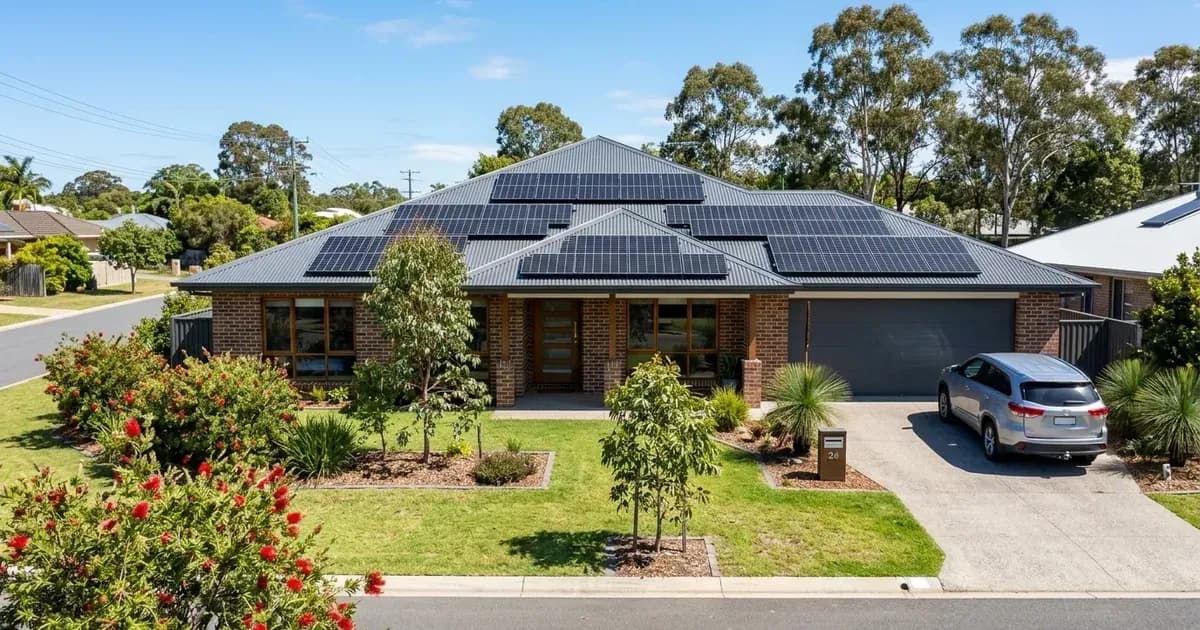
Selecting the right solar system capacity is the most critical financial decision when transitioning to renewable power in Australia. Over the past decade, the fundamental economics of residential solar have shifted dramatically. Where early adopters oversized rooftop arrays to capitalise on generous government feed-in premiums, contemporary grid rules and electricity retail pricing require a precision engineering approach centred entirely on household consumption profiles.
Because the rates you will be paid by the electricity retailers for solar power sold back into the grid ( feed in tariff ) have decreased considerably over the last decade, the historic practice of exporting massive energy volumes has been replaced by self-consumption maximisation. Modern solar design focuses on matching the solar power generation to the energy requirements of the home you are minimising the amount of surplus energy to be sold to the grid, ensuring every kilowatt-hour generated offsets retail grid purchases rather than earning depreciated export credits.
The Economic Shift: Self-Consumption vs Exporting
In the current Australian retail electricity market, with the low feed in tariffs selling power back to the grid is no longer financially attractive. Standard feed-in tariffs in New South Wales, Victoria, Queensland, and South Australia frequently sit between 3c and 7c per kWh, while peak retail electricity rates hover around 30c per kWh or higher. Consequently, self-consuming a single unit of solar energy delivers four to ten times greater financial value than exporting that same energy.
However, system sizing cannot be determined in isolation from your occupancy routine. As Solar Choice design analysis demonstrates, generating solar power while having limited electricity usage is not the most ideal scenario. When households are completely unoccupied between 9:00 AM and 3:00 PM, substantial solar generation flows directly to the distribution network at low export values, lengthening the capital payback timeframe.
The 20 Kilowatt-Hour Benchmark Household: Morning/Evening vs Daytime Profile
To quantify the financial impact of consumption timing, consider an Australian home using 20 kilowatt-hours of total electricity daily. The following data benchmarks demonstrate how system performance and return on investment vary between an evening-peaking lifestyle and a daytime-peaking lifestyle:
Consumption Pattern | Daily Household Load | Array Size | Solar Offset Ratio | Energy Rates Assumed | Daily & Annual Savings | Payback Period |
|---|---|---|---|---|---|---|
Morning & Evening Peak | 20 kilowatt-hours daily | 6kW array | 40% load offset | 30c import / 7c feed-in | $3.56/day ($1,300/yr) | 4.6 years |
Daytime Focus (Work from Home) | 20 kilowatt-hours daily | 6kW array | 64% load offset | 30c import / 7c feed-in | $4.67/day ($1,703/yr) | 4.2 years |
As the benchmark indicates, in this example the home is using 20kwh of energy per day and the 6kw system would offset 40% of the homeowner's electrical usage under standard morning and evening peak hours. Under these operating conditions, with an electricity tariff of 30c per kwh and feed in tariff of 7c per kwh this customer would save $3 daily, amounting to approximately $1,300 per year.
Conversely, when daytime load shifting occurs—such as running pool pumps, air conditioners, washing machines, and heat pump water heaters while the sun shines—this customer has been able to offset 64% of their energy usage with the same size solar system. Elevating self-consumption from 40% to 64% improves annual savings by over $400, reducing the investment payback timeframe from 4.6 years down to 4.2 years.
Comparing System Capacities: Financial Returns & Sizing Payback
Detailed empirical modelling across thousands of Australian solar quotes illustrates the return on investment across common residential system sizes. For a home consuming 20 kilowatt-hours per day, Solar Choice data indicates:
```
[20 Kilowatt-Hour Daily Consumption]
├── 3kW System --> $3,650 Cost | Lower efficiency per watt | 5.1 yr payback
├── 5kW System --> $4,600 Cost | Solid baseline | 4.7 yr payback
├── 6kW Optimal --> $4,910 Cost | Highest ROI | 4.2 to 4.6 yr payback
├── 7kW System --> $5,930 Cost | Marginal expansion | 4.5 to 4.9 yr payback
└── 10kW System --> $8,190 Cost | Oversized without EV/Battery | 4.9 to 5.3 yr payback
```
Examining both load profiles confirms that we can see that for 20kwh electricity usage under a morning and evening peak profile the best solar system size is 6kw for return on investment. Likewise, for the daytime focus electricity load profile the best size is 6kw.
Verified Financial Benchmarks: 6kW vs 10kW
The verified installed costs, annual bill savings, and capital recovery timelines under both operational scenarios are detailed below:
System Capacity & Specification | Installed Turnkey Cost | Morning/Evening Annual Savings | Morning/Evening Payback | Daytime Focus Annual Savings | Daytime Focus Payback |
|---|---|---|---|---|---|
6kW Optimal Array | $4,910 | $1,266 | 4.6 years | $1,437 | 4.2 years |
10kW High-Capacity Array | $8,190 | $1,757 | 5.3 years | $1,922 | 4.9 years |
Under an evening peak profile, the verified data shows 6kw optimal $4910 $1266 4.6 years, compared to 10kw $8190 $1757 5.3 years. When daytime self-consumption is optimised, the return improves further: 6kw optimal $4910 $1437 4.2 years, against 10kw $8190 $1922 4.9 years.
While a 10kW system yields larger absolute gross dollar savings each year, the initial capital outlay is over $3,200 higher, extending the payback period by roughly 7 to 8 months. However, if a household anticipates purchasing an electric vehicle or adding home battery storage in the near term, installing a 10kW array immediately is frequently more economical than expanding a smaller array later.
Why Sub-6kW Systems Have Disappeared
A decade ago, entry-level 2kW and 3kW systems represented the bulk of the Australian residential market. Today, smaller system sizes drop off in roi as the price per kw installed is more expensive. Fixed project expenses—including scaffolding, Clean Energy Council accredited electrical labour, engineering compliance, administrative grid connection approvals, and inverter balance-of-system hardware—remain relatively static whether mounting 8 panels or 16 panels.
Consequently, unless there is limited roof space it is rare to see systems installed that are smaller than 6kw. Across modern suburban homes, on average most homes require a system between 5kw and 7kw but this can vary widely depending on household occupancy, swimming pool pumps, ducted heating and cooling loads, and EV charging demands.
Regulatory and Network Export Limits
When evaluating system sizing, Australian homeowners must adhere to Clean Energy Regulator (CER) standards and local network operator limitations:
- Small-Scale Renewable Energy Scheme (SRES): Under federal rules, qualifying residential systems must have a capacity less than 100 kW and have a total annual electricity output less than 250 MWh. Systems meeting these conditions generate Small-scale Technology Certificates (STCs), creating an upfront point-of-sale discount. While certificate prices fluctuate, the usual price is $33 – $38 per certificate.
- DNSP Single-Phase Limitations: Most state distribution network service providers (such as Ausgrid, Endeavour Energy, Energex, SA Power Networks, and Powercor) limit single-phase residential inverter capacity to 5kW or export capacity to 5kVA. Installing a 6.6kW panel array paired with a 5kW inverter complies perfectly with the Clean Energy Council 133% DC oversizing rule while staying within single-phase grid connection allowances.
- Site Evaluation: Before making a final commitment, always engage an experienced, accredited provider to assess your specific needs and recommend the best system size for your home, accounting for roof azimuth, shading from mature trees, and switchboard capacity.
For further insights into system design, explore our comprehensive guides on 5kW Solar System Guide Australia, 6.6kW Solar System Guide Australia, and 10kW Solar System Guide Australia.
References
- Solar Choice - What Size Solar System Do I Need — accessed 16 September 2026
- Clean Energy Regulator - Rooftop Solar Systems — accessed 16 September 2026
Related guides
More from what to buy — and how not to get cheated.