8kW Solar System Australia: Cost, Panels, Output, and Payback
Updated 19 September 2026 · By SolarNevs Research Desk, Dealer surveys + verified sources · 3 sources · Method ↗
Key Takeaways
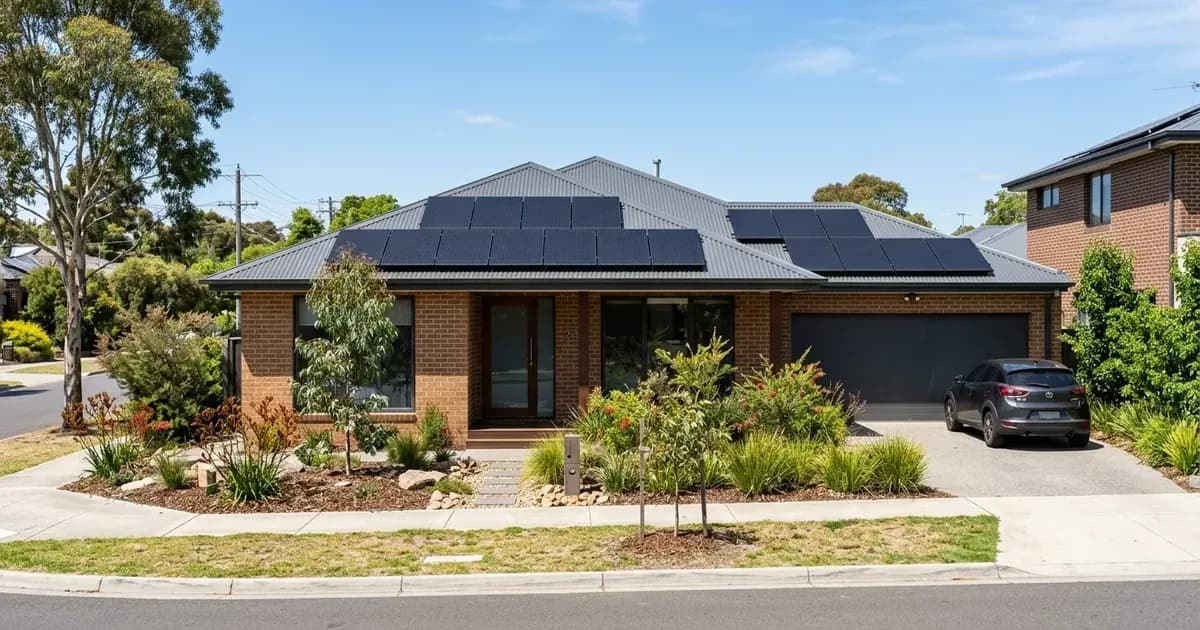
- An 8kW solar system requires 20 to 24 solar panels and occupies approximately 45 to 60m2 of unshaded roof space.
- Across Australia, the average turnkey cost is $7,467 installed after deducting federal STC incentives and including GST.
- An 8kW array produces between 25 kWh and 35 kWh of electricity per day depending on location, generating over 10,000 kWh annually in most capital cities.
- With higher household energy consumption of 40 kWh daily, investment payback ranges from 2.9 yrs in Adelaide to 4.9 yrs in Melbourne.
Who Should Install an 8kW Solar System in Australia?
An 8kW solar system sits right between the popular entry-level residential arrays and the upper residential limit. In Australia, 15 kilowatts (kW) is generally regarded as the upper limit for residential installations because a system of that scale produces sufficient electricity to meet peak daytime domestic loads. An 8kW solar system is ideally configured for medium-to-large households with slightly higher electricity demand than average—such as properties with ducted reverse-cycle air conditioning, swimming pool pumps, all-electric heat pump hot water, or home electric vehicle charging.
If your household daily energy usage runs around 30 kWh to 40 kWh, an 8kW system provides an optimal balance between daytime self-consumption and roof real estate usage. Compare this with smaller arrays in our 6.6kW solar system guide Australia or commercial-residential transitions in our 10kW solar system guide Australia.
Panel Counts and Roof Space Requirements for an 8kW System
For an 8kW solar system (representing 8,000 watts of DC capacity), the physical installation requires:
Parameter | Sizing Benchmark | Design Consideration |
|---|---|---|
Total panel count | 20 to 24 panels | Varies with selected module wattage rating |
Individual panel footprint | Approx 1.7m 2 per module | Standard residential panel dimensions |
Total roof area needed | 45 to 60m 2 | Includes maintenance pathways and boundary margins |
Roof exclusion zones | Ridge and gutter clearance | AS/NZS mounting rules mandate perimeter margins |
Installers must leave clearance zones near roof ridges, hips, and gutters to comply with wind loading standards and provide servicing access. If you have multiple roof pitches (for instance, split East and West arrays), an 8kW system allows split-string MPPT tracking to capture morning and afternoon sun.
How Much Does an 8kW Solar System Cost in Australia?
Australia has some of the most competitive solar installation pricing globally because the federal Small-scale Renewable Energy Scheme (SRES) covers around 30% to 35% of the upfront costs through Small-scale Technology Certificates (STCs).
According to installer market data compiled in the Solar Choice Price Index, the national average turnkey cost of an 8kW solar system in Australia is $7,467 after the STC rebate has been deducted and including GST.
Capital city pricing benchmarks illustrate regional differences driven by distributor charges, state requirements, and installer competition:
Capital City | Turnkey Installed Cost (Net of STCs) | Cost per Watt Installed |
|---|---|---|
Perth | $7,420 | $0.80 |
Melbourne | $7,500 | $0.84 |
Adelaide | $6,810 | $0.85 |
Sydney | $6,830 | $0.85 |
Canberra | $6,790 | $0.93 |
Brisbane | $7,270 | $0.97 |
Hobart | $9,650 | $1.05 |
Hobart carries higher out-of-pocket costs due to island freight and specialized steep-pitch tile roof mountings, while Adelaide, Sydney, and Perth offer exceptionally competitive per-watt installed rates between $0.80 and $0.85 per watt. You can review quote breakdowns and installer checks in our guide on how to compare solar quotes Australia.
Daily and Annual Energy Output by Capital City
The volume of electricity an 8kW solar system produces depends on sunlight intensity (measured in Peak Sun Hours, or PSH), roof orientation, shading, and ambient panel temperatures. Modeling based on Bureau of Meteorology historical solar irradiation data and standard 75% overall system efficiency demonstrates substantial electricity yields:
Capital City | Average Daily Generation | Estimated Annual Production |
|---|---|---|
Darwin | 35 kWh per day | 12,848 kWh |
Perth | 34 kWh per day | 12,264 kWh |
Brisbane | 32 kWh per day | 11,680 kWh |
Adelaide | 31 kWh per day | 11,242 kWh |
Canberra | 31 kWh per day | 11,242 kWh |
Sydney | 29 kWh per day | 10,512 kWh |
Melbourne | 27 kWh per day | 9,782 kWh |
Hobart | 25 kWh per day | 9,052 kWh |
In northern and western capitals, an 8kW system routinely produces more than 12,000 kWh annually. In southern locations like Melbourne and Hobart, annual generation reaches 9,052 kWh to 9,782 kWh, delivering robust winter generation to offset space heating and heat pump hot water loads.
Payback Periods and Return on Investment for an 8kW Array
With electricity retailers charging tariffs ranging anywhere from 18¢ to 27¢ or more per kWh while voluntary export feed-in tariffs offer only modest credits, maximizing on-site self-consumption is the primary driver of financial return.
For a household with higher electricity demand consuming an average of 40 kWh daily, investment returns across major cities demonstrate compelling economics:
City | System Cost | Grid Tariff | Feed-in Rate | Year 1 Bill Savings | Payback Period |
|---|---|---|---|---|---|
Adelaide | $6,810 | 35c | 8c | $2,356 | 2.9 yrs |
Sydney | $6,830 | 29c | 7c | $1,997 | 3.4 yrs |
Canberra | $6,790 | 29c | 7c | $1,791 | 3.8 yrs |
Perth | $7,420 | 31c | 6c | $1,956 | 3.8 yrs |
Brisbane | $7,270 | 26c | 6c | $1,611 | 4.5 yrs |
Hobart | $9,650 | 33c | 8c | $2,094 | 4.6 yrs |
Melbourne | $7,500 | 22c | 5c | $1,529 | 4.9 yrs |
In Adelaide, higher retail grid rates deliver an internal rate of return exceeding 30% and an estimated payback period of 2.9 yrs. In Sydney and Canberra, payback is achieved within 3.4 yrs to 3.8 yrs.
Grid Connection Rules: Single-Phase vs Three-Phase
When planning an 8kW system, network connection standards set by your local Distribution Network Service Provider (DNSP) are critical:
- Single-phase properties: Many urban networks cap single-phase inverter output at 5kVA for unconstrained export. Installing an 8kW inverter on single-phase may require network pre-approval, export limitation software, or dynamic export management.
- Three-phase properties: Homes connected to three-phase power can install an 8kW or 10kW three-phase inverter with balanced export across all three phases, avoiding phase-voltage rise issues.
To maintain eligibility for federal incentives, the solar PV system must have a capacity less than 100 kW and generate a total annual electricity output less than 250 MWh. The STCs created trade at market values where the usual price is $33 to $38 per certificate. Learn more in our small-scale technology certificates guide.
Safety and Installation Compliance
Rooftop photovoltaic arrays operate at high DC voltages that pose severe electrical shock and arc-flash hazards if handled improperly.
[!WARNING]Solar panels generate dangerous DC voltage whenever exposed to daylight. Do not attempt to mount rails, wire DC circuits, or install isolation switches yourself. All electrical connections, inverter wiring, and grid synchronisation must be performed by a licensed electrician holding Clean Energy Council accreditation.
Ensure your accredited installer conducts an on-site structural check, confirms switchboard capacity, installs AS/NZS compliant DC isolation switchgear, and tests circuit insulation resistance before commissioning.
References
- Solar Choice - 8kW Solar Systems: Compare outputs, installers and returns — accessed 16 September 2026
- Clean Energy Regulator - Rooftop Solar Small-scale Renewable Energy Scheme — accessed 16 September 2026
- Clean Energy Regulator - Calculate Small-scale Technology Certificate Entitlements — accessed 16 September 2026
Related guides
More from what to buy — and how not to get cheated.