Qcells Solar Panels Review Australia: Q.ANTUM DUO Z Technology
Updated 19 September 2026 · By SolarNevs Research Desk, Dealer surveys + verified sources · 2 sources · Method ↗
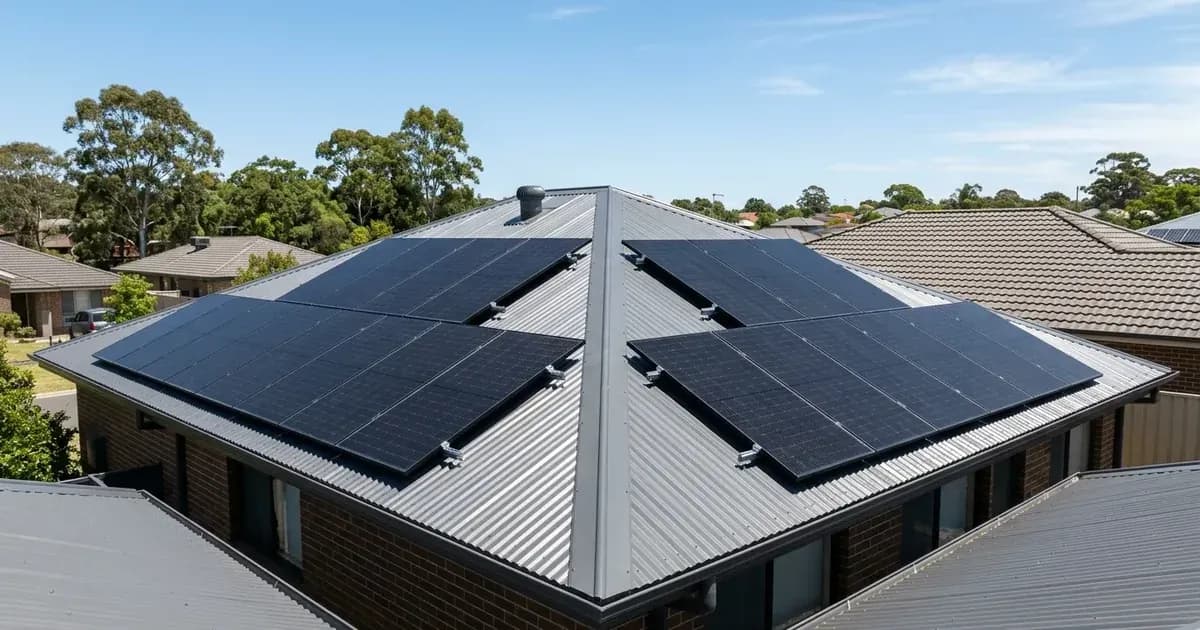
Qcells (Hanwha Q CELLS) is one of the foundational brands of the Australian rooftop solar market. Combining research and development headquartered in Thalheim, Germany with the extensive industrial and financial scale of South Korea's Hanwha Group, Qcells occupies a distinct bridge between European engineering heritage and mass-scale Asian manufacturing.
For Australian homeowners navigating installer quotes, Qcells offers high brand recognition and consistent field reliability. However, evaluating a quote requires understanding the crucial distinction between its entry-level Q.MAXX series and its premium Q.PEAK DUO lines, especially regarding product warranty duration.
Brand Heritage & Corporate Scale
Established in Germany in 1999 and acquired by Hanwha Group in 2012, Qcells operates large-scale manufacturing facilities across South Korea, Malaysia, China, and the United States.
In Australia, the manufacturer operates via Hanwha Q CELLS Australia Pty Ltd with its headquarters located in Sydney. Having a long-established domestic corporate entity ensures direct warranty claim processing and customer service support, protecting consumer rights under Australian Consumer Law independently of the original retail installer.
Bankability & PVEL Reliability Testing
Qcells maintains a Bloomberg Tier 1 ranking. In the commercial solar sector, Bloomberg New Energy Finance (BNEF) Tier 1 status evaluates financial bankability—verifying that major banking syndicates have provided non-recourse project debt for installations deploying the manufacturer's panels.
In independent laboratory evaluations conducted by PV Evolution Labs (PVEL) with DNV GL support, Qcells achieved Top Performer status across three out of seven reliability tests in the 2024 scorecard. PVEL tests subject modules to rigorous stress sequences including thermal cycling, mechanical stress, and damp heat exposure to assess long-term resistance to micro-cracking and moisture ingress.
Proprietary Technology: Q.ANTUM DUO Z
Qcells modules are built upon proprietary Q.ANTUM technology, which combines half-cut cell layouts with advanced passivation layers and zero-gap cell interconnection:
- Zero-Gap Interconnection: Traditional solar panels leave visible white space between individual cells. Qcells' DUO Z technology overlaps cell edges, eliminating inter-cell gaps and increasing overall module active surface area without enlarging the outer frame dimensions.
- Anti PID Technology: Potential-Induced Degradation occurs when high system voltages drive stray electrical currents through the solar glass to the grounded frame. Qcells incorporates Anti PID protection into its cell encapsulation, preventing premature voltage-induced output degradation.
- Hot-Spot Protect: Defective solar cells under partial shade can overheat and create localized hot spots that burn through the backsheet. Qcells applies automated electroluminescent sorting during production to ensure hot-spot-free operation.
Product Lineup: Q.MAXX vs Q.PEAK DUO
The Australian product catalog is divided into two primary residential tiers:
1. Q.MAXX Series
The Q.MAXX family represents Qcells' cost-competitive residential offering. Engineered to compete directly with standard Tier-1 Asian panels, Q.MAXX utilizes monocrystalline half-cut cells and provides reliable solar generation at an accessible entry price point.
2. Q.PEAK DUO Series
The Q.PEAK DUO family (including G5+, G6+, G9+, and G10+ models) represents Qcells' premium residential and commercial platform. Featuring higher module conversion efficiency and upgraded bill-of-materials encapsulation, Q.PEAK DUO modules carry upgraded warranty terms suited for premium residential investments.
Specifications Comparison Table
The following technical data contrasts the electrical parameters across Qcells' residential module lineup:
Parameter | Q.MAXX 330W | Q.PEAK DUO-G5+ 330W | Q.PEAK DUO-G6+ 350W |
|---|---|---|---|
Cell Architecture | Monocrystalline | Monocrystalline | Monocrystalline |
Cell Layout | 120 Half-cut Cells | 120 Half-cut Cells | 120 Half-cut Cells |
Power Output | 330W | 330W | 350W |
Max Power Voltage | 34.14V | 33.98V | 34.07V |
Panel Efficiency | 19.6% | 19.6% | 19.5% |
Module Dimensions | 1685 × 1000 × 32 mm (1.68 m²) | 1685 × 1000 × 32 mm (1.68 m²) | 1740 × 1030 × 32 mm (1.79 m²) |
Module Weight | 18.7kg | 18.7kg | 19.9kg |
Product Warranty | 12 Years | 25 Years | 25 Years |
Warranties: Q.MAXX vs Q.PEAK DUO
Warranty terms represent the most significant decision factor when reviewing a Qcells quote:
- Product Warranty: For the Q.Maxx and Q.Maxx-G2 panels, the summary of warranty terms provides a 12 years limited product Warranty: “For material defects or processing defects, Hot-Spot Protect and Anti PID Technology.” In contrast, for the Q.PEAK DUO-G9+ and Q.PEAK DUO-G10+ panels, the warranty extends to a 25 years limited product Warranty: “For material defects or processing defects, Hot-Spot Protect and Anti PID Technology.” Homeowners seeking long-term security should verify their quote specifies a 25-year Q.PEAK model.
- Performance Warranty: Across both model tiers, Qcells modules degrade at 0.54% after the first year which beats most of their peers (normally 0.7%) and is backed by a 25-year performance warranty. This guarantees that at year 25, the system retains at least 85% of its initial rated power output.
Pricing & Installation Costs in Australia
Qcells panels occupy the upper-mid tier of the Australian solar market. They are priced slightly above standard budget Chinese panels, reflecting their German R&D heritage and local Sydney support infrastructure.
Based on Solar Choice market indexing across Australian capital cities, average fully installed turnkey costs for systems utilizing Qcells panels (inclusive of standard inverter, mounting rails, and installation net of federal STC discounts) are:
- 6kW System: Average fully installed cost of $6,968
- 8kW System: Average fully installed cost of $9,532
- 10kW System: Average fully installed cost of $12,047
Final installed pricing fluctuates depending on whether the system is paired with a standard string inverter or a premium hybrid battery-ready unit, as well as specific roof mounting pitch and multi-storey access requirements.
Rebate Eligibility & Standards Compliance
To qualify for federal rebates under the Australian Government's Small-scale Renewable Energy Scheme (SRES), residential installations must satisfy mandatory Clean Energy Regulator (CER) standards:
- Capacity Limits: Installations must have a capacity less than 100 kW and have a total annual electricity output less than 250 MWh to generate Small-scale Technology Certificates (STCs).
- Accreditation: Installers must list its panels and inverter on the Clean Energy Council list of approved products, confirming all hardware satisfies Australian and New Zealand electrical safety standards.
- Serial Verification: To help protect you from purchasing non-genuine solar panels, the Solar Panel Validation Initiative gives you an easy way to check and confirm that solar panels installed on your roof are authentic units verified directly against manufacturer ledgers.
- STC Financial Offsets: STCs trade on open markets typically between $33 and $38 per certificate, providing an upfront point-of-sale deduction that reduces out-of-pocket invoice costs.
To evaluate how Qcells compares against other leading panel brands, explore our Jinko Solar panels review Australia, LONGi Solar panels review Australia, and our comprehensive best solar panels Australia buying guide.
Frequently asked questions
What is the warranty period for Qcells solar panels in Australia?
Q.MAXX and Q.MAXX-G2 panels come with a 12-year limited product warranty, while premium Q.PEAK DUO-G9+ and G10+ models feature an extended 25-year limited product warranty. Both are backed by a 25-year performance warranty.
How much does a fully installed Qcells solar system cost in Australia?
Based on Solar Choice market indexing across Australian capital cities, average turnkey installed costs net of STCs are $6,968 for 6kW, $9,532 for 8kW, and $12,047 for 10kW systems.
What is the annual degradation rate of Qcells solar panels?
Qcells panels degrade at an annual rate of 0.54% after the first year, which outperforms standard market rates of 0.7% and guarantees at least 85% output at year 25.
How did Qcells perform in PVEL independent reliability testing?
In the 2024 PV Evolution Labs (PVEL) reliability scorecard, Qcells achieved Top Performer status across 3 out of 7 tests, confirming resilience against thermal cycling and mechanical stress.
References
- Solar Choice - Qcells Solar Panels Independent Review — accessed 28 August 2026
- Clean Energy Regulator - Rooftop Solar SRES Rules — accessed 28 August 2026
Related guides
More from what to buy — and how not to get cheated.