Australian Industrial Solar Power Factor and Harmonics Guide
Updated 18 September 2026 · By SolarNevs Research Desk, Dealer surveys + verified sources · 1 source · Method ↗
Key Takeaways
- Industrial solar systems ranging between 200kVA and 1MVA require formal utility network studies to protect local grid power quality.
- Proponents must lodge formal enquiries with statutory fees ($3,500 plus GST enquiry fee and $5,000 plus GST application fee).
- Network assessments evaluate steady-state power flow, protection coordination, harmonics, and dynamic power factor response.
- System design and compliance documentation require certification by a professional engineer on the National Engineering Register (NER).
- Following physical construction, developers must execute commissioning tests within a nominated 2-week window before receiving formal Approval to Operate.
Industrial Connection Scope and Statutory Fee Structures
Heavy industrial facilities deploying rooftop solar and battery storage frequently operate inverters in the hundreds of kilovolt-amperes. As set forth in Australian network service rules:
"You want to connect an embedded generation system (such as solar panels) greater than 200kVA up to 1MVA to the network."
To initiate the assessment process, distributors enforce structured fee schedules:
- "Enquiry fee \- $3,500 plus GST"
- "Application fee\- $5,000 plus GST"
The preliminary phase confirms distribution infrastructure capacity:
"The enquiry stage involves a high-level feasibility assessment, which usually determines whether the network can support the proposed generation capacity."
Industrial embedded generator connection stages (200kVA-1MVA):
- Stage 1: Preliminary Feasibility ($3,500 + GST Fee): Initial high-level grid capacity and feasibility assessment.
- Stage 2: Network Studies & Schedules ($5,000 + GST Fee): Comprehensive evaluations of steady-state flow, fault levels, harmonics, and power quality.
- Stage 3: Construction & 2-Week Commissioning Window: Physical installation and execution of the nominated commissioning test window.
- Stage 4: Approval to Operate & Retailer ETAF Lodgement: Final test result submission and electricity retailer transfer lodgement.
Power Quality Studies and Professional Engineering Oversight
Industrial loads such as variable speed drives, arc furnaces, and large inductive induction motors introduce harmonic distortions. To ensure the solar plant mitigates rather than exacerbates these issues:
"Assess aspects like network steady-state flow, protection, power quality, and monitoring/control requirements."
Professional engineering sign-off is mandatory under statutory rules:
"The services of a National Engineering Register (NER) engineer will be required to advise in generator design and connection."
Furthermore, installations must comply with foundational Australian electrical standards:
"Installation needs to be compliant with the requirements of the Technical Rules, AS/NZS 4777.1, AS/NZS 4777.2, and AS/NZS 3000."
Comprehensive Network Studies and Stability Modeling
Prior to detailed engineering approvals, developers enter into formal study agreements:
"Signing of a contract for network studies. Studies assess such aspects as network steady-state flow, fault levels, protection, power quality, dynamic stability and monitoring/control requirements."
These simulations evaluate voltage fluctuation, total harmonic distortion (THD), and reactive power capability across the entire operational envelope.
Construction, Commissioning Window, and Approval to Operate
Once physical equipment is installed, a formal testing protocol is executed:
"Following construction, the customer submits completed the Technical Schedules, a Technical Compliance Report and Commissioning Plan.""You'll nominate a 2-week period to complete your commissioning testing."
Upon verification of witness testing logs and power quality compliance:
"Customer submits the commissioning results, and a request for Approval to Operate.""The site’s electrical retailer is required to submit an ETAF (Electricity Transfer Application Form) to Western Power."
Electrical Safety and Industrial Switchboard Standards
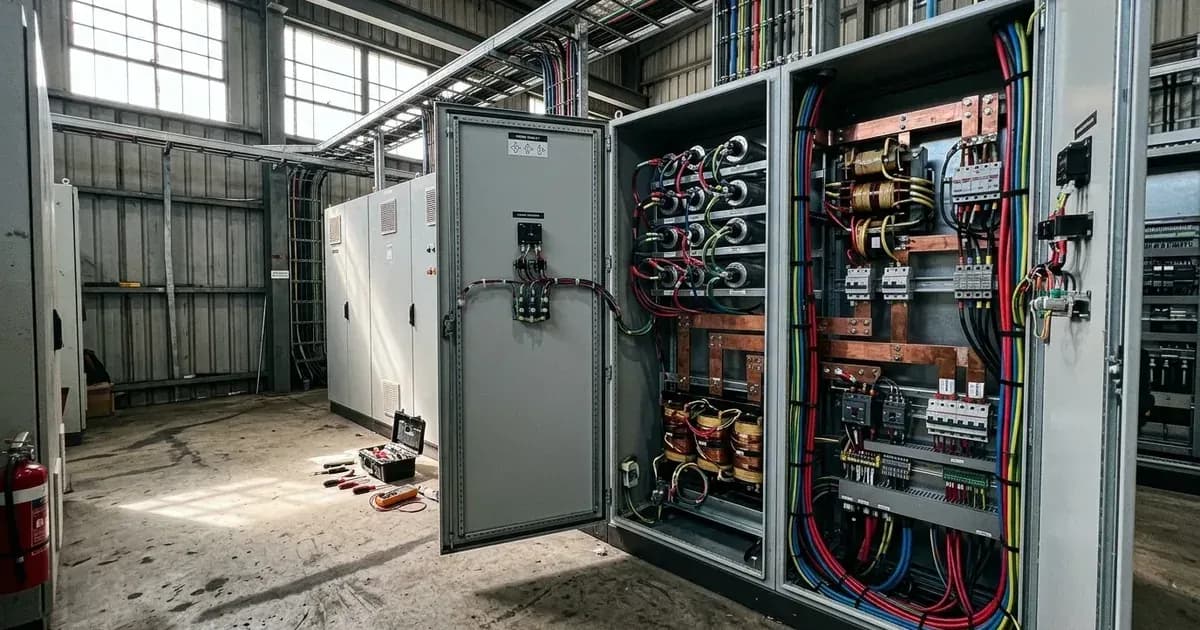
All industrial solar installations exceeding 200kVA must incorporate secondary interface protection relays, motor-driven circuit breakers with mechanical interlocks, and dedicated anti-islanding trip coils. Switchboards must comply with AS/NZS 61439. Qualified electrical contractors must observe arc-flash boundaries and verify earthing resistance under AS/NZS 3000 before energisation.
Frequently asked questions
What capacity range triggers dedicated industrial network studies?
Connecting an embedded generation system greater than 200kVA up to 1MVA requires formal enquiry, network studies, and power quality assessments.
What professional qualifications are required for industrial solar connection design?
The services of a National Engineering Register (NER) engineer will be required to advise in generator design and connection.
What technical aspects are evaluated in network studies?
Studies evaluate network steady-state flow, fault levels, protection, power quality, dynamic stability, and monitoring/control requirements.
References
- Western Power Inverter System Greater Than 200kVA Up to 1MVA Guide — accessed 26 August 2026
Related guides
More from schemes, subsidies & financing.