Australian Mine Site Solar Diesel Hybrid Microgrids Guide
Updated 19 September 2026 · By SolarNevs Research Desk, Dealer surveys + verified sources · 1 source · Method ↗
Key Takeaways
- Western Australian resource operations are leading global adoption of off-grid multi-megawatt renewable microgrids.
- The Agnew Renewable Energy Microgrid combines 18MW of wind, 4MW from a 10,000 panel solar farm, and advanced battery storage.
- Integrating predictive solar forecasting reduces the operational need for fossil-fuel thermal generators to run on continuous spinning reserve.
- Commercial structures utilize Independent Power Producer (IPP) contracts with single-point accountability for total energy security.
- Advanced microgrids deliver up to 60% renewable energy penetration while maintaining heavy industrial mining reliability.
Pioneering Renewable Microgrids in Australian Mining
Remote mining operations in the Australian outback have historically relied entirely on expensive, carbon-intensive diesel and gas generators. The development of high-penetration hybrid microgrids marks a transformative shift in resource sector economics:
"A Western Australian gold mine will be the first Australian mine to be powered by a wind, solar and battery hybrid system."
As an industry precedent, "This project will provide a blueprint for organisations to deploy similar off-grid energy systems."
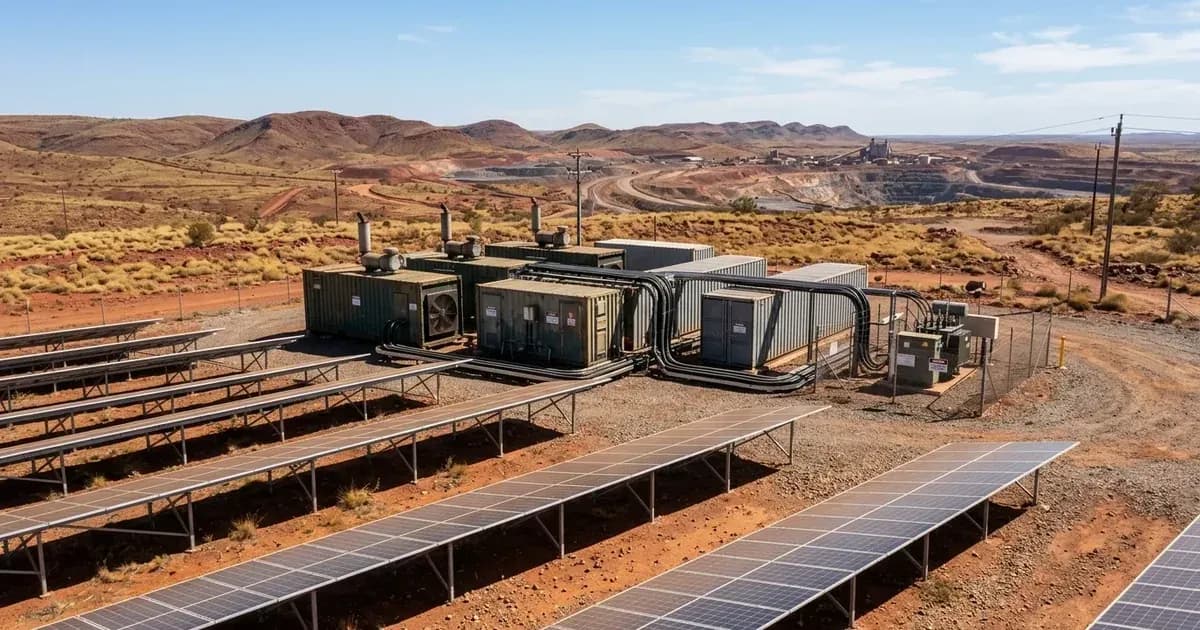
The off-grid mine-site hybrid generation fleet coordinates distributed generation assets through centralized control:
- 10,000 Panel Array (4MW Solar Field): Photovoltaic generation field.
- Five Wind Turbines (18MW Wind Farm): Rotational wind turbine capacity.
- Reciprocating Gas / Diesel Power Plant: Thermal generation providing baseline firming.
- Advanced Battery Energy Storage System (Ancillary Control): Battery storage managing dynamic ancillary control.
- Microgrid Controller: Predictive Forecasting & Load Shed: Central automation platform coordinating forecasting and dynamic load shedding.
Generation Infrastructure and Predictive Telemetry
The physical engineering of the Agnew microgrid demonstrates the scale required to power heavy underground mining assets:
"The Agnew Renewable Energy Microgrid project will consist of five wind turbines delivering 18MW of generation, a 10,000 panel solar farm generating 4MW"
To manage intermittent solar irradiance and fluctuating desert winds without tripping sensitive underground ventilation fans and ball mills:
"The renewable generation will be supported by predictive solar forecasting technology and a battery storage system."
Commercial Models and Thermal Spinning Reserve Elimination
Deploying multi-technology hybrid systems requires innovative contractual and operational architectures:
- Single Accountability IPP Model: > "A single source of accountability for energy security with one IPP contracted to own and operate the microgrid."
- Advanced Battery Ancillary Services: > "Utilisation of technologies that integrate the ancillary service capabilities of the battery into the microgrid."
- Spinning Reserve Displacement: > "Incorporation of renewable resource forecasting to limit the need for excessive spinning reserve."
- Resource Risk Allocation: > "The mine will intrinsically take on wind and solar risk as it free issues the gas to the IPP."
- Future Innovation Platform: > "The project will provide a platform for future innovation in energy storage."
Operational Practices and High Renewable Penetration
To maximize clean energy utilization, site engineers implement sophisticated load control:
"Gold Fields are also adopting innovative operational practices such as dynamic load shedding."
Under this integrated control system:
"The Agnew hybrid microgrid is forecast to deliver up to 60% renewable energy to the Agnew mine.""The project aims to pave the way for the adoption of renewable energy in the mining industry.""The Agnew project will demonstrate technology risk can be mitigated, as well as provide data and learnings"
Industrial Electrical Safety and High-Voltage Standards
Mining microgrids must comply with AS/NZS 3007 (Electrical equipment for mines and quarries) and AS/NZS 3000 Wiring Rules. High-voltage overhead reticulation (typically 11kV or 33kV) requires dedicated protection relays with sensitive earth fault (SEF) detection and neutral grounding resistors (NGR) to restrict touch potential during phase-to-ground faults. All switching must follow strict site lock-out/tag-out (LOTO) protocols.
Frequently asked questions
What renewable penetration can modern Australian mine-site microgrids achieve?
Pioneering projects like the Agnew hybrid microgrid are forecast to deliver up to 60% renewable energy to remote mining operations.
What technologies are combined in utility-scale mining microgrids?
The Agnew project incorporates five wind turbines delivering 18MW, a 10,000 panel solar farm generating 4MW, and battery energy storage.
How do hybrid microgrids reduce diesel and gas fuel consumption?
By integrating predictive resource forecasting and battery storage, operators eliminate excessive thermal spinning reserve requirements.
References
- ARENA Agnew Renewable Energy Microgrid Project Report — accessed 26 August 2026
Related guides
More from schemes, subsidies & financing.