BMS Guide - What It Is and Why Cheap Batteries Die
Updated 2 August 2026 · By SolarNevs Research Desk, Dealer surveys + verified sources · 4 sources · Method ↗
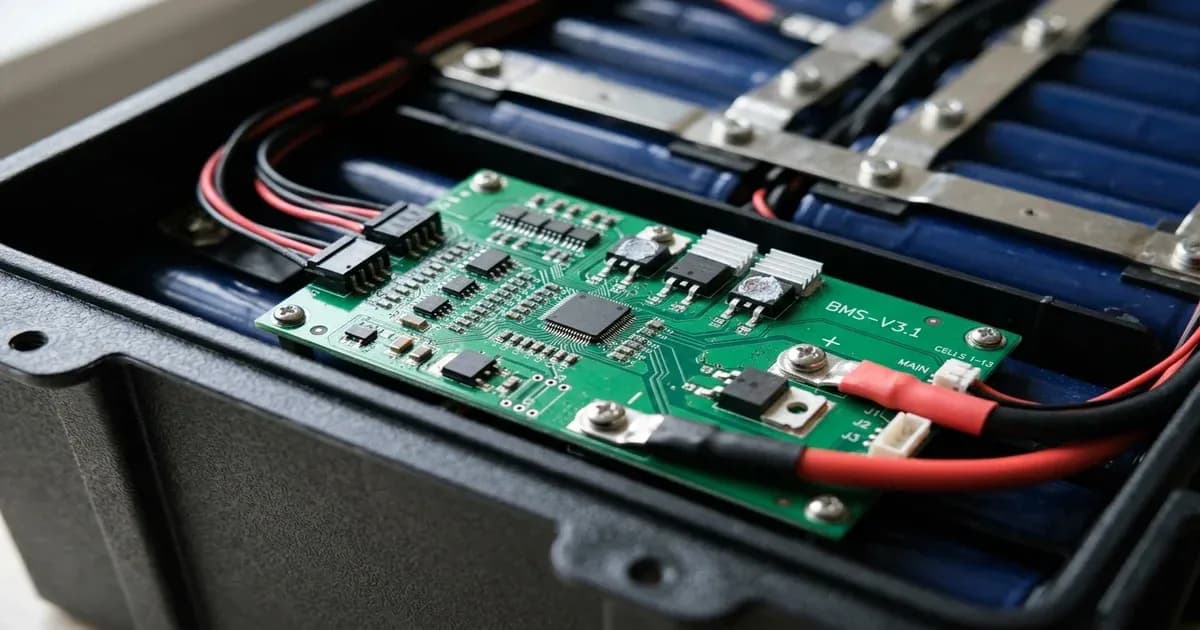
BMS Guide - What It Is and Why Cheap Batteries Die
{/* visual_plan. stat_block */}
Key Takeaways
- The BMS serves as the central brain of a lithium battery pack, protecting against overvoltage, undervoltage, and thermal breakdown.
- Cheap lithium packs use basic hardware BMS boards that lack cell balancing and temperature sensors, causing cell failure within 1 to 2 years.
- Smart BMS boards with active cell balancing maintain uniform cell voltages, extending battery life to 6,000 cycles.
- CAN bus communication allows the BMS to share live telemetry with hybrid inverters, optimizing charge rates automatically.
What is a Battery Management System (BMS) and how does it work?
A Battery Management System (BMS) is the electronic control unit responsible for managing and protecting a lithium battery pack. Unlike lead-acid batteries which tolerate minor overcharging through gas dissipation, LiFePO4 cells are sensitive to voltage extremes.
A standard 48V (51.2V nominal) LiFePO4 battery contains 16 individual 3.2V cells connected in series. The BMS constantly measures the voltage of each individual cell, overall pack current, and ambient temperature.
If any cell voltage exceeds 3.65 volts during charging, or drops below 2.50 volts during discharging, the BMS opens solid-state MOSFET switches or contactors to isolate the battery pack, preventing permanent chemical damage.
Why do cheap lithium batteries fail prematurely without a smart BMS?
The primary reason low-cost lithium batteries fail after 1 to 2 years in Pakistan is the use of substandard, hardware-only BMS boards.
Cheap hardware BMS boards only monitor pack voltage, ignoring individual cell imbalances. Over repeated charge cycles, manufacturing variations cause individual cell voltages to drift apart.
Without cell balancing, one cell may reach 3.85 volts (overcharge state) while adjacent cells remain at 3.30 volts. The overcharged cell swells, vents gas, and breaks down, ruining the entire 16-cell series string even though 15 cells remain healthy.
What is the technical difference between passive and active BMS balancing?
Cell balancing mechanisms are essential for maintaining cell voltage uniformity across the battery pack over multi-year use.
Passive balancing uses small resistors to bleed off tiny amounts of excess energy as heat from cells with higher voltages during the final charging stage. Passive balancing currents are small (typically 30mA to 100mA), making it ineffective at correcting severe cell imbalances.
Active balancing uses capacitive or inductive charge-transfer circuits to move electrical energy from high-voltage cells to lower-voltage cells. Active balancers deliver currents up to 2A, quickly equalizing cell voltages and extending pack lifespan to 6,000 cycles.
BMS Feature | Basic Hardware BMS | Smart BMS with Active Balancer |
|---|---|---|
Individual Cell Voltage Tracking | None (Pack Voltage Only) | Precise (Every Cell Monitored) |
Cell Balancing Type | None or Basic Passive (30mA) | Active Inductive / Capacitive (1A to 2A) |
Thermal Sensors | 1 Sensor (Pack Level) | Multiple NTC Sensors (Direct Cell Mounting) |
Inverter Communication | None | CAN Bus & RS485 (July 2026) Native Protocols |
Historical Data Logging | None | Bluetooth App & Event Memory |
Estimated Pack Lifespan | 1 to 2 Years (500 Cycles) | 12 to 15 Years (6,000 Cycles) |
How does CAN bus communication between BMS and inverter protect your investment?
High-quality lithium batteries from brands like Pylontech, Dyness, Inverex, and Livoltek feature smart BMS units equipped with CAN bus and RS485 (July 2026) communication ports.
When connected to a hybrid inverter (such as Deye or Solis), the BMS transmits live data every second, including maximum allowable charge current, real-time SoC, and cell temperatures.
If summer ambient temperatures rise, the BMS commands the inverter to lower charging current from 100A to 30A. This active handshake prevents battery overheating, eliminates voltage estimation errors, and guarantees safe operation under peak solar generation.
What BMS features should you demand when selecting a solar battery?
When evaluating lithium batteries in Pakistan, insist on packs equipped with a digital smart BMS featuring CAN bus and RS485 (July 2026) ports.
verify the BMS incorporates at least four NTC temperature sensors attached directly to cell terminals and MOSFET heat sinks to trigger thermal cutoffs if temperatures exceed 55 degrees Celsius.
Choose batteries that provide Bluetooth smartphone monitoring or LCD displays reporting individual cell voltages. Being able to inspect cell balance directly guarantees early detection of cell drift before performance degrades.
Frequently Asked Questions
What is a Battery Management System (BMS)?
A Battery Management System is an electronic control board that monitors cell voltages, currents, and temperatures to protect lithium battery packs from overcharging, deep discharge, and thermal runaway.
Why do cheap lithium batteries die quickly without a smart BMS?
Cheap batteries use basic hardware BMS boards without cell balancing, causing cell voltage drift where weak cells overcharge or over-discharge, killing the entire pack in 1 to 2 years.
What is the difference between active and passive BMS balancing?
Passive balancing bleeds off excess charge from high cells as heat through resistors, whereas active balancing transfers energy efficiently from high cells to low cells during charging.
References
Frequently asked questions
What is a Battery Management System (BMS)?
A Battery Management System is an electronic control board that monitors cell voltages, currents, and temperatures to protect lithium battery packs from overcharging, deep discharge, and thermal runaway.
Why do cheap lithium batteries die quickly without a smart BMS?
Cheap batteries use basic hardware BMS boards without cell balancing, causing cell voltage drift where weak cells overcharge or over-discharge, killing the entire pack in 1 to 2 years.
What is the difference between active and passive BMS balancing?
Passive balancing bleeds off excess charge from high cells as heat through resistors, whereas active balancing transfers energy efficiently from high cells to low cells during charging.
References
- Pylontech — accessed 25 July 2026
- Solar Citizen — accessed 25 July 2026
- W11Stop — accessed 25 July 2026
- NEPRA — accessed 25 July 2026
Related guides
More from what to buy — and how not to get cheated.