Solar Inverter Overheating and Fan Noise in Pakistan Summers
Updated 2 August 2026 · By SolarNevs Research Desk, Dealer surveys + verified sources · 29 sources · Method ↗
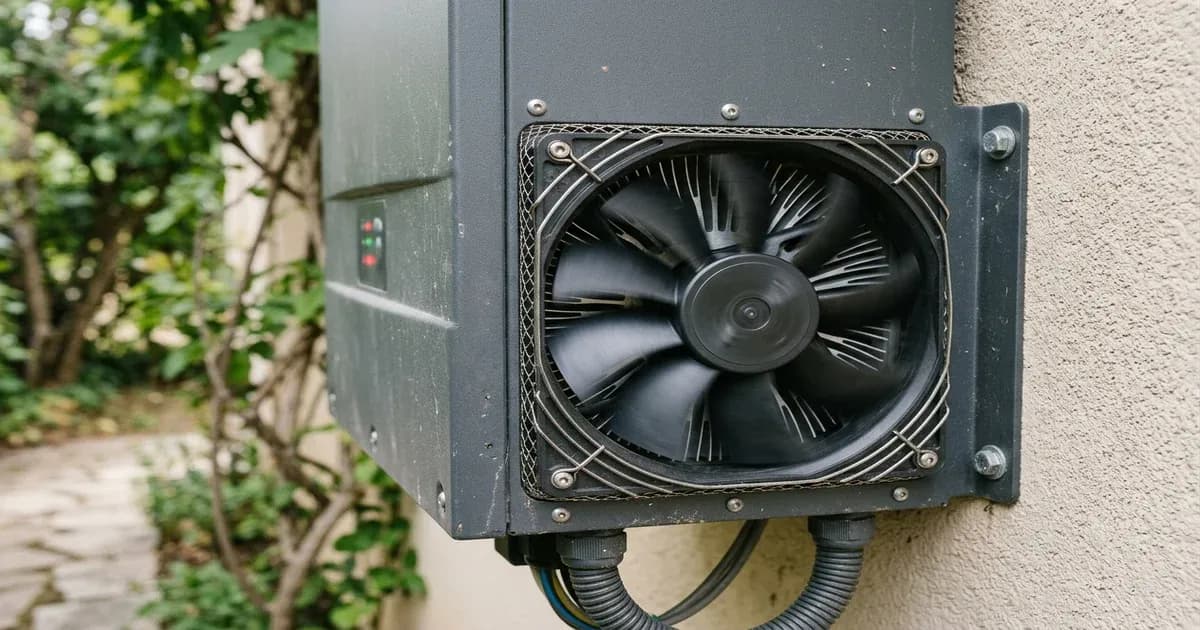
Solar Inverter Overheating and Fan Noise in Pakistan Summers
{/* visual_plan: stat_block */}
Key Takeaways
- Solis publishes exact thresholds, such as fan on at 85C internal (about 38C ambient), fan off at 75C internal (about 31C ambient), and inverter shutdown at 110C internal (about 60C ambient), verified July 2026.
- Deye's SUN-5K hybrid manual requires roughly 50cm clearance to each side, 50cm above and below, and 100cm in front for heat dissipation (verified July 2026).
- On 8 July 2026 Sibi recorded an air temperature of 42C with a heat index of 68.2C, and Dadu recorded 43C, according to the Pakistan Meteorological Department figures reported by The Nation.
- Deye rates the SUN-5K-SG03LP1 for an operating range of -40C to +60C, but the rated range is not the derating-free range; output falls well before the upper limit.
- The fault names differ by brand, including Solis OV-TEM, Deye F64 (heat sink high temperature), Growatt hybrid Error 408, and Growatt SPF 5000 ES fault code 02 (verified July 2026).
Why do inverters lose output before they ever show a fault?
An inverter is a box of semiconductors that turns a small percentage of the power passing through it into heat. That heat has to leave through the heatsink. When the heatsink cannot shed it fast enough, the inverter does the only safe thing available, reducing its own output until the heat balance works again. This is derating, and it is silent.
That silence is the problem. A derating inverter does not beep, does not raise an alarm, and does not appear in the fault log. It simply produces less. A 10kW unit quietly delivering 8kW through the worst three hours of a Multan afternoon looks completely healthy on the screen, and the owner concludes the panels are underperforming.
The published thresholds vary by manufacturer but cluster in the same region. Industry documentation puts the onset of derating at roughly 45C to 50C ambient for most residential units, with one comparison showing about a 10 percent drop in output level between 35C and 45C. Solis is unusually specific about its own thermal management, where its fan switches on at 85C internal, corresponding to about 38C ambient, switches off at 75C internal or about 31C ambient, and the unit shuts down entirely at 110C internal, corresponding to about 60C ambient (verified July 2026).
Note what those numbers imply for Pakistan. A 38C ambient is an ordinary May morning in Lahore. The fan is not an emergency device here; it runs for most of the year.
What does 45C-plus really do to an inverter in Pakistan?
The ambient temperature at your inverter is not the temperature on the weather app. That is a shade reading at 1.5 metres in a screened enclosure. Your inverter is usually on a wall, often facing west, frequently with afternoon sun on it, sometimes inside a store room with a steel door and no vent.
The scale of the Pakistani problem is documented. On 8 July 2026 the Pakistan Meteorological Department figures reported by The Nation showed Sibi at 42C air temperature with a heat index of 68.2C, Dadu at 43C, Sukkur at 40C, Faisalabad at 40C and Peshawar at 40.5C. Earlier in the season, a PMD heatwave alert for 25 to 31 May 2026 forecast 47C to 50C across interior Sindh, southern Punjab and parts of Balochistan, naming Jacobabad, Larkana, Dadu, Sibi, Multan, Rahim Yar Khan and Bahawalpur.
Add the wall. Industry guidance for Pakistan notes that rooftop temperatures regularly exceed 50C in summer and that cable temperatures inside conduits run higher still. An inverter in direct sun on a west wall in Multan in June is not operating at the 44C the app reports. It is operating meaningfully above it.
Two consequences follow. First, your inverter will derate on the hottest days, which are also the days your air-conditioning load is highest. That is the worst possible coincidence and it is structural, not a defect. Second, sustained high-temperature operation ages electrolytic capacitors and solder joints. An inverter that spends five summers derating is not the same asset as one that spends five summers cool.
{/* visual_plan: comparison */}
How much clearance and shade does the inverter need?
Deye's SUN-5K hybrid manual is explicit and gives the clearest published figures we found, which is to allow approximately 50cm to the side, approximately 50cm above and below, and 100cm to the front (verified July 2026). It also instructs installers to avoid direct sunlight and to mount on a vertical, load-bearing, non-flammable wall.
Compare that with what happens on Pakistani installations. Inverters get mounted inside meter cupboards, in stair-under storage, behind the door of a small store room, or wedged between the distribution board and a corner with 15cm of side clearance. The manual's numbers are not decorative; they define the volume of air the heatsink needs to draw from.
The interventions that work, in order of effect:
Get it out of direct sun. Manufacturer guidance across brands is consistent, advising you not to install where the unit receives direct sunlight, and where that cannot be avoided, build a dedicated weatherproof awning or shade. A simple shade over a west-facing inverter is the cheapest thermal upgrade available and often removes derating entirely.
Restore the clearances. If the unit is boxed in, move it. This is a half-day job for an electrician and it is permanent.
Ventilate the room. A store room with a closed steel door has no air exchange. An exhaust fan, or even a louvred vent at high and low level, converts a heat trap into a functioning space.
Do not put it above heat sources. Inverters mounted above a gas geyser or next to a generator exhaust are cooked by design.
Is dust the real problem, and how do you clean it safely?
In Pakistan, frequently yes. Dust is not incidental here; it is a design condition. Fine dust builds a felt layer on the heatsink fins and inside the fan guard, and that layer is an insulator. Solis, Deye, Growatt and independent guides all name blocked airflow and debris accumulation as a primary overheating cause, and Solis specifically instructs technicians to check the fan and heatsink for obstructions including dust and animal nests.
Rodent and bird nesting inside inverter enclosures is a real Pakistani failure mode, not a foreign curiosity. So is a wasp nest in a fan grille.
Cleaning safely means shutting the system down first, and that sequence matters. Turn off the AC isolator, turn off the DC isolators, and wait several minutes for internal capacitors to discharge before you go anywhere near the enclosure. Then clear the external fins and fan grilles with dry compressed air or a soft brush, working outward. Do not use water. Do not open the sealed enclosure of an IP-rated unit yourself, because the gasket seal is what keeps monsoon moisture out and a badly reseated cover converts a heat problem into an isolation-fault problem.
An annual pre-summer clean, done in April before the heat arrives, is worth more than three emergency visits in June.
{/* visual_plan: step_flow */}
When is fan noise normal, and when is the fan failing?
Fan noise scales with temperature by design. A hybrid inverter that is silent in January and audible in June is behaving correctly. Judging it by loudness alone will mislead you.
Judge it by character and by correlation instead.
Normal. A smooth rising whoosh that tracks load and time of day. Loudest in the afternoon, quiet at night, quiet on cool days. Speed changes gradually.
Suspicious. A rattle, a buzz, or a grinding note. A fan that hunts up and down rapidly. A fan that runs at full speed continuously even at night in mild weather, which usually means the temperature sensor or the control logic is misreading. A fan that starts, stalls, and restarts.
Failing or failed. Any grinding or scraping is bearing wear and the fan will seize. Silence when the inverter is hot is the dangerous one, because it means the fan is dead and the only warning you will get is a derate or a shutdown. If you can safely observe the fan while the unit is working hard and it is not turning, stop using the system at high load until it is repaired.
Related fault codes. Solis raises OV-TEM, which its documentation ties to high ambient temperature above 60C, a malfunctioning cooling fan, blocked vents, improper ventilation, or a failed thermal sensor. Deye raises F64, heat sink high temperature. Growatt hybrid units raise Error 408 for over-temperature, attributed in Pakistani field documentation to direct sunlight, blocked airflow, dust and high ambient heat. The Growatt SPF 5000 ES off-grid unit signals over-temperature as fault code 02, commonly caused by poor ventilation, high ambient temperature, heavy load or a faulty cooling system.
One honest note on cost. We could not find a dated, double-sourced Pakistani price for inverter cooling-fan replacement in July 2026, so we are not quoting one. Ask two independent service centres for a written quote before authorising work, and insist that the replacement fan matches the original part number and voltage rather than being a generic computer fan, which is a common and quietly damaging substitution.
Frequently Asked Questions
At what temperature does a solar inverter start losing output?
Most residential inverters begin derating once internal temperature passes roughly 45C to 50C. Solis documents its fan starting at 85C internal, around 38C ambient, and full shutdown at 110C internal, around 60C ambient.
How much clearance does a hybrid inverter need?
Deye's manual specifies about 50cm to each side, 50cm above and below, and 100cm in front. Anything tighter traps heat and brings derating forward.
Is a loud inverter fan a fault?
Not by itself. Fans ramp up as temperature rises, which is normal in summer. Grinding, rattling, intermittent stalling or a fan that never spins at high temperature is a failing bearing.
References
- Solis North America, inverter temperature de-rating thresholds
- Solis Service Center, OV-TEM alarm
- Solis North America, OV-TEM alarm troubleshooting
- Deye SUN-5K-SG03LP1-EU hybrid inverter user manual
- Deye SUN-5K-SG03LP1-EU datasheet
- Deye inverter fault code list F01-F64
- Growatt inverter error codes, Pakistan context
- Growatt SPF 5000 ES service manual fault reference codes
- The Nation, heat index soars across Pakistan as severe heatwave intensifies, 8 July 2026
- The Asian Mirror, PMD heatwave alert for major Pakistani cities, 2026
- Aforenergy, understanding inverter overheating causes and prevention
- Alpha Solar Pakistan, common solar inverter problems and solutions
- Aforenergy, high temperature solar inverter heat-proof guide
Frequently asked questions
At what temperature does a solar inverter start losing output?
Most residential inverters begin derating once internal temperature passes roughly 45C to 50C. Solis documents its fan starting at 85C internal, around 38C ambient, and full shutdown at 110C internal, around 60C ambient.
How much clearance does a hybrid inverter need?
Deye's manual specifies about 50cm to each side, 50cm above and below, and 100cm in front. Anything tighter traps heat and brings derating forward.
Is a loud inverter fan a fault?
Not by itself. Fans ramp up as temperature rises, which is normal in summer. Grinding, rattling, intermittent stalling or a fan that never spins at high temperature is a failing bearing.
References
- Solis Support — accessed 26 July 2026
- Solis Support — accessed 26 July 2026
- Afor Energy — accessed 26 July 2026
- PAS Solar — accessed 26 July 2026
- Jouvoli — accessed 26 July 2026
- Deye — accessed 26 July 2026
- Discomp — accessed 26 July 2026
- Deye — accessed 26 July 2026
- Manuals+ — accessed 26 July 2026
- Solar-Kit — accessed 26 July 2026
- The Nation — accessed 26 July 2026
- Dunya News — accessed 26 July 2026
- The Asian Mirror — accessed 26 July 2026
- Momentum Pakistan — accessed 26 July 2026
- Enon Traders — accessed 26 July 2026
- SolarFaults — accessed 26 July 2026
- Solis Support — accessed 26 July 2026
- Inverter Error Codes — accessed 26 July 2026
- Solar Deals — accessed 26 July 2026
- Solar Inverters PK — accessed 26 July 2026
- ManualsLib — accessed 26 July 2026
- Growatt Support — accessed 26 July 2026
- ManualsLib — accessed 26 July 2026
- Afor Energy — accessed 26 July 2026
- GreenTech Renewables — accessed 26 July 2026
- Alpha Solar — accessed 26 July 2026
- Solis Support — accessed 26 July 2026
- W11Stop — accessed 26 July 2026
- Mehran Experts — accessed 26 July 2026
Related guides
More from inverter errors & fixes.